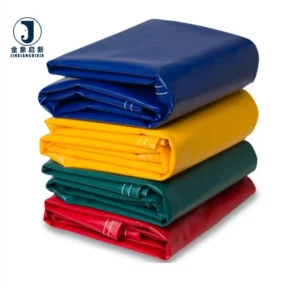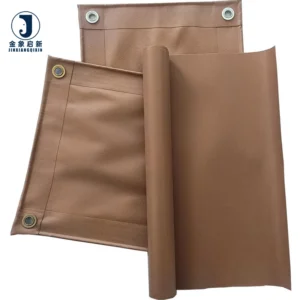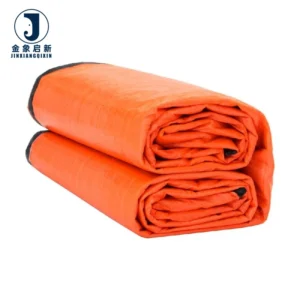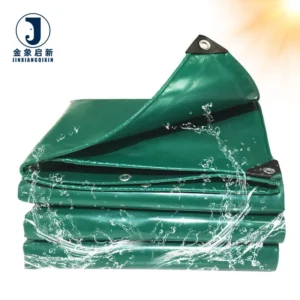
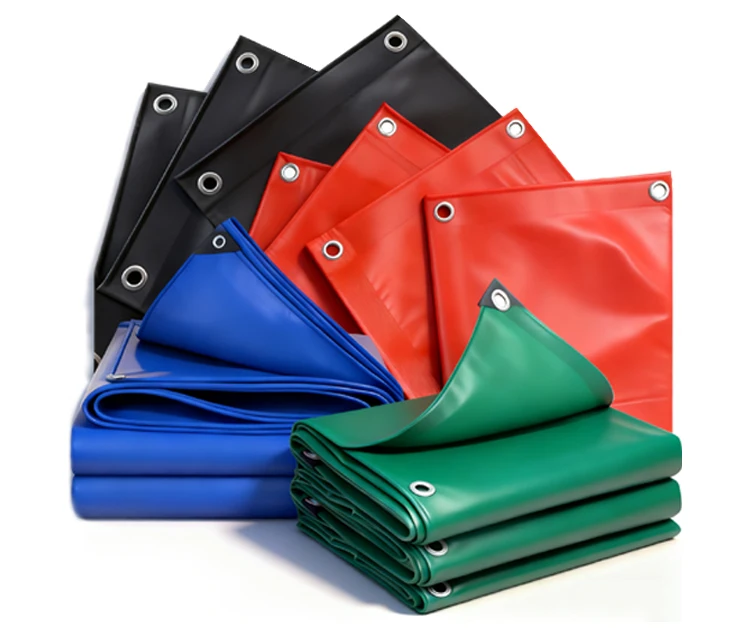
Coating Weight Control — Hot melt and lamination lines calibrated to maintain GSM across every roll, backed by pre-shipment weight verification per roll.
Technical Specifications
| Parameter | Value |
|---|---|
| Product Type | PVC Coated Tarpaulin Roll |
| Base Material | 100% high toughness polyester yarn with PVC coating |
| Coating Technology | Lamination technology and hot melt coating technology |
| Thickness (Medium Grade) | 0.35–0.45 mm |
| Weight (Medium Grade) | 400–500 g/m² |
| Base Fabric Denier (Medium) | 500D |
| Tensile Strength (Medium, N/5cm) | Longitude 1500–2000 / Latitude 1200–1800 |
| Thickness (Heavy-Duty Grade) | 0.70–1.0 mm |
| Weight (Heavy-Duty Grade) | 700–1000 g/m² |
| Base Fabric Denier (Heavy) | 1000D |
| Tensile Strength (Heavy-Duty, N/5cm) | Longitude 2000–2500 / Latitude 1800–2200 |
| Thickness (Super Heavy Grade) | 1.2–1.5 mm |
| Weight (Super Heavy Grade) | 1100–1500 g/m² |
| Base Fabric Denier (Super Heavy) | 500D–2000D |
| Tensile Strength (Super Heavy, N/5cm) | Longitude 2500–3000 / Latitude 2200–2800 |
| Weld Tear Strength | Excellent |
| Color Fastness | Best color fastness |
| Weather Resistance | Outdoor living guarantee, good weather resistance |
| Custom Treatment Options | Flame retardant; Anti-static; Cold resistant; Mold proof; UV treatment |
| Flame Retardant | Available in flame retardant grades — confirm the grade required for your market |
| Anti-Static | Anti-static treatment available — surface resistance or standard to be confirmed |
| UV Treatment | UV treatment available — test basis to be confirmed |
| Standards | ISO, CE |
Application Suitability
| Application | Exposure & Requirement |
|---|---|
| Truck tarpaulin and side curtains | Constant flexing at tie-down points, road debris abrasion, UV and rain exposure, weld seams under dynamic load |
| Industrial pipe canopy and engineering covers | Long-term outdoor weathering, wind load stress, chemical dust contact, structural tension at fixing points |
| Tensioned membrane structures | Permanent architectural tension, high wind uplift, thermal cycling, fire compliance for enclosed public spaces |
| Mining and tunnelling ventilation duct | Fire and static discharge risk underground, abrasive particulate in airflow, continuous negative or positive pressure |
| Farm and transport covers | Crop moisture, fertiliser contact, repeated folding and unfolding, seasonal UV exposure |
Why PVC Coated Polyester Fabric Weight Verification Matters More Than the Quoted GSM
A quoted GSM figure only confirms intent, not the material that arrives on your loading dock.
Every technical buyer has encountered the discrepancy: the specification sheet states one weight, but the roll that arrives measures lighter. With PVC coated polyester fabric, the gap between quoted and actual GSM directly affects tensile capacity, weld integrity and long-term weathering. The root cause is typically inconsistent coating application across the production run, where the PVC paste thickness varies from the centre to the edge of the web or between successive batches. Without roll-by-roll verification before dispatch, the fabricator discovers the shortfall only after cutting and welding — when the seam fails under tension or the material tears at a stress point that a correctly coated grade would have withstood [NEED_CITE: tensile and tear test methods for coated fabrics per ISO 1421].
Hot Melt Coating Versus Lamination and What It Means for Your Weld Line
The two coating methods — hot melt coating technology and lamination technology — produce fundamentally different bond structures between the PVC layer and the polyester base yarn. Hot melt forces the PVC compound into the interstices of the woven scrim under heat and pressure, creating a mechanical lock that resists delamination when the fabric is heat-welded. Lamination bonds a pre-formed PVC film to the scrim surface, which can separate at the weld zone if the thermal input exceeds the adhesive threshold. For fabricators welding seams on truck curtains or membrane panels, the coating method determines the welding temperature window and the peel strength of the finished joint.
How Base Fabric Denier Determines the Ceiling of Tensile Performance
The denier of the polyester yarn — 500D, 1000D, or up to 2000D — sets the mechanical baseline before any PVC is applied. A 500D scrim coated to 400–500 g/m² achieves longitude tensile figures of 1500–2000 N/5cm, which serves medium-duty truck covers and temporary site enclosures. Moving to a 1000D base at 700–1000 g/m² raises the tensile envelope to 2000–2500 N/5cm in the warp direction, matching the load demands of heavy transport and permanent industrial canopies. At the super heavy tier, the 500D–2000D denier range at 1100–1500 g/m² delivers warp tensile figures of 2500–3000 N/5cm, required for tensioned architectural membranes and large-scale inflatable structures [NEED_CITE: relationship between yarn denier and coated fabric tensile performance]. Selecting the correct denier-to-GSM pairing prevents both over-specification and under-performance.
Reading the Specification Sheet Beyond the Headline Weight
GSM alone tells you how much material exists per square metre, but it does not explain how that weight is distributed between base fabric and coating. A 700 g/m² PVC coated polyester fabric can be built on a lighter scrim with a thicker PVC coat, or on a heavier scrim with a thinner coat — and the two constructions behave differently under load, at the weld line, and during folding. The coating-to-scrim ratio influences cold-crack resistance, because a thicker PVC layer becomes brittle at lower temperatures while a denser scrim maintains flexibility. For buyers specifying material for cold-climate transport or high-altitude membrane structures, requesting the base fabric weight and coating weight separately — not just the combined GSM — provides the data needed to match the grade to the thermal environment.
What Happens When the Wrong Grade Reaches the Weld Table
A fabricator cutting and welding a membrane panel assumes every roll in the batch shares the same coating thickness and adhesion profile. When one roll carries a lighter coat than the next, the welding operator uses the same temperature and dwell time across both — and the lighter roll delaminates at the seam while the heavier roll holds. This inconsistency is rarely caught until the panel is installed and wind load cycles the joint. Similarly, specifying a medium-duty 400–500 g/m² grade for a heavy-transport side curtain exposes the fabric to dynamic loads beyond its tensile envelope, leading to tear propagation from the eyelet line or the hem fold. These failures trace back to a specification mismatch, not a manufacturing defect [NEED_CITE: common causes of coated fabric seam failure in transport applications].
Why Technical Buyers Source PVC Coated Polyester Fabric From This Line
Three full production lines with 36 sets of professional equipment run hot melt and lamination coating simultaneously, so lead times stay predictable even when custom widths or treatment grades are specified. A dedicated ten-person R&D team develops samples within days, allowing fabricators to test weld parameters and tensile behaviour before committing to a bulk order. QA and QC checkpoints at every production stage — from base fabric inspection through coating weight measurement to final roll winding — catch GSM deviation and colour drift before the roll reaches the packing area. Every roll ships with a pre-shipment inspection record that documents the measured weight against the agreed specification, giving the buyer traceability from inquiry to installation.
Documentation & Verification
- Material specification sheet stating base fabric denier, coating method, measured GSM and tensile data per roll
- Test report for flame retardant and anti-static grades confirming the standard and classification achieved
- Pre-shipment inspection record with GSM verification measured against the quotation tolerance
- ISO and CE certificates supplied for compliance documentation in regulated markets
- Roll packing list with individual roll weights and dimensions for container loading verification
Fabrication, Handling & Storage
- Set hot-air weld temperature based on coating method: hot melt grades tolerate a wider thermal window than laminated grades
- Store rolls upright on a flat surface to prevent edge deformation that causes tracking issues during unrolling
- Allow cold-stored rolls to reach ambient temperature before unrolling to avoid coating crack on the 0.35–0.45 mm medium grades
- Reinforce eyelet and hem zones with an extra PVC patch layer on the 700–1000 g/m² heavy-duty grades to distribute tie-down load
- Use PVC-compatible solvent cleaners only; aggressive alkaline agents degrade the coating surface on anti-static treated rolls
Specifying the Right Grade for Your Project
To match the correct PVC coated polyester fabric grade to your application, share the end-use environment, the mechanical loads the fabric will carry, and any fire or static compliance requirements for your market. Indicate whether you need rolls in stock widths or custom widths, the annual volume, and whether finished panels or raw rolls are required. Request a sample roll for weld testing and tensile verification before placing the production order.
Frequently Asked Questions
Q: How is GSM verified on arrival and what tolerance applies per roll?
A: Each roll is weighed and measured during pre-shipment inspection, with the recorded GSM compared against the agreed specification. The inspection report travels with the shipment so the buyer can cross-check on receipt. Any roll falling outside the stated tolerance is flagged before dispatch, preventing short-weight material from reaching the cutting table.
Q: What test standard supports the flame-retardant and anti-static treatment claims?
A: Flame retardant and anti-static treatments are available across the PVC coated polyester fabric range, but the specific grade and test standard must be confirmed for your market and application. Request the test report with your sample so the classification — whether for building membrane, mining duct or transport use — can be verified against your local regulatory requirement before bulk ordering.
Q: How does base fabric denier affect tensile and tear performance?
A: Denier defines the yarn thickness in the polyester scrim, which sets the mechanical baseline before coating. A 500D base yields medium-duty tensile figures suited to light truck covers, while 1000D and 2000D bases deliver the higher warp and weft strength needed for heavy transport, membrane structures and ventilation duct. The coating adds weight and surface protection but cannot compensate for an under-specification base scrim.
Q: What is the difference between lamination and hot melt coating for welding?
A: Hot melt coating forces PVC into the woven scrim under heat, creating a bond that withstands higher welding temperatures without delamination. Lamination applies a pre-formed PVC film to the scrim surface, which requires a narrower thermal window during heat welding. Fabricators running high-speed weld lines typically prefer hot melt grades for their wider process tolerance and stronger peel strength at the seam.
Q: How is batch-to-batch colour consistency controlled across rolls?
A: Colour is matched to a reference standard at the coating compound stage, and every production run is checked against that reference under controlled lighting before the roll is wound. Rolls allocated to a single order are produced in the same batch wherever possible to minimise visual variation. Buyers requiring absolute colour uniformity across a large order should request a pre-production sample for side-by-side approval.