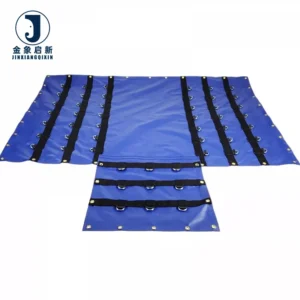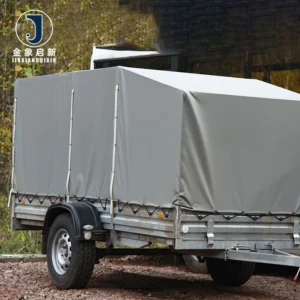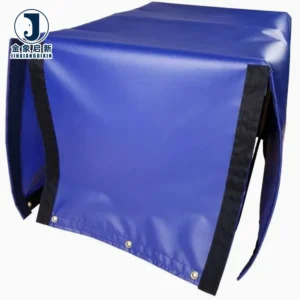
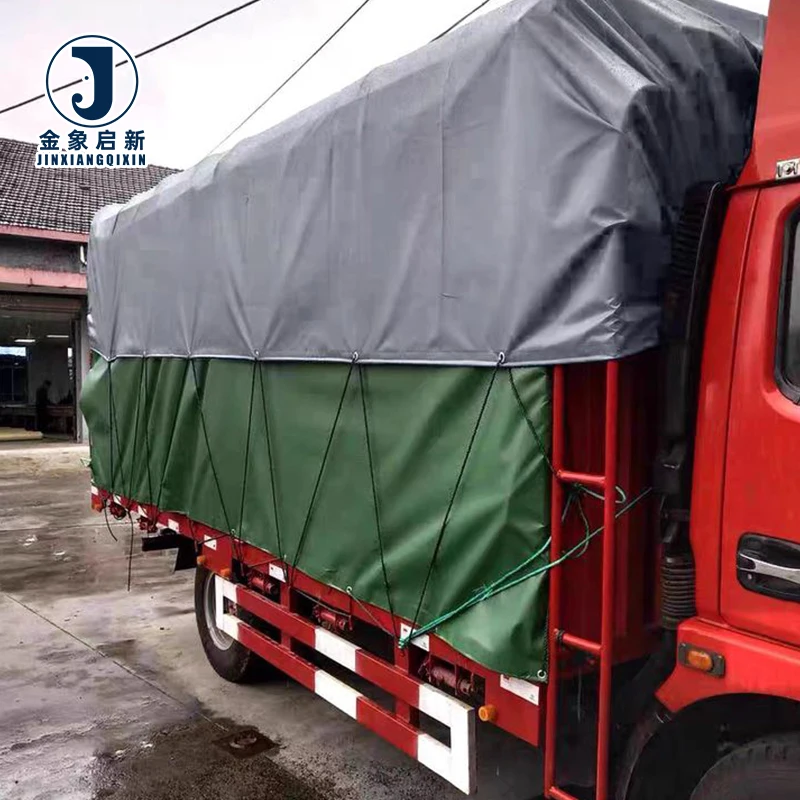
Coating Process Control — Hot melt lamination technology applied across three dedicated production lines with in-process QA at every coating stage to ensure the PVC-to-polyester bond holds under field stress.
Technical Specifications
| Parameter | Value |
|---|---|
| Product Type | PVC Coated Tarpaulin for Truck Cover – Laminated Grade |
| Coating Material | PVC |
| Base Fabric | 100% high toughness polyester yarn |
| Coating Method | Lamination technology and hot melt coating technology |
| Weight (Medium-duty) | 400-500 g/m² |
| Thickness (Medium-duty) | 0.35-0.45 mm |
| Knitting Density (Medium-duty) | 500D |
| Tensile Strength (Medium-duty) | Warp 1500-2000 / Weft 1200-1800 N/5cm |
| Weight (Heavy-duty) | 700-1000 g/m² |
| Thickness (Heavy-duty) | 0.70-1.0 mm |
| Knitting Density (Heavy-duty) | 1000D |
| Tensile Strength (Heavy-duty) | Warp 2000-2500 / Weft 1800-2200 N/5cm |
| Weight (Super Heavy-duty) | 1100-1500 g/m² |
| Thickness (Super Heavy-duty) | 1.2-1.5 mm |
| Knitting Density (Super Heavy-duty) | 500D-2000D |
| Tensile Strength (Super Heavy-duty) | Warp 2500-3000 / Weft 2200-2800 N/5cm |
| Key Features | Waterproof, cold resistant cracking, mold proof, excellent welding tear strength, best color fastness |
| Treatment Options | Flame retardant (grade not stated), anti-static (standard not stated), UV treatment (test basis not stated) |
| Color Options | Blue, Blue/Orange, Green, Grey, Black, Clear, Grey/Green, Orange, or custom |
| Customization | Custom printing, custom colors, custom sizes |
| Certification | ISO, CE |
Application Suitability
| Application | Exposure & Requirement |
|---|---|
| Heavy-duty truck tarpaulin | Constant flexing at load shift points, road abrasion, wind uplift, weather exposure |
| Trailer side curtain fabric | Repeated rolling and tension cycles, UV exposure, contact friction at guide rails |
| Farm equipment covers | Moisture, organic matter contact, seasonal temperature swings, UV degradation |
| Construction site protection | Abrasive surfaces, puncture risk from materials, wind-driven rain, dust containment |
| Industrial pipe canopy | Welded seam stress at frame joints, thermal expansion, long-term weathering |
| Tensioned structural fabric | Sustained tensile load, wind flutter, coating adhesion under continuous tension |
Why Base Fabric Density Matters More Than GSM Alone When Specifying PVC Coated Tarpaulin
GSM tells you what the fabric weighs — base fabric denier and weave density tell you how it resists tearing under real load.
Technical buyers often evaluate PVC coated tarpaulin by weight alone, but two rolls at the same GSM can behave entirely differently when a truck cover flexes at 90 km/h or a side curtain snaps under wind load. The reason sits in the weave: a tighter knit with higher denier yarn distributes stress across more intersection points, resisting tear propagation even when the coating layer shows surface damage [NEED_CITE: tensile and tear test methods for coated fabrics per ISO 1421]. A lighter base fabric coated with more PVC to reach the same GSM will feel heavy in hand but fail at the weave structure when a puncture starts to spread. Specifying by denier and knitting density alongside GSM gives you a material that holds together at the points where covers actually fail — not just one that passes a weight check on the receiving dock.
Coating Adhesion and What Lamination Technology Delivers
Hot melt coating technology creates a direct molecular bond between the PVC layer and the 100% high toughness polyester yarn base. Unlike solvent-based or paste coating methods where the PVC sits primarily on the surface, hot melt lamination drives the coating into the weave structure under heat and pressure. For a PVC coated tarpaulin used as truck cover material, this bond determines whether the coating peels away from the base fabric after repeated flexing at fold lines and tie-down points. When adhesion fails, the exposed base fabric absorbs moisture and degrades — the cover is finished even though the PVC layer itself is still intact.
Weld Performance at High-Stress Seam Points
Truck covers and side curtains are only as strong as their weakest seam. The welding tear strength of a laminated PVC coated tarpaulin determines whether a heat-welded joint holds or splits when the load shifts during braking or cornering. Lamination technology produces a coating that softens uniformly under hot air or wedge welding, allowing the PVC from two panels to fuse into a continuous bond rather than sitting as two layers pressed together. This uniform melt behaviour is critical at flex points — the exact locations where welded seams fail before the surrounding fabric does [NEED_CITE: hot air welding parameters for PVC coated fabrics]. Consistent coating thickness across the roll, achieved through stage-by-stage QA, ensures the same welding temperature and speed produce reliable joints from the first metre to the last.
Reading the Specification Sheet Beyond Weight and Colour
Three duty grades — medium at 400-500 g/m², heavy at 700-1000 g/m², and super heavy at 1100-1500 g/m² — each serve distinct structural roles. The knitting density range from 500D to 2000D determines how the base fabric resists tear propagation: higher denier yarn at closer spacing creates more resistance points per square centimetre. Tensile strength values across the three grades show that both warp and weft directions strengthen with denier and coating weight, but not in equal proportion — the heavier grades gain proportionally more weft strength, which matters when a truck cover is pulled tight across a load and the lateral stress exceeds the longitudinal. Coating method is equally important: hot melt lamination delivers the interlocking bond that gives laminated PVC coated tarpaulin its characteristic peel resistance, while the base fabric weave geometry controls how force distributes from a point load outward. Thickness values from 0.35 mm to 1.5 mm correlate with puncture resistance but add weight and stiffness — a factor in manual handling during installation.
What Happens When Specification Gaps Reach the Field
A truck cover specified at a certain GSM but delivered lighter will reach its tensile limit earlier than calculated, particularly at the eyelet line where tie-down tension concentrates. Covers specified without a stated flame retardant grade may pass visual inspection but fail when a site safety auditor requests test documentation — a delay that costs far more than the fabric itself [NEED_CITE: fire safety compliance requirements for transport covers in industrial sites]. Colour variation between rolls in the same order becomes visible the moment panels are installed side by side on a fleet of trailers, forcing rejection of material that is technically sound but visually inconsistent. Weld failures at seam lines, caused by uneven coating weight that disrupts welding parameters, typically surface weeks into service rather than at installation — after the cover has already been fitted, loaded, and dispatched.
Process Capability Behind Every Roll
Coating weight is monitored at each production stage across three full production lines, with 36 sets of professional equipment supporting consistent GSM control from roll start to roll end. A 10-person R&D team handles material selection, custom sizing, and sample development, producing samples within days for colour, weight, and treatment verification before bulk production proceeds. Pre-shipment inspection covers 100% of output — every roll is checked against the material specification sheet before it leaves the facility, not sampled from the batch. This process depth, built over years of focused production on coated fabrics, means the PVC coated tarpaulin arriving at your dock matches the specification you approved during sampling. Custom width, colour matching, and pattern printing are handled on the same lines with the same QA protocol, so custom orders carry the same consistency controls as standard grades [NEED_CITE: quality control methodology for coated fabric production].
Documentation & Verification
- Material specification sheet stating exact GSM, base fabric denier, coating method, and colour reference for each roll
- Pre-shipment inspection record covering 100% of rolls with weight verification against quoted GSM
- Test reports for flame retardant, anti-static, and UV treatments available upon request — confirm grade required before ordering
- Roll packing list with individual roll identification for traceability from dispatch to installation
- Certificate of origin and customs documentation prepared per destination country requirements
Fabrication, Handling & Storage
- Hot air welding at temperature and speed matched to the specific GSM grade — verify parameters on scrap before production runs
- Seam allowance on laminated PVC coated tarpaulin should account for coating thickness to ensure full bond penetration at joints
- Store rolls upright on pallets to prevent flat spots that create permanent crease lines in heavier grades above 700 g/m²
- Unroll and allow cold-stored material to reach ambient temperature before fabricating to avoid cracking in cold resistant grades
- Use PVC-compatible cleaners only — solvent-based products can soften the hot melt coating layer and reduce surface adhesion
- Cut panels with sealed edges where possible to prevent moisture ingress into the polyester base fabric at exposed weave ends
What We Need to Quote Accurately
To specify the right PVC coated tarpaulin grade, share the application type and the primary exposure conditions — mechanical stress, UV duration, temperature range, and whether the cover will be welded or sewn. If your market requires flame retardant or anti-static compliance, state the target standard so the correct treatment grade is selected from the available options. For custom width, colour, or printed branding, provide the required dimensions and Pantone reference along with estimated annual volume to determine the most efficient production run.
Frequently Asked Questions
Q: How do you verify the GSM on each roll matches the quoted weight?
A: Coating weight is controlled during production through in-process monitoring on all three production lines. Before dispatch, 100% pre-shipment inspection includes weight verification of every roll against the material specification sheet. The recorded weight is documented on the inspection report provided with the shipment.
Q: What flame retardant grades are available for truck cover applications?
A: Flame retardant treatment is available as an option. The specific grade depends on your target market requirements — confirm the fire safety standard applicable in your region before ordering. Test reports are provided for the specified grade upon request to support compliance documentation.
Q: Can the PVC coated tarpaulin be customised for specific trailer dimensions?
A: Custom sizing, colour matching, and pattern printing are all available. Samples are developed within days to verify colour, weight, and treatment before bulk production. Provide the exact dimensions, colour reference, and any printing requirements to receive a sample for approval.
Q: How do you ensure colour consistency when ordering multiple rolls?
A: Batch consistency is controlled through dedicated QA at every production stage, including colour reference verification during coating. Rolls in the same order are produced from the same coating batch where possible, and colour checks are part of the 100% pre-shipment inspection before dispatch.