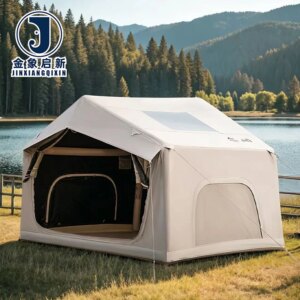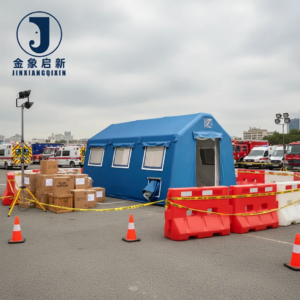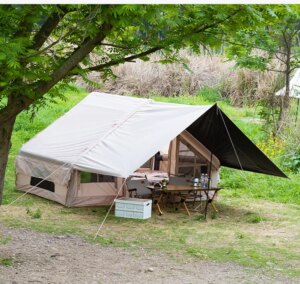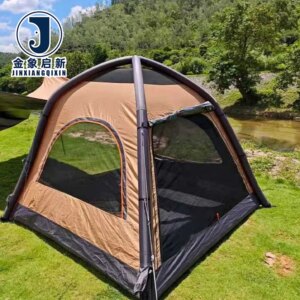
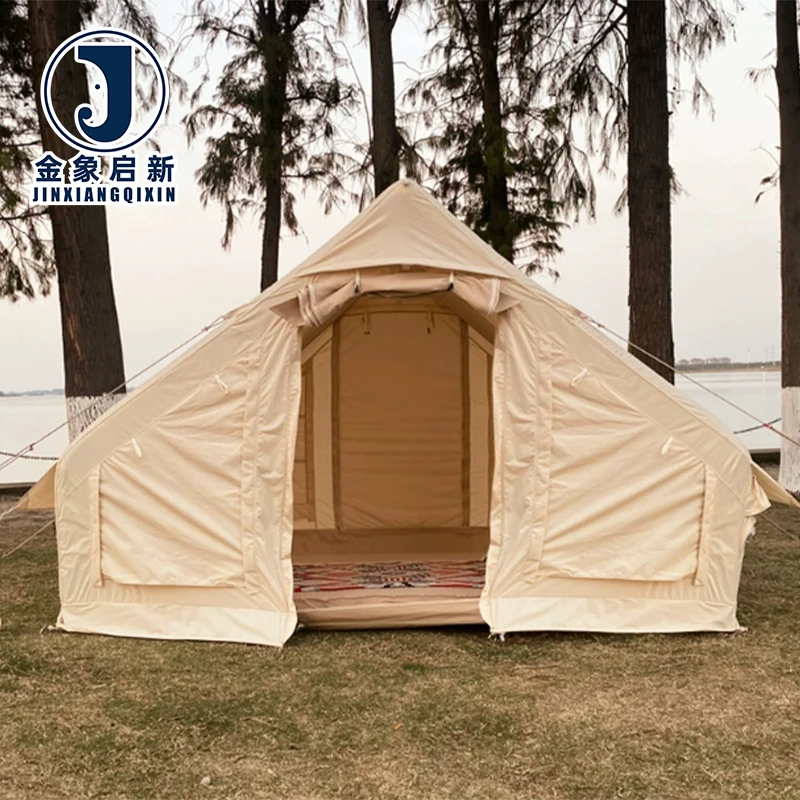
Coating Adhesion Mastery — PVC coated fabric engineered for inflatable tent structures, combining verified GSM control with seam integrity that survives repeated inflation cycles.
Technical Specifications
| Parameter | Value |
|---|---|
| Product Type | Inflatable Tent |
| Core Material | PVC Tarpaulin |
| Product Forms | Inflatable structure with automatic opening mechanism |
| Waterproof | Fully waterproof coated construction |
| UV Resistance | UV-resistant treatment available — confirm the grade required for your market |
| Fire Retardant | Fire-retardant grades available — confirm the grade required for your market |
| Anti-static | Anti-static treatment available — confirm surface resistance requirement |
| Tear Resistance | Tear-resistant construction (test basis not stated — request report) |
| Customization | OEM & ODM: sample customization, pattern printing, material selection, product design |
| Production Lines | 3 full production lines |
| Processing Equipment | 36 sets of professional processing equipment |
| R&D Team | 10 technicians |
| Certifications | ISO9001, ISO14001, ISO45001, CE |
Application Suitability
| Application | Exposure & Requirement |
|---|---|
| Commercial camping operations | Repeated inflation and deflation cycles, four-season weather exposure, guest safety compliance |
| Industrial field accommodations | Extended outdoor deployment, certified fire-retardant material requirements, wind load resistance |
| Specialized outdoor work shelters | Remote site logistics, rapid deployment, structural integrity under continuous inflation pressure |
| Four-season outdoor environments | Temperature fluctuation, UV degradation risk, precipitation and moisture ingress prevention |
What "Fire-Retardant" Means When the Test Report Is Missing
A fire-retardant claim without a documented grade shifts compliance risk entirely onto the tent manufacturer.
PVC Inflatable Tent aftermarket supplier specifications frequently list flame resistance as a headline feature. Yet when the fabric arrives on the fabrication floor, the accompanying paperwork often lacks the specific test standard — DIN 4102, NFPA 701, or the local building code reference the end user actually needs. This gap creates a dangerous situation where the shelter passes visual inspection but fails the fire marshal’s audit. For inflatable tent manufacturers supplying commercial camping sites or industrial accommodation projects, that failure can mean dismantling an entire deployed fleet. [NEED_CITE: fire classification standards for temporary structures and tensile membrane buildings]
The root issue is not dishonesty but misalignment between what the coating line can produce and what the buyer’s market legally demands. A PVC Inflatable Camping Tent deployed at a European festival site faces different certification requirements than one installed at a mining camp in Western Australia. Requesting the exact test report before placing a bulk order eliminates this ambiguity at the quotation stage rather than at the container door.
Base Fabric Construction and Inflation Load Behaviour
The structural integrity of an inflatable tent depends on the PVC tarpaulin base fabric resisting the outward pressure of continuous air inflation. When the internal air pressure pushes against the shell, every square metre of fabric experiences tensile stress distributed across the warp and weft yarns. A PVC Inflatable Tent aftermarket supplier that controls the base fabric denier and weave density can produce material that distributes this load evenly, preventing localized stress concentrations at seam junctions and valve attachment points.
Coating Weight, Adhesion and Weld Line Integrity
Inflatable tent fabrication relies heavily on high-frequency or hot-air welding to join panels into airtight chambers. The coating adhesion strength determines whether the weld line holds or delaminates under inflation pressure. When coating weight is applied consistently across the production run, weld parameters set on the first panel remain valid for the last — eliminating the trial-and-error adjustments that waste material and delay production schedules. This consistency is what separates a reliable PVC inflatable tent fabric supply from one that generates costly fabrication rework. [NEED_CITE: high-frequency welding parameters for PVC coated polyester fabrics]
Reading the Specification Sheet Beyond the GSM Number
The stated GSM of a PVC tarpaulin tells you the total weight per square metre but conceals how that weight is distributed between base fabric and coating layers. A heavier coating applied over a lighter base fabric may achieve the target GSM while offering inferior tear resistance compared to a lighter coating on a denser base weave. For inflatable tent applications where the fabric must flex during packing and deployment without cracking the coating, the ratio of coating to substrate matters as much as the total weight. Coating method — whether knife-over-roll, calendering, or dip coating — further influences peel strength, surface finish, and how the material responds to repeated folding. Anti-static treatment availability should be verified with surface resistance measurements if the tent will house sensitive electronic equipment in dry conditions. UV-resistant treatment options require documented test exposure data to estimate service life in high-irradiance environments. Fire-retardant grades must be matched to the specific regulatory framework of the destination market, as a B1 classification under DIN 4102 does not automatically satisfy NFPA 701 requirements in North American jurisdictions.
The Hidden Cost of Undocumented Treatment Claims
When a batch of inflatable tent fabric arrives claiming anti-static or UV-resistant treatment but without batch-specific test documentation, the fabricator faces a choice: accept the risk and proceed, or halt production and commission independent testing. Either path carries cost. Undocumented fire-retardant treatment poses an even greater exposure — if a deployed shelter fails a fire safety inspection, the liability traces back through the supply chain to whoever specified the material. Colour variation between rolls in the same order creates visible inconsistency once panels are welded side by side on a large tent structure, forcing selective panel matching that reduces cutting yield and extends fabrication time. [NEED_CITE: batch colour consistency standards for coated fabric in architectural membrane applications] Weld seam failure under inflation pressure typically occurs not because the fabric is weak, but because the welding temperature or dwell time was calibrated for a different coating formulation than what arrived.
Why Source Inflatable Tent Fabric Through This Production Setup
The three full production lines and 36 sets of processing equipment provide the capacity to run dedicated inflatable tent fabric orders without competing for line time against standard tarpaulin grades. The 10-technician R&D team handles material selection, sample development, and pattern printing specification — meaning a custom inflatable tent prototype can move from enquiry to physical sample without leaving the facility. Dedicated QA and QC personnel stationed on the production floor conduct incoming material checks, in-process coating weight verification, and pre-shipment inspection against the stated specification sheet. ISO9001, ISO14001, ISO45001, and CE certification documentation supports market access across regulated jurisdictions. OEM and ODM capability covers the full development cycle from initial material recommendation through pattern printing and product design, reducing the number of suppliers a tent manufacturer must coordinate.
Documentation & Verification
- Material specification sheet confirming GSM, base fabric weave, and coating weight per roll
- Batch-specific test reports for fire-retardant grade and UV-resistance treatment where applicable
- Pre-shipment inspection records documenting seam integrity, dimensional accuracy, and surface condition
- Certificate of origin and customs documentation prepared for cross-border procurement
- Roll packing list with individual roll weights and running metres for inventory reconciliation
Fabrication, Handling & Storage
- Set high-frequency welding parameters based on the specific PVC coating weight to avoid delamination at inflation seams
- Store rolls vertically on padded racks to prevent permanent creasing that weakens the coating layer
- Allow cold-transported rolls to acclimatize before unrolling to prevent coating micro-cracking at low temperatures
- Use compatible PVC adhesive for field repairs, matching the coating formulation to ensure bond strength
- Plan cutting layout to minimize weld joints across high-stress inflation chambers and valve zones
- Avoid abrasive cleaners on UV-resistant treated surfaces to preserve the protective topcoat integrity
Preparing Your Enquiry for Accurate Quotation
Specify the inflation pressure range and expected deployment duration so we can recommend the appropriate base fabric density and coating weight for your inflatable tent application. Confirm the fire-retardant grade required by your target market — different jurisdictions reference different test standards, and this determines the coating formulation we select. Indicate whether you require roll stock for your own fabrication line or finished cut-and-welded panels, along with any pattern printing or colour matching requirements.
Frequently Asked Questions
Q: What test documentation accompanies fire-retardant and anti-static treatment claims?
A: Each batch of fire-retardant PVC inflatable tent fabric ships with a test report referencing the specific standard applied — request the exact grade required for your destination market at enquiry stage. Anti-static treatment is accompanied by surface resistance measurement data. If your project requires third-party independent certification, specify this during sample development so testing can be arranged before bulk production commences.
Q: Can custom dimensions and pattern printing be combined in a single production run?
A: Yes, the OEM and ODM capability covers pattern printing alongside custom sizing within the same PVC inflatable tent fabric order. The 10-technician R&D team reviews artwork files and confirms colour reproduction feasibility before production. Provide print specifications at the sample stage so registration accuracy and ink adhesion can be verified on the actual coating surface before the full run is committed.
Q: What is the sample development timeline for new inflatable tent specifications?
A: Customized samples for PVC inflatable tent fabric are developed within days once material selection and treatment requirements are confirmed. The sample approval step includes physical evaluation of coating adhesion, weld behaviour, and surface finish. Adjustments based on buyer feedback are incorporated before mass production authorization, ensuring the bulk run matches the approved sample specification.
Q: How is roll-to-roll colour consistency controlled across large batch orders?
A: Colour matching for PVC inflatable tent fabric is managed through dedicated QA checks at the coating stage, with inspection records documenting shade consistency across all rolls in an order. Specify your colour reference standard at enquiry — Pantone, RAL, or physical swatch — and request pre-shipment inspection photographs showing adjacent rolls for visual comparison before dispatch authorization.
Q: Which certifications support market access for EU and North American distribution?
A: Production holds ISO9001, ISO14001, ISO45001, and CE certification, which support quality management system audits required by EU and North American buyers. Specific fire-retardant certifications depend on the grade selected — confirm whether your market references DIN 4102, NFPA 701, or local building codes. Certificate documentation is compiled per shipment to accompany customs clearance and end-user compliance files.