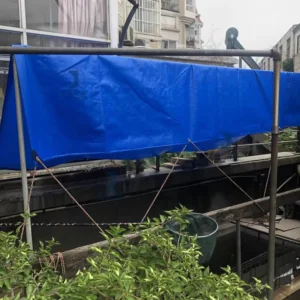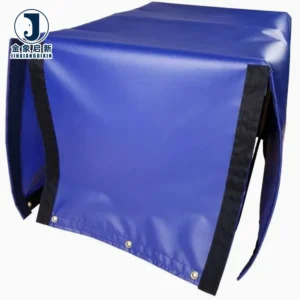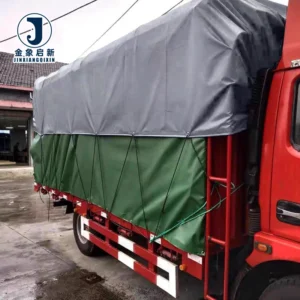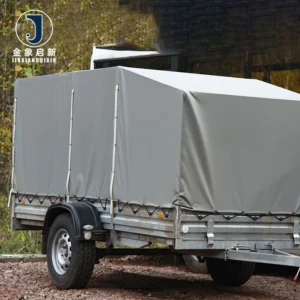
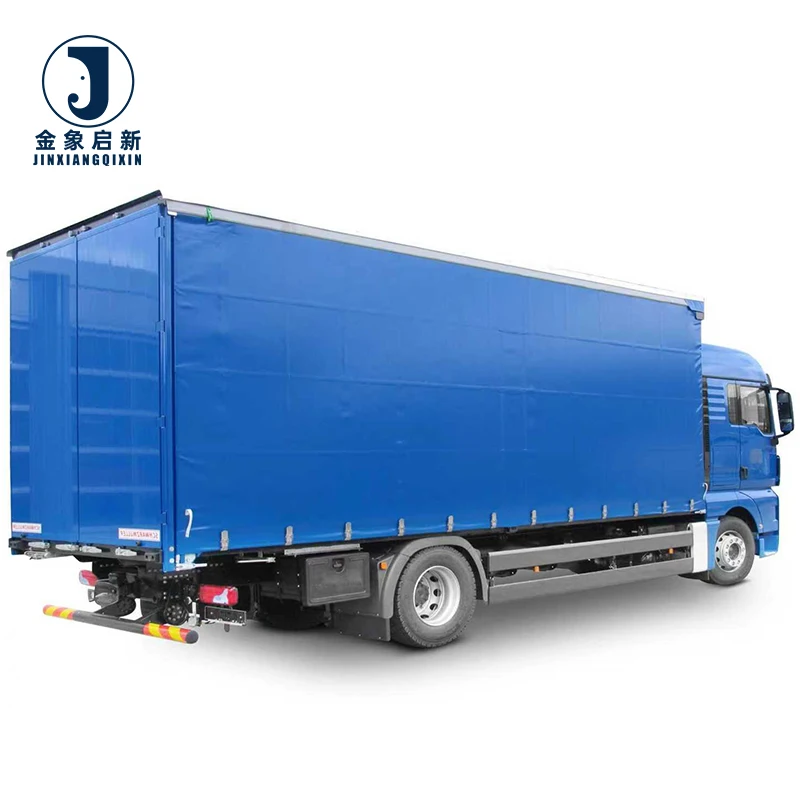
Coating Weight Control — Nearly 30 years of focused PVC coating experience ensures adhesion and weight consistency across every roll of truck tarpaulin produced.
Technical Specifications
| Parameter | Value |
|---|---|
| Product Type | PVC Coated Tarpaulin Truck Cover / Side Curtain |
| Coating Material | PVC |
| Construction | Double-faced, knife coated |
| Water Resistance | Water resistant, anti-mildew |
| Anti-UV Treatment | Yes (test basis not stated in source) |
| Flame Retardant | Yes (grade not stated in source) |
| Color Options | Multiple colors available |
| Printing Option | Logo printing / advertising tarpaulin customization |
| Product Form | Truck cover / side curtain for trailer |
| Standards | ISO, CE |
Application Suitability
| Application | Exposure & Requirement |
|---|---|
| Truck and trailer load covering | Continuous UV and rain exposure, road debris impact, wind-induced flexing at tie-down points |
| Side curtain for trailers | Repeated rolling and folding, abrasion against cargo and frame, high tensile demand at curtain runners |
| Advertising fleet tarpaulins | Outdoor weathering, color fidelity across panels, print adhesion under thermal cycling |
| Transport equipment weather protection | Prolonged sun exposure, water pooling on horizontal surfaces, mildew risk in humid transit routes |
Why Generic-Sized Truck Covers Cost More Than Custom Ones
A cover cut to standard dimensions leaves gaps, flaps and stress concentrations that shorten service life on any non-standard trailer.
Fleet operators routinely receive PVC truck tarpaulin covers that technically match the quoted size but fail to account for the actual geometry of their specific trailer model. The result is material that pulls tight across protruding fittings, sags over recessed areas, and flaps in crosswinds — accelerating wear at every point where the fabric contacts the frame. [NEED_CITE: impact of improper fitment on tarpaulin abrasion rates] Generic sizing also forces installers to improvise tie-down routes, placing eyelets and hems under loads they were not designed for.
How Knife Coating Supports Side Curtain Demands
The double-faced knife coated construction of this PVC truck tarpaulin provides uniform coating thickness on both sides of the base fabric. This matters for side curtains that are constantly rolled, unrolled and exposed on both faces — a single-sided coating would leave the reverse face vulnerable to moisture ingress and fibre degradation. Knife coating also delivers a smoother surface profile compared to dip or spray methods, which supports consistent print quality when fleet branding is applied.
Welded Seams at Flex Points: Where Covers Typically Fail
The most common failure on a PVC truck tarpaulin is not the fabric tearing — it is the welded seam splitting where the load flexes most during transit. [NEED_CITE: weld seam failure modes in coated fabric assemblies] Coating adhesion strength directly determines whether a heat-welded joint holds under cyclic loading. Our production process controls coating weight and adhesion at every stage, so the weld line retains integrity through repeated flex cycles on the road. Request a sample weld test panel to verify seam strength against your specific trailer dynamics.
Reading Beyond GSM: What Actually Determines Truck Cover Durability
GSM alone tells you the total mass per square metre but says nothing about how that mass is distributed between base fabric and coating. A PVC tarpaulin truck cover with a high GSM achieved through heavy coating but light base fabric will have poor tear propagation resistance — the coating cracks and the thin yarns pull apart. Conversely, a tightly woven high-denier base with moderate coating weight delivers superior tensile and tear performance even at a lower overall GSM. Knife coated construction allows precise control of coating thickness independent of the base fabric, so each layer contributes its intended mechanical function. Surface finish also plays a role: a glossy face sheds water and dirt more effectively on horizontal truck tops, while a matte face may reduce glare and improve print ink adhesion on side curtain panels. Anti-UV and flame retardant treatments are available in multiple grades — confirm the grade required for your market before specifying. [NEED_CITE: relationship between base fabric denier and tear strength in PVC coated textiles]
The Hidden Cost of Unverified Treatment Claims
When anti-UV or flame retardant treatment is claimed on a quotation but not backed by a test report, the buyer assumes a level of protection that may not exist in the delivered material. A PVC truck tarpaulin installed on a fleet vehicle without verified UV stabilisation will show colour shift and embrittlement sooner than expected. Similarly, flame retardant grades vary by jurisdiction — a cover that passes one regional standard may not satisfy the fire safety requirements of a mining or tunnelling site where the truck operates. Batch colour inconsistency is another costly oversight: covers from different rolls installed side by side on a fleet reveal visible shade variation, forcing replacement or rework. [NEED_CITE: batch colour variation tolerances in coated fabric production]
Why Sourcing From a Dedicated Coated Fabric Manufacturer Matters
Three full production lines and 36 sets of professional equipment support bulk PVC truck tarpaulin output with consistent delivery scheduling. A 10-person R&D team handles material selection, custom sizing and sample development — meaning a fit-verification sample for your exact trailer model can be produced within days, not weeks. Dedicated QA and QC at every production stage ensures 100% pre-shipment inspection, catching GSM deviations, colour drift and weld defects before dispatch. The knife coated process is controlled in-house, giving direct command over coating weight and adhesion rather than relying on third-party laminators. Nearly 30 years of focused coated fabric production translates to established process parameters that reduce trial-and-error on repeat orders.
Documentation & Verification
- Material specification sheet stating base fabric type, coating weight and colour reference per order
- UV and flame retardant test reports issued where applicable — verify treatment claims against documentation
- Pre-shipment inspection record confirming GSM, colour consistency and weld integrity before dispatch
- Roll packing list with gross and net weight for container loading planning
- Certificate of origin and customs documentation for cross-border shipment clearance
Fabrication, Handling & Storage
- Heat weld parameters must match the double-faced PVC coating thickness for full seam adhesion
- Reinforce eyelet zones at tie-down points where the knife coated surface transfers load to the base fabric
- Store rolls upright on end caps to prevent flat-spot creasing on the PVC coating surface
- Allow cold-stored rolls to reach ambient temperature before unrolling to avoid coating crack
- Use mild detergent for cleaning; avoid solvents that attack the plasticiser in the PVC coating
What to Include in Your Enquiry
Provide your exact trailer model, overall cover dimensions and the number of units required so we can confirm sizing and lead time. Specify whether you need roll stock for your own fabrication or finished covers with eyelets, hems and reinforcements already installed. If fleet branding is required, share your logo artwork, Pantone colour references and the panel layout for each side curtain so we can prepare a print proof and sample before bulk production.
Frequently Asked Questions
Q: How do I ensure the truck cover fits my specific trailer model?
A: Provide the exact trailer make, model and year along with overall length, width and height measurements including any protruding fittings. We develop a cut-to-size sample within days for fit verification on your actual vehicle before bulk production begins, eliminating the gaps and stress points that generic-sized covers create.
Q: What flame retardant grade and UV test basis can be supplied?
A: Flame retardant and anti-UV treatments are available in multiple grades depending on your market requirements. We supply test reports for the specific grade applied to your order — confirm the standard your local regulations or site safety plan requires at enquiry stage so the correct treatment is specified from the start.
Q: How is batch colour consistency maintained across multiple covers?
A: Every production run uses controlled pigment dosing and inline colour checking against the approved reference swatch. A pre-shipment inspection record documents roll-to-roll colour consistency before dispatch, and we can provide a physical colour sample from your batch for side-by-side comparison upon arrival.
Q: What is the process for custom logo printing on advertising tarpaulins?
A: Share your artwork in vector format along with Pantone colour codes and placement layout. We produce a digital print proof for approval, followed by a physical printed sample panel so you can verify colour accuracy, print sharpness and ink adhesion on the actual PVC coated surface before full production runs.