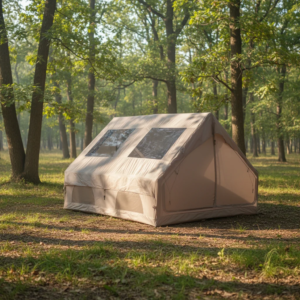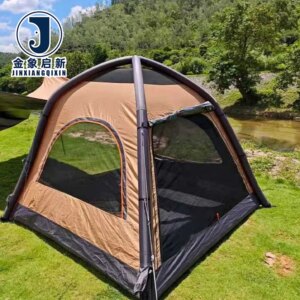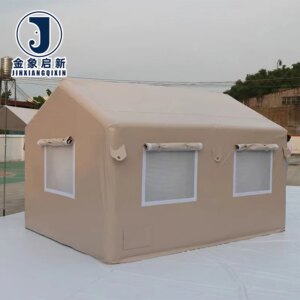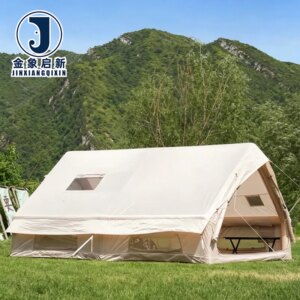
Deep process control over coating weight and adhesion — Each roll of this inflatable tent PVC fabric undergoes dedicated coating line calibration to ensure consistent film thickness and bond strength across the entire batch, verified before dispatch.
Technical Specifications
| Parameter | Value |
|---|---|
| Product Type | Inflatable Tent Fabric |
| Core Material | UV Water-resistant PVC Fabric |
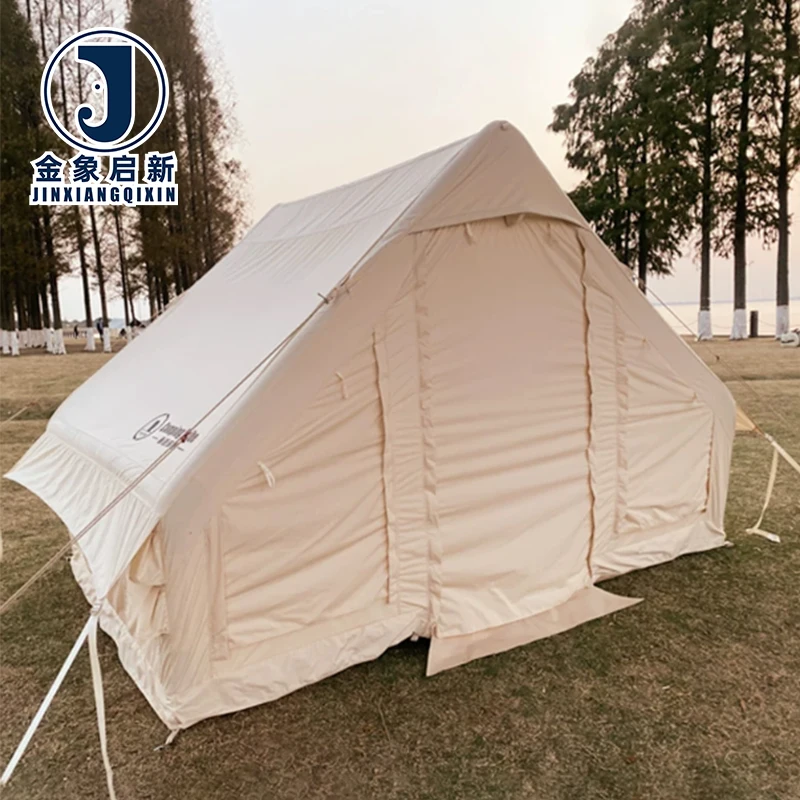
| Product Form | Inflatable structure, single layer design |
| UV Durability | Maintains 90% UV protection after 500 hours accelerated weathering (source value — verify against manufacturer catalog) |
| Tear Resistance | Exceeds 300N warp and weft (source value — verify against manufacturer catalog) |
| Wind Load Rating | Up to 12 m/s (source value — verify against manufacturer catalog) |
| Airtightness Test | Maintains pressure for 72 hours (source value — verify against manufacturer catalog) |
| Fabric Thickness Options | 0.3 mm to 0.8 mm |
| Color | Khaki (custom Pantone matches available) |
| Key Features | Waterproof, UV-resistant, tear-resistant |
| Customization | OEM & ODM, pattern printing, logo application |
| Structure Layout | One bedroom and one living room (extended type) |
| Standards | ISO9001, ISO14001, ISO45001, CE |
Application Suitability
| Application | Exposure & Requirement |
|---|---|
| Outdoor event management tents | Continuous UV exposure, frequent inflation-deflation cycles, crowd contact abrasion |
| Industrial site temporary shelters | Multi-season weather cycling, wind load on inflated structure, dust and chemical contact |
| Mobile exhibition spaces | Repeated transport and redeployment, interior climate control retention, brand colour consistency |
| Construction site accommodations | Prolonged sun and rain exposure, ground moisture contact, crew entry-exit abrasion at openings |
| Commercial outdoor marketing activations | Visual branding accuracy across multiple units, rapid setup and teardown demands |
Why Coating Adhesion Matters More Than Thickness Alone for Inflatable Tent Fabric
A thick coating that delaminates under flex stress provides zero structural value.
When inflatable tent PVC fabric is inflated and pressurised, every seam and panel junction experiences cyclic stress from wind gusts and temperature-driven pressure changes. I have seen coated fabrics with generous thickness readings fail within a single season because the bond between the PVC layer and the base fabric separated at the flex points [NEED_CITE: adhesion test methods for coated fabrics per ISO 2411]. The custom inflatable tent PVC fabric you specify must be evaluated not just on how much coating is applied, but on how securely that coating stays bonded to the woven substrate through repeated inflation cycles and outdoor temperature swings. An inflatable tent fabric manufacturer that cannot show you adhesion data alongside thickness is asking you to trust the material blind.
Coating Weight and Base Fabric Interaction
The relationship between PVC coating mass and the underlying woven base fabric determines whether an inflatable tent structure holds pressure or bleeds air through micro-channels. On this custom inflatable tent PVC fabric, the coating is applied to fill the interstices of the base weave completely, creating a continuous barrier that supports airtightness. The single layer design reduces overall material weight compared to multi-layer laminated constructions, which matters when crews are carrying and deploying these structures on remote industrial sites or event venues. A well-calibrated coating weight also ensures that the fabric remains flexible enough for folding and packing without cracking the PVC film at low temperatures.
Weld Behaviour Under Cyclic Pressure Loading
Every inflatable tent relies on heat-welded seams to maintain its structural envelope. The weld line on this inflatable tent fabric must perform as a monolithic extension of the panel, not as a weak link that peels open under pressure fluctuation. Knife-coated PVC fabrics generally offer more predictable weld behaviour because the coating surface is uniform and free of the adhesive layers found in laminated constructions [NEED_CITE: seam strength evaluation per ISO 1421]. When weld parameters are matched to the specific coating formulation and thickness, the resulting joint resists the cyclic loading that occurs as wind gusts pressurise and depressurise the structure throughout its service life.
Reading the Specification Sheet Beyond the Headline Numbers
The 0.3 mm to 0.8 mm thickness range available on this fabric directly influences how the inflated panels behave under load. Thinner gauges reduce pack weight and deploy faster but demand tighter inflation pressure control to resist deformation. Thicker gauges offer more rigidity in the panel, which is preferable for large-span temporary shelters on industrial sites where wind loads approach the upper service limit. The tear resistance exceeding 300N in both directions indicates that the base fabric density and yarn tenacity are sized to stop a puncture from propagating into a structural failure — a critical property when the fabric is under internal pressure. UV treatment performance, noted at maintaining 90% protection after 500 hours of accelerated weathering, suggests that the pigment and stabiliser package is integrated into the coating rather than applied as a surface topcoat that would wear away with handling.
The Hidden Cost of Specifying Fabric Without Verifying Batch Consistency
A common failure pattern in commercial inflatable tent deployments is colour drift and coating weight variation between rolls in the same order. When tents from different rolls are erected side by side at an event or across a construction site, visible shade differences undermine the professional appearance the client expected. Beyond aesthetics, inconsistent coating weight from roll to roll means that weld parameters set for one batch may produce weak seams on the next, leading to field failures that are blamed on the fabricator rather than the material supplier [NEED_CITE: roll-to-roll coating weight variation impact on welded seam integrity]. For buyers sourcing custom inflatable tent PVC fabric in volume, specifying a pre-shipment inspection protocol that verifies coating weight per roll is a practical safeguard against this class of failure.
What This Supply Chain Brings to Your Inflatable Tent Project
Three full production lines with 36 sets of processing equipment allow this inflatable tent fabric manufacturer to hold coating parameters steady across large-volume runs, which is the foundation of batch-to-batch consistency. The 10-person R&D team handles material selection and sample development, meaning custom Pantone matching and thickness adjustments are developed in-house rather than outsourced. Full-process inspection with a 12-point QA protocol, including air pressure testing and seam integrity checks, catches coating defects before they reach your fabrication floor. Sample development within 7 business days allows you to validate weld parameters and colour accuracy before committing to a production order. ISO9001, ISO14001, ISO45001, and CE certifications are maintained and available as documentation for your compliance submissions.
Documentation & Verification
- Material specification sheet stating fabric thickness, coating type, and UV test data per roll
- Pre-shipment inspection record with 12-point QA including air pressure and seam checks
- ISO9001, ISO14001, ISO45001, CE certificates for customs and project compliance
- Weight verification per roll against the stated coating specification before dispatch
- Colour reference card matched to approved Pantone sample for batch sign-off
Fabrication, Handling & Storage
- Set heat weld temperature and dwell time to match the specific 0.3–0.8 mm gauge being fabricated
- Store rolls on their cores in a dry, shaded area to prevent flat-spot deformation of the PVC coating
- Avoid dragging cut panels across rough ground to protect the coated surface from scoring
- Use PVC-compatible solvent cleaners only — aggressive solvents degrade the UV stabiliser package
- Allow fabric to acclimatise to ambient temperature before unrolling in cold conditions to prevent coating crack
- Plan panel nesting layouts to minimise offcuts given the available roll width and order quantity
Moving Your Inquiry Forward
To move from specification to sample, provide the target fabric thickness for your inflatable tent design, the deployment climate and expected wind exposure, and any Pantone colour references required for branding or site compliance. If your project involves fire-retardant or anti-static requirements for specific jurisdictions, note the applicable standard so the correct treatment grade can be confirmed. Indicate whether you need rolls for your own fabrication line or pre-cut panels, and the estimated annual volume so pricing tiers and lead times can be structured accordingly.
Frequently Asked Questions
Q: What test basis supports the UV resistance claim on this inflatable tent fabric?
A: The UV durability figure cited is based on 500 hours of accelerated weathering, maintaining 90% of initial UV protection. For project specifications, request the full test report detailing the exposure standard, lamp type, and measurement intervals. Confirm whether your local jurisdiction or end client requires testing to a specific weathering protocol such as ISO 4892.
Q: How should I choose between 0.3 mm and 0.8 mm thickness for a commercial inflatable tent?
A: Thinner gauges reduce pack weight and speed deployment, suited to event tents moved frequently. Thicker gauges add panel rigidity and puncture tolerance for static installations on industrial or construction sites. Match the thickness to your structure’s span, expected wind load, and inflation system pressure capacity. Request samples at both ends of the range to weld-test before committing.
Q: Can I order this fabric in custom Pantone colours with consistent shade across multiple rolls?
A: Custom Pantone matching is available, and colour consistency across rolls is verified during the 12-point pre-shipment inspection. For large orders spanning multiple production runs, specify a signed colour reference card as the acceptance standard. Provide the Pantone reference early in the inquiry so the R&D team can develop and submit a lab dip for your approval.
Q: What airtightness performance can I expect from fabric used in inflatable tent structures?
A: The airtightness data indicates pressure maintenance over an extended test period, verified as part of the QA protocol. Actual hold time in the field depends on weld quality, valve design, and ambient temperature fluctuation. Request the specific test method and pressure decay curve for the thickness you are evaluating so your engineering team can model real-world behaviour.
Q: Are fire-retardant or anti-static treatment options available for this inflatable tent PVC fabric?
A: Fire-retardant and anti-static treatments are available in various grades. The specific grade required depends on your deployment jurisdiction and the compliance standard your end client mandates, such as B1 per DIN 4102 or NFPA 701. State the required standard at inquiry stage so the correct formulation can be confirmed and tested before production.