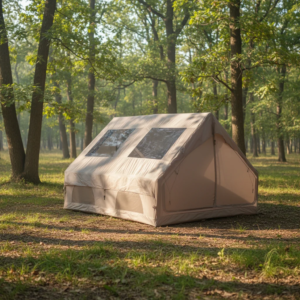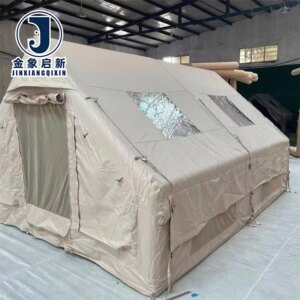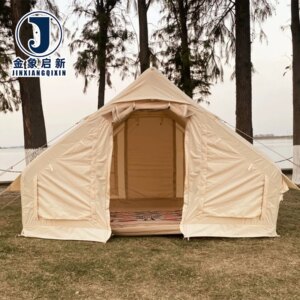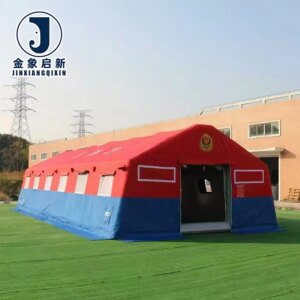
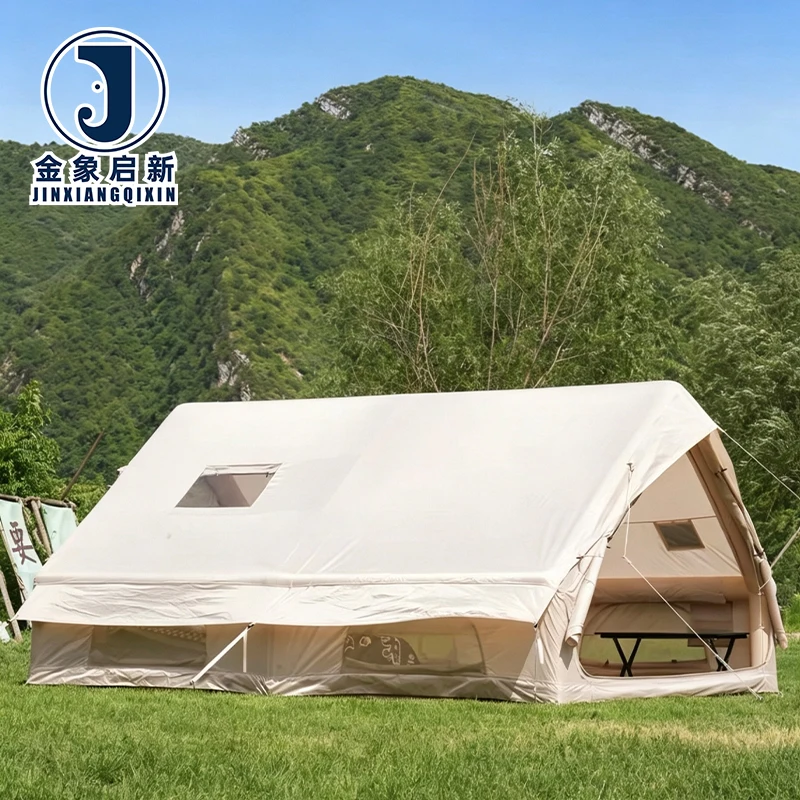
Coating Weight Control — digital gauge monitoring maintains ±2% thickness tolerance across every roll of inflatable tent fabric we produce, verified before dispatch.
Technical Specifications
| Parameter | Value |
|---|---|
| Product Type | Inflatable Tent |
| Core Material | PVC Tarpaulin |
| Waterproof Rating | 3000mm water column |
| Fire-retardant Standard | EN 13501-1 |
| Raw Material Standard | GB/T 5761-2006 (virgin PVC resin) |
| Thickness Tolerance | ±2% across production batches |
| UV Resistance | Available in UV-resistant grades — confirm the grade required for your market |
| Anti-static Treatment | Available in anti-static grades — confirm the standard required for your application |
| Tear Resistance | Tear-resistant coated construction |
| Quality System | ISO9001, ISO14001, ISO45001, CE |
| Inflation Testing | 24-hour airtightness and structural stability test before shipment |
| Customization | OEM & ODM, sample customization, pattern printing |
| Production Lines | 3 full production lines |
| Processing Equipment | 36 sets of professional equipment |
| R&D Team | 10 technicians |
Application Suitability
| Application | Exposure & Requirement |
|---|---|
| Commercial inflatable tent manufacturers | Roll-to-roll colour and thickness consistency for multi-unit production runs, weld seam integrity under repeated inflation cycles |
| Expedition and adventure tourism operators | Four-season weather exposure, fire-retardant certification for temporary structures in regulated venues |
| Event management companies | Rapid deployment shelters requiring long service life, consistent air-holding performance across varying temperatures |
| Industrial temporary workforce housing | Remote site wind loading, membrane structure stability, compliance with site safety fire standards |
| Field research stations | Extended outdoor exposure in harsh climates, resistance to abrasion from ground contact and repeated packing |
| Commercial adventure tourism operations | High-frequency inflation and deflation cycles, UV exposure at altitude, guest safety fire compliance |
Why Coating Weight Alone Cannot Predict Inflatable Structure Performance
Inflatable tent fabric must hold air under flex stress — coating adhesion to the base fabric matters as much as the GSM figure on the datasheet.
Technical buyers reviewing inflatable tent fabric often fixate on a single weight number, assuming heavier automatically means stronger. In practice, we see coated fabrics with identical GSM values behave very differently once welded into an inflatable tube and pressurised. The base fabric denier, weave density, and the coating method all interact to determine how the material performs when the structure flexes under wind load or temperature-induced pressure changes. A knife-coated PVC layer bonded to a high-density polyester base will resist delamination at the weld line far better than a laminated construction of the same stated weight. [NEED_CITE: tensile and tear test methods for coated fabrics per ISO 1421]
How Knife Coating Secures the Weld Line in Inflatable Tubes
The weld seam on an inflatable tent tube is where coating adhesion faces its most demanding test. Our Inflatable Tent Fabric uses knife coating applied to a virgin PVC resin base conforming to GB/T 5761-2006, which penetrates the polyester weave rather than sitting on top of it. This creates a mechanical bond that resists peeling when the tube flexes during inflation and deflation cycles. The coating weight and the base fabric density together determine how much stress the weld zone can absorb before the coating separates from the yarn.
Fire-Retardant Certification That Your Site Inspector Will Accept
Specifying fire-retardant fabric without a recognised standard attached creates a compliance gap that only surfaces when the site safety officer asks for paperwork. Our inflatable tent fabric carries EN 13501-1 classification, which is the harmonised European reaction-to-fire standard accepted across most regulated temporary structure markets. Each batch ships with a test report referencing this standard, so your compliance file is complete before the structure goes on site. For markets requiring different classifications, confirm the specific grade needed and we will match the formulation. [NEED_CITE: EN 13501-1 reaction to fire classification for construction products]
Reading the Specification Sheet Beyond the GSM Number
Three parameters on our material specification sheet interact to define real-world performance in inflatable structures. First, the base fabric denier and weave density control how tear propagation is arrested once a puncture occurs — a tighter weave limits the damage radius. Second, the coating weight relative to the base fabric weight determines surface durability and weld compatibility; too little coating and the heat weld burns through to the yarn, too much and the seam becomes brittle. Third, the ±2% thickness tolerance maintained through digital gauge monitoring at every production stage ensures that your welding machine settings remain valid across every roll in the order. Waterproof performance tested to 3000mm water column confirms the coating continuity across the full fabric width without pinholes or thin spots.
What Happens When Roll Consistency Fails on a Multi-Unit Order
Colour shift between rolls in a single shipment is not just a cosmetic issue for inflatable tent manufacturers. When panels from different rolls are welded side by side on a large structure, the visual mismatch is immediately visible to the end client and can trigger rejection of the entire unit. Beyond colour, thickness variation between rolls forces fabricators to recalibrate welding temperature and pressure for each roll change, increasing scrap rate and slowing production throughput. We control batch consistency through dedicated QA and QC inspection at every production stage with 100% inspection before shipment, matching colour to Pantone references and holding thickness within ±2%. [NEED_CITE: colour measurement methods for PVC coated fabrics in production batches]
Why Fabric Buyers Source Inflatable Tent Fabric From Jinan Jinxiang
Three full production lines and 36 sets of professional equipment give us the capacity to fulfil bulk roll orders without compressing lead times on custom widths or colours. The 10-person R&D team develops sample panels with your exact colour, width, and printing requirements within days, so you approve the material before committing to volume. Every production stage runs under dedicated QA and QC staff who verify coating weight, colour match, and thickness tolerance before the roll moves to the next step. Virgin PVC resin sourced to GB/T 5761-2006 means no recycled content enters the coating bath, eliminating the inconsistent plasticiser absorption that causes surface defects. Samples ship quickly so you can run your own weld trials and inflation tests before placing the production order.
Documentation & Verification
- Material specification sheet stating GSM, base fabric denier, coating type, and Pantone colour reference per roll
- EN 13501-1 fire-retardant test report with batch traceability for compliance audits
- Pre-shipment inspection record including 24-hour inflation test results on finished units
- ISO9001, ISO14001, ISO45001, and CE certificates supporting regulatory approval in export markets
- Roll packing list with net weight, gross weight, and roll dimensions for container loading plans
- Certificate of origin and customs documentation for destination market clearance
Fabrication, Handling & Storage
- Set hot-air welding temperature to match the PVC coating formulation — knife-coated layers bond at standard PVC weld settings
- Store rolls upright on pallets to prevent permanent creasing across the coated surface width
- Allow cold-stored rolls to reach ambient temperature before unrolling to avoid coating crack at low flex points
- Use PVC-compatible solvent cleaners only; aggressive solvents will attack the knife-coated surface layer
- Cut panels with a margin for weld overlap — the ±2% thickness tolerance keeps seam allowance predictable across rolls
What to Include in Your Inflatable Tent Fabric Enquiry
Send us the intended application, whether the fabric will form inflatable tubes, canopy panels, or ground sheets, as each zone has different tensile and flex requirements. Specify the fire-retardant or anti-static grade your destination market mandates so we match the correct formulation from the outset. Include your required roll width, target colour by Pantone reference, and estimated annual volume so we can confirm lead time and minimum order. If you need sample panels for weld testing before committing to bulk, state this in your initial enquiry.
Frequently Asked Questions
Q: How is the GSM of inflatable tent fabric verified upon delivery?
A: Every roll is weighed and measured against the stated GSM before dispatch. Our pre-shipment inspection record documents the actual weight per square metre for each roll in your order. Digital gauge monitoring during production maintains ±2% thickness tolerance, so the fabric arriving at your facility matches the specification sheet you approved at sample stage.
Q: What fire-retardant grade does the PVC tarpaulin carry, and does it meet my market’s requirements?
A: Our inflatable tent fabric is classified to EN 13501-1, the European reaction-to-fire standard widely accepted for temporary structures. A batch-specific test report ships with your order. If your market requires a different classification such as NFPA 701 or a national standard, share the requirement early so we can confirm formulation availability.
Q: What is the test basis for UV resistance, and how does it relate to outdoor service life?
A: UV resistance is available in specific grades depending on the additive package used during coating. We recommend confirming the UV test standard required for your target market and expected deployment conditions. This ensures the formulation matches the actual solar exposure your inflatable structures will face in service.
Q: How do you control thickness consistency across rolls in the same order?
A: Digital gauge monitoring runs at every production stage, holding thickness within ±2% across the full batch. Dedicated QA and QC staff inspect each roll before it is packed. This consistency means your welding parameters remain valid from the first roll to the last without mid-production recalibration.
Q: What base fabric denier and weave structure are used for inflatable tent applications?
A: The base fabric denier and weave density are selected based on the structural demands of your inflatable design — tube sections require higher tensile values than canopy panels. Share your inflation pressure and expected wind loading so our R&D team can recommend the appropriate base fabric construction and provide a sample for your evaluation.