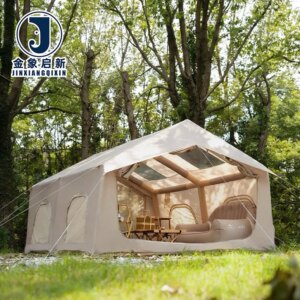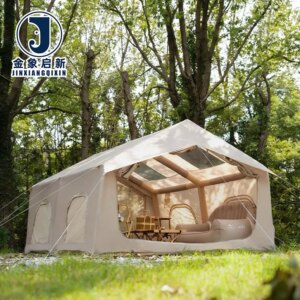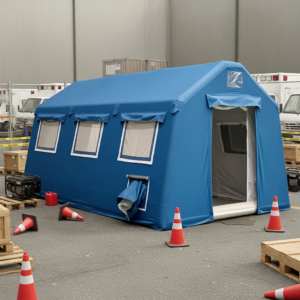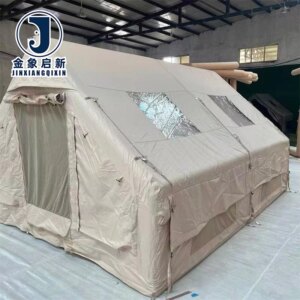
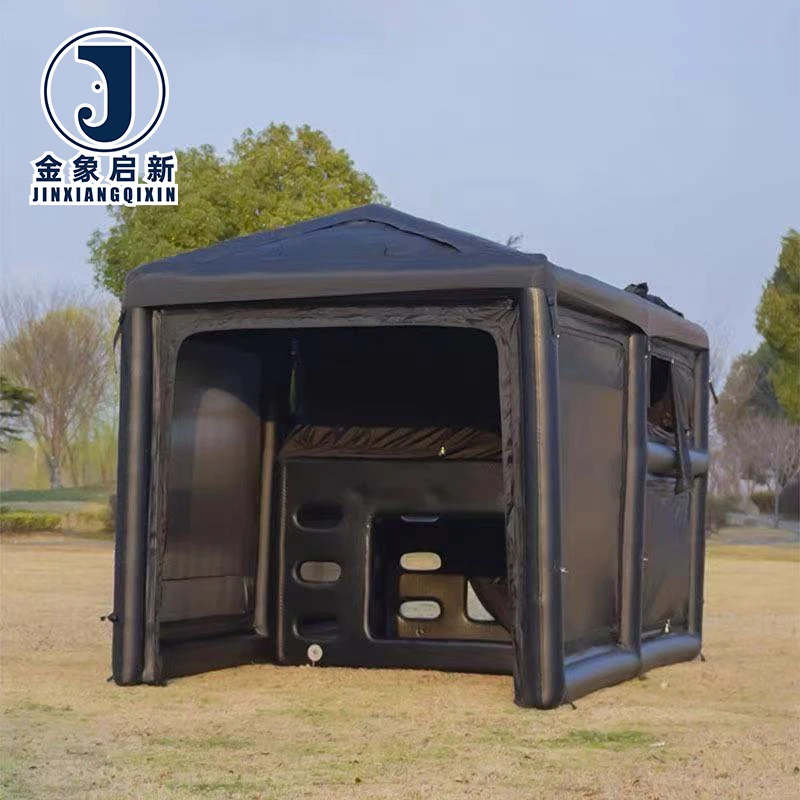
Deep Process Control — Nearly 30 years of PVC coated fabric production experience applied to inflatable tent material, with full OEM/ODM customization from base fabric selection to pattern printing and finished product development.
Technical Specifications
| Parameter | Value |
|---|---|
| Product Type | Inflatable Tent |
| Core Material | PVC Tarpaulin (PVC knife-coated fabric) |
| Key Performance | Waterproof, UV-resistant, Tear-resistant, Quick automatic opening |
| Product Forms | Single Layer Construction, Extended Type |
| Seasonality | Four seasons outdoor use |
| Customization Service | OEM & ODM (sample customization, pattern printing) |
| UV Treatment | UV-resistant (test basis not stated in source) |
| Flame Retardant | Available in flame retardant grades — confirm the grade required for your market |
| Standards | ISO9001, ISO14001, ISO45001, CE |
Application Suitability
| Application | Exposure & Requirement |
|---|---|
| Inflatable camping tent manufacturing | Air-beam stress, internal pressure flexing, rapid inflation cycles, four-season weather exposure |
| Commercial event and temporary shelters | Rapid deployment, frequent assembly and teardown, crowd contact abrasion, variable ground conditions |
| Emergency response logistics | All-weather deployment, fast inflation under field conditions, transport and storage durability |
| Industrial site temporary accommodation | Extended outdoor siting, wind loading on membrane surfaces, UV exposure over project duration |
Why Coating Weight Alone Does Not Guarantee Inflatable Structure Integrity
Air-beam fabric fails at the weld line long before the coating weight reaches its limit.
When sourcing inflatable tent fabric, buyers often fixate on GSM as the primary quality indicator. But a heavy coating applied over a loosely woven base fabric will still tear under air-beam pressure. The knife-coated PVC construction used here addresses this by bonding coating directly into the base fabric weave, creating a composite where tensile load transfers through both layers simultaneously. This matters because inflatable structures concentrate stress at welded seams and beam junctions — points where coating adhesion to the base fabric determines whether the panel holds or delaminates [NEED_CITE: tensile and tear test methods for coated fabrics per ISO 1421].
Coating Method and Its Effect on Air-Beam Weld Integrity
The knife-coated PVC fabric construction delivers a direct bond between coating and base fabric that supports reliable heat-welded seams. For inflatable tent manufacturers, weld integrity at air-beam junctions is the critical failure point — the fabric must withstand internal pressure without seam separation. This Inflatable Tent Fabric manufacturer custom capability extends to adjusting coating weight and base fabric specification to match the inflation pressure and structural design of your specific tent model.
R&D Support for Custom Inflatable Designs
The 10-person R&D team handles material selection, pattern printing, and sample development for custom inflatable tent projects. This covers everything from base fabric denier selection to surface finish specification for printing compatibility. When you need inflatable tent fabric matched to a particular air-beam diameter or canopy geometry, the development process starts with material recommendation before moving to sample production.
How Base Fabric and Coating Interact Under Inflation Pressure
The relationship between base fabric denier, weave density, and PVC coating weight determines how inflatable tent panels behave under load. Base fabric denier and weave density establish the tensile and tear strength baseline — the coating adds waterproofing, UV protection, and weldability, but cannot compensate for an underspecified base fabric. Knife coating forces PVC compound into the weave structure, which improves peel strength at welded seams compared to laminated alternatives. This is why GSM alone is an incomplete specification: a 650 GSM fabric with tight weave and proper knife coating will outperform a heavier fabric with loose weave and poor adhesion at the weld line. Surface finish selection — glossy or matte — affects both cleaning behaviour and print adhesion for branded inflatable structures [NEED_CITE: coating adhesion and peel strength testing for PVC tarpaulin].
The Hidden Cost of Underspecified Inflatable Tent Fabric
Colour variation between rolls in the same production batch forces tent manufacturers to reject material mid-run, delaying delivery to end customers. Welded seams that fail before the fabric reaches its rated tear strength indicate coating adhesion problems, not fabric weakness — and this surfaces only after the inflatable structure is pressurised in the field. When UV treatment is claimed without supporting test data, premature chalking and embrittlement appear after the first season of outdoor exposure, generating warranty claims against the tent brand rather than the fabric supplier. These failures trace back to specification gaps at the procurement stage, not to manufacturing defects [NEED_CITE: common failure modes in PVC inflatable structures].
Why Source Inflatable Tent Fabric Through This Facility
Three full production lines and 36 sets of professional equipment support bulk inflatable fabric orders with consistent roll-to-roll output. Dedicated QA/QC operates at every production stage, with 100% pre-shipment inspection verifying GSM, colour, and coating adhesion before material leaves the facility. The R&D team develops samples within days for custom inflatable tent fabric requirements, covering base fabric selection, coating weight, surface finish, and pattern printing. Production capability spans single-layer construction and extended-type inflatable tent formats, with OEM and ODM services supporting buyers who need finished product development alongside raw fabric supply. ISO and CE certification underpins the quality system, with documentation packages matched to each shipment.
Documentation & Verification
- Material specification sheet stating base fabric denier, PVC coating method, GSM, and colour reference per roll batch
- UV resistance and flame retardant test reports matched to order batch where applicable treatments are specified
- Pre-shipment inspection record confirming GSM, colour consistency, and coating adhesion verification
- ISO9001, ISO14001, ISO45001, and CE certificates included with every dispatch
- Certificate of origin and customs documentation for international inflatable tent fabric shipments
Fabrication, Handling & Storage
- Heat-weld parameters must be calibrated to the specific PVC knife-coated fabric GSM and coating weight before production runs begin
- Store rolls upright on pallets to prevent permanent creasing in the PVC coating layer that affects air-beam panel flatness
- Allow material to acclimatise to workshop temperature before unrolling to prevent cold-cracking in the PVC surface
- Clean printed surfaces with pH-neutral detergent only to preserve pattern printing integrity on branded inflatable structures
- Use matched PVC repair patches from the same coating batch for field repairs to maintain colour consistency
What We Need to Quote Your Inflatable Tent Fabric Project
Provide the air-beam diameter and inflation pressure for your tent design, along with target market fire safety requirements if applicable. Specify required roll width, annual volume, and whether you need raw fabric or OEM finished panel cutting. Colour references and pattern printing artwork should be submitted for sample development before bulk production commitment.
Frequently Asked Questions
Q: What base fabric denier do you recommend for inflatable tent air-beam panels versus canopy panels?
A: Air-beam panels require higher denier base fabric to withstand internal pressure and repeated inflation cycles, while canopy panels can use lighter denier for weight reduction. The R&D team recommends specific base fabric constructions based on your tent design and target inflation pressure, with samples produced for weld testing before bulk order.
Q: How do you verify UV resistance for inflatable structures deployed across four seasons?
A: UV-resistant treatment is applied during the PVC coating process, and test reports documenting performance are available for applicable grades. We recommend confirming the UV test standard required by your target market at inquiry stage so the correct treatment specification and supporting documentation can be matched to your order batch.
Q: What flame-retardant certifications are available for inflatable tent fabric?
A: Flame retardant grades are available and should be confirmed based on your target market requirements and the specific fire safety standards applicable to temporary structures in that region. Provide the required certification at inquiry stage so the correct treatment and test documentation can be included with your shipment.
Q: Can you maintain colour consistency across multiple rolls for large inflatable tent production runs?
A: Roll-to-roll colour consistency is verified during pre-shipment inspection as part of the dedicated QA/QC process. Each batch is checked against the colour reference stated on the material specification sheet, and inspection records are included with dispatch documentation to confirm consistency across your order.
Q: What is the sample development lead time for custom inflatable tent fabric?
A: Samples are developed within days for custom requirements, covering base fabric selection, coating weight, surface finish, and pattern printing specifications. The sample process allows you to validate weld parameters and inflation performance before committing to bulk production volumes.