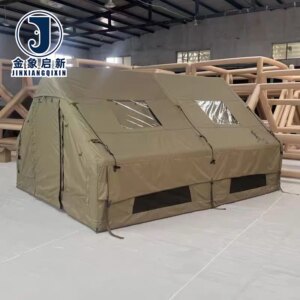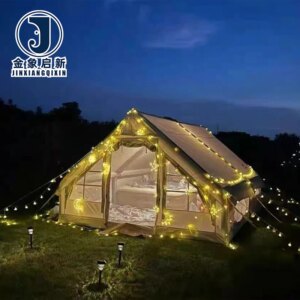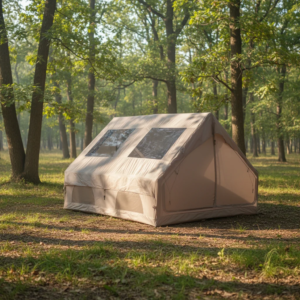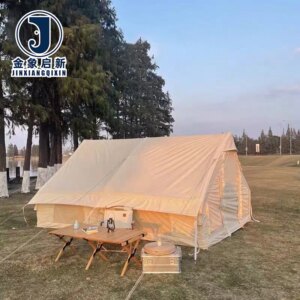
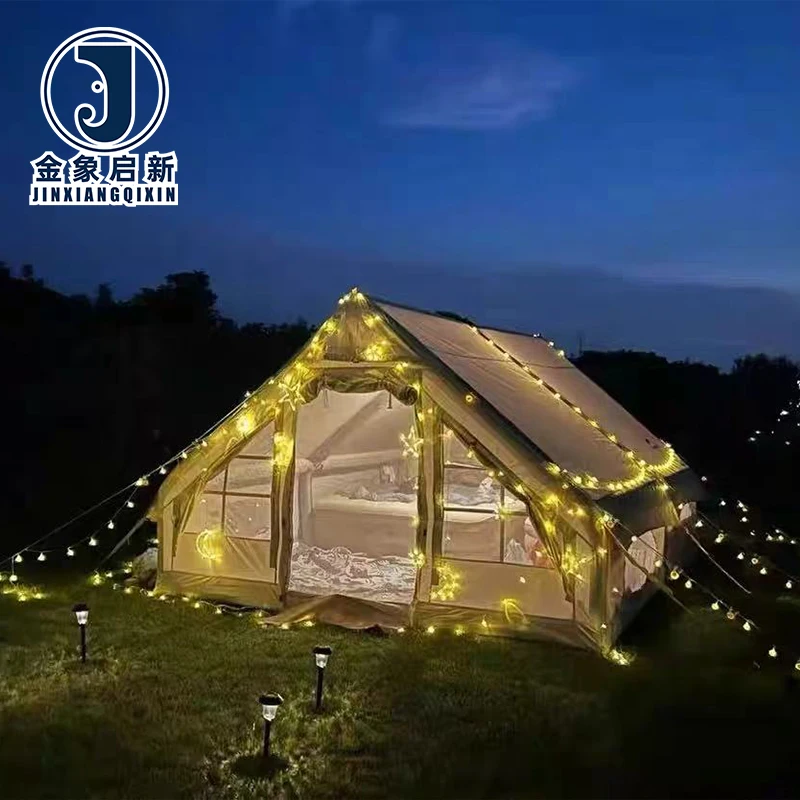
Coating Adhesion Mastery — Thirty years of PVC coating process control delivers consistent layer bonding across every roll, ensuring inflatable tube seams hold pressure without delamination during fabrication or field use.
Technical Specifications
| Parameter | Value |
|---|---|
| Product Type | Inflatable Tent |
| Core Material | PVC Tarpaulin |
| Key Performance | Waterproof, UV-resistant (test basis not stated), Tear-resistant |
| Capacity | 4-6 Person |
| Opening Mechanism | Quick Automatic Opening (inflatable) |
| Layer Design | Single Layer |
| Certifications | ISO9001, ISO14001, ISO45001, CE |
| Customization | OEM & ODM — sample customization, pattern printing |
| Quality Control | Full-process inspection with dedicated QA & QC staff |
Application Suitability
| Application | Exposure & Requirement |
|---|---|
| Outdoor events management temporary workspace | Repeated inflation cycles, UV exposure, crowd proximity abrasion |
| Construction site equipment storage shelter | Rain and dust ingress, puncture from tools and debris, wind loading |
| Disaster relief mobile facility | Rapid deployment urgency, variable weather, transport handling stress |
| Commercial outdoor gear manufacturing | Batch colour consistency, weld seam reliability, documented material traceability |
| Engineering firm temporary on-site structures | Structural air-hold integrity, professional appearance, compliance documentation |
Why Coated Fabric Colour Varies Between Rolls in the Same Inflatable Tent Order
Batch-to-batch colour shift in PVC coated inflatable tent fabric stems from inconsistent pigment dispersion and coating weight variation across production runs.
When inflatable structure manufacturers source inflatable tent fabric PVC coated material from suppliers without in-line colour monitoring, the result is visible mismatch once adjacent panels are installed. A tent maker assembling a large event shelter may find one roll reads slightly warmer than the next, forcing costly sorting or outright rejection. The inflatable tent fabric PVC coated material must hold colour within a tight Delta-E tolerance from first roll to last, because commercial buyers cannot absorb rework on fabricated structures already cut and welded. [NEED_CITE: colour consistency standards for coated textile batches in industrial fabric sourcing]
Coating Weight and Adhesion for Inflatable Tube Fabrication
The inflatable tent fabric PVC coated material relies on knife-coat application to build a uniform PVC layer over the base fabric. Consistent coating weight ensures that when fabricators apply heat welding to form inflatable tubes, the PVC layers melt and fuse evenly without dry spots or excess build-up. Uneven coating creates weak zones where air escapes before the seam reaches full strength, which is the most common failure point in inflatable structures.
Tear Resistance Under Cyclic Inflation Loads
Every inflation and deflation cycle places stress on the structural seams of an inflatable tent. The tear-resistant construction in this PVC tarpaulin addresses the flex fatigue that accumulates over repeated pressurisation. For commercial outdoor gear manufacturers integrating this inflatable tent fabric PVC coated material into shelter product lines, predictable tear behaviour under cyclic loading means fewer warranty claims from end users who deploy and pack the structure daily. [NEED_CITE: cyclic flex fatigue testing methods for inflatable structure fabrics]
How GSM, Base Fabric and Coating Interact to Determine Performance
GSM alone does not define how well an inflatable tent fabric performs under internal pressure. A high GSM achieved through heavy coating on a low-density base fabric will show good stiffness but poor tear propagation resistance — the coating cracks before the yarns absorb the load. Conversely, a dense base fabric with a thin, well-bonded coating delivers better tear strength at a lower overall weight. For inflatable tent manufacturers, specifying the base fabric denier and weave alongside the total GSM ensures the material behaves predictably during welding and under inflation stress. The single-layer design of this PVC tarpaulin reduces weight while maintaining the coating adhesion needed for reliable heat-welded seams on inflatable tubes.
The Hidden Cost of Specifying Inflatable Fabric on GSM Alone
Manufacturers who select inflatable tent fabric PVC coated material based only on quoted GSM frequently discover upon receipt that the actual weight falls short, because the supplier achieved the number through excessive filler rather than quality coating resin. The consequence is a material that feels stiff but tears easily at the weld line, where the heat has already weakened the PVC. For inflatable tent production, this means welded seams fail before the fabric body does — exactly where internal pressure concentrates. Sourcing on verified coating composition and base fabric specification, not just total weight, prevents this pattern of field failure. [NEED_CITE: tensile and tear test methods for coated fabrics per ISO 1421]
Why Fabricators Source This Inflatable Tent Fabric Here
Three full production lines and 36 sets of professional processing equipment support bulk roll output with controlled coating parameters maintained across every production run. The 10-person R&D team develops custom samples within days, allowing inflatable tent manufacturers to validate thickness, colour and weld behaviour before committing to volume orders. Dedicated QA and QC staff inspect every roll before dispatch, catching coating weight deviation and colour shift at the point of production rather than at the customer’s cutting table. Full-process quality inspection means the inflatable tent fabric PVC coated material you receive matches the specification sheet — roll after roll, order after order.
Documentation & Verification
- Material specification sheet stating GSM, base fabric type and coating reference per roll
- UV-resistant test report matched to batch number where applicable
- ISO and CE certificates included with every shipment
- Pre-shipment inspection record documenting coating weight and colour check per roll
- Certificate of origin and customs support documentation for international dispatch
Fabrication, Handling & Storage
- Heat-weld temperature and dwell time must be calibrated to the specific PVC coating thickness on this tarpaulin
- Store rolls upright on pallets to prevent flat-spot creasing that weakens the coating bond
- Single-layer PVC construction allows clean cutting with standard rotary or die-cut equipment
- Avoid dragging rolls on unprotected surfaces to prevent abrasion damage to the PVC coating face
- Clean welded seams with compatible PVC solvent to maintain air-hold integrity in inflatable tubes
- Pattern printing, where specified, should be validated on sample before bulk production to confirm ink adhesion
What We Need to Move Your Inquiry Forward
Provide the intended application and deployment environment so we can confirm whether the standard UV-resistant grade meets your exposure conditions, or whether a higher grade is required. Specify your target roll width, annual volume and any pattern printing or colour requirements so we can align production scheduling. If you need finished cut sizes rather than roll stock, share the panel dimensions and seam construction method your fabrication team uses. Request a sample to validate weld parameters and colour before placing a bulk order.
Frequently Asked Questions
Q: How is GSM verified on arrival and what documentation supports the quoted weight?
A: Each roll ships with a pre-shipment inspection record showing measured coating weight. The material specification sheet included in the documentation package states the GSM, base fabric type and coating composition. Buyers can cross-check the roll weight against the stated specification upon receipt.
Q: What test basis supports the UV-resistant claim and how is it reported per batch?
A: The UV-resistant grade is available with a test report matched to the batch number where applicable. Buyers should confirm the specific UV performance standard required for their target market, as test methods vary by region and end-use exposure conditions.
Q: How is batch-to-batch colour consistency controlled across rolls for inflatable structures?
A: In-line colour monitoring during coating production ensures each roll matches the approved reference. The dedicated QA team checks colour per roll before dispatch. For large orders spanning multiple production runs, a colour sample from each batch is retained for comparison.
Q: What are the heat-weld and seam recommendations for PVC inflatable tube fabrication?
A: Weld temperature and dwell time should be calibrated to the specific PVC coating thickness. A sample roll should be tested first to establish optimal parameters. Consistent coating adhesion in this material supports reliable heat-welded seams when proper fabrication procedures are followed.
Q: What OEM and ODM customization is available for inflatable tent fabric orders?
A: Customization covers sample development in custom thickness and colour, pattern printing for branding, and roll sizing to match your cutting layout. The R&D team develops samples within days so you can validate material behaviour before committing to production volume.