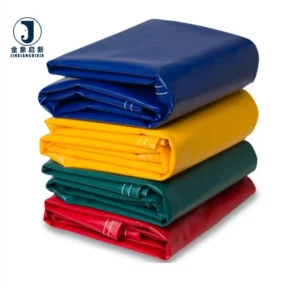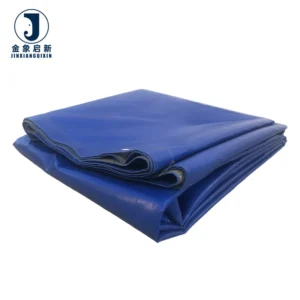
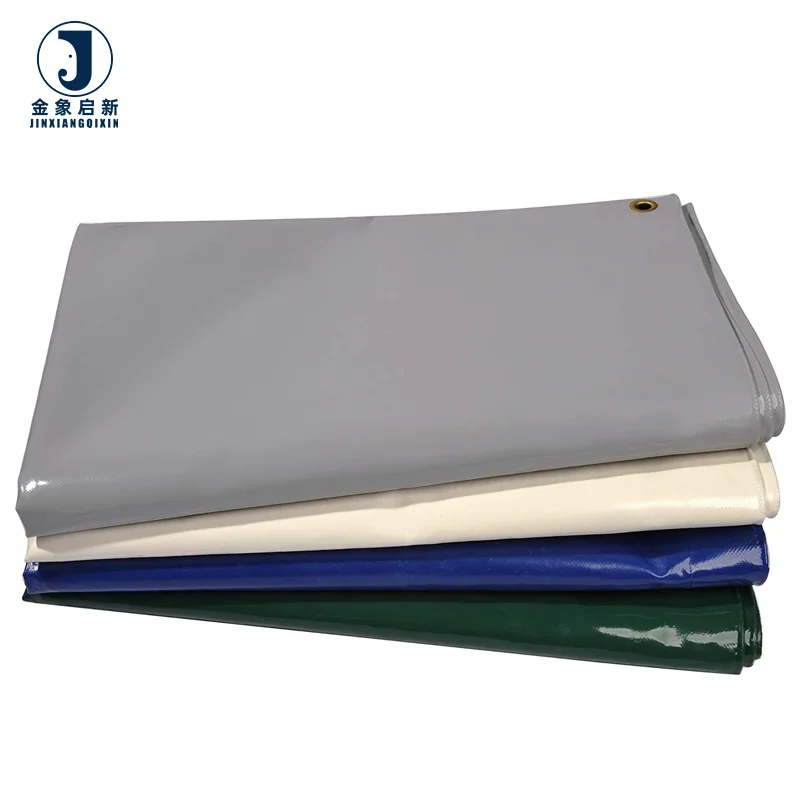
Coating Adhesion Control — Deep process control over coating weight and adhesion across PVC double-sided grades ensures base fabric and coating perform as a single unit under load.
Technical Specifications
| Parameter | Value |
|---|---|
| Product Type | PVC Coated Tarpaulin |
| Base Fabric Denier | 500D×840D / 500D×1000D / 1000D×1000D / 1000D×1300D / 1300D×1300D / 1000D×2000D |
| Mesh Count | 30×19 / 20×20 / 30×15 (varies by grade) |
| Weight (GSM) | 350 / 400 / 420 / 500 / 600 / 650 / 750 / 900 |
| Total Thickness | 0.29 mm / 0.32 mm / 0.38 mm / 0.44 mm / 0.46 mm / 0.55 mm / 0.65 mm |
| Coating Material | PVC double-sided coating on polyester base |
| Tensile Strength (Warp) | 1650 N to 3900 N (varies by GSM grade, test standard not stated) |
| Tensile Strength (Weft) | 1600 N to 3500 N (varies by GSM grade, test standard not stated) |
| Flame Retardant | Available in flame retardant grades — confirm the grade required for your market |
| Anti-UV Treatment | Anti-UV treatment available — confirm test basis for your exposure conditions |
| Waterproof Rating | Waterproof coated construction (hydrostatic head not stated) |
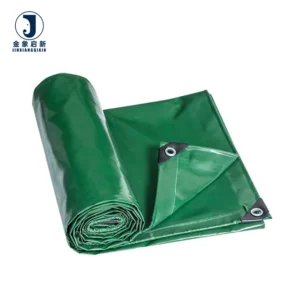
| Edge Finishing | 5 mm rope, high-temperature heat-sealed seamless edge wrapping, 3 cm enlarged aluminum alloy buttonhole, reinforced corners |
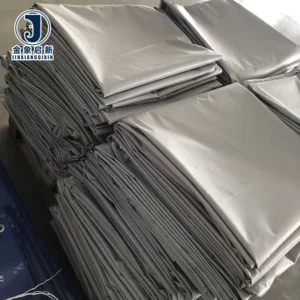
| Color | Gray |
| Key Features | Water resistant, flame retardant options, anti-UV options, waterproof |
Application Suitability
| Application | Exposure & Requirement |
|---|---|
| Truck and trailer side curtains | Constant flexing at load points, road debris abrasion, UV and weather exposure — demands verified tensile strength and coating adhesion |
| Tent and awning structures | Wind load tension, prolonged sun exposure, rain ingress at seam lines — requires consistent GSM and reliable heat-sealed welds |
| Pergola and canopy rain covers | Permanent outdoor installation, pooled water load, seasonal temperature swing — depends on coating weight and anti-UV stability |
| Machine and equipment covers | Static outdoor storage, dust and moisture ingress, periodic handling — benefits from reinforced corner eyelets and sealed edges |
| Garden furniture and plant covers | Ground moisture contact, UV degradation, lightweight handling — suited to lower GSM grades with adequate denier |
Why Coating Weight and Material Technology Define PVC Coated Tarpaulin Performance
A quoted GSM figure means nothing without the base fabric denier and mesh count behind it.
Technical buyers who specify PVC coated tarpaulin on GSM alone are purchasing a number, not a material system. A 650 GSM roll built on 1000D×1300D base fabric with 20×20 mesh behaves fundamentally differently from a 650 GSM roll achieved by loading a lighter base with excess coating. The first tears before it stretches; the second cracks at the weld. When the coating and base fabric are not matched by design, the failure always appears at the point of highest stress — typically the seam or the eyelet [NEED_CITE: tensile and tear test methods for coated fabrics per ISO 1421].
How Base Fabric Denier Progression Maps to Real Tensile Capacity
The denier progression in this PVC coated tarpaulin range — from 500D×840D at the 350–420 GSM grades through to 1000D×2000D at 900 GSM — is not arbitrary. Each step pairs a heavier yarn with a correspondingly tighter or adjusted mesh count, so the polyester skeleton carries a proportional share of the mechanical load. Warp tensile values climb from 1650 N at 350 GSM to 3900 N at 900 GSM, reflecting the combined contribution of yarn mass and weave density rather than coating thickness alone. For technical buyers selecting roll stock by material properties, this denier-to-GSM mapping is the primary reference for predicting how the fabric will behave under tie-down tension or wind load.
Coating Thickness and the Heat-Seal Performance Window
The double-sided PVC coating on this PVC coated tarpaulin delivers thickness values from 0.29 mm at 400 GSM to 0.65 mm at 900 GSM, giving fabricators a predictable heat-seal window. Thinner coatings at the lower GSM grades require lower sealing temperatures and shorter dwell times; the heavier grades demand more energy input to achieve full interlayer fusion without scorching the outer surface. Coating adhesion — the bond between PVC and polyester — is the variable that determines whether a weld holds or delaminates under peel stress. Process control during coating is the single largest factor in that bond strength [NEED_CITE: coating adhesion and peel strength test protocols for PVC-polyester laminates].
Reading the Specification Sheet Beyond the GSM Number
When evaluating PVC coated tarpaulin for a structural or transport application, three parameters on the specification sheet interact to predict field behaviour. First, base fabric denier and mesh count together define the tear propagation resistance — a tight 30×19 mesh on 500D×840D arrests a tear differently than a 20×20 mesh on 1000D×1300D, even at comparable GSM. Second, total thickness indicates coating volume, which governs abrasion resistance at contact surfaces and the available material for a heat-seal bond. Third, warp and weft tensile asymmetry — the gap between the two directional values — reveals which axis is load-bearing and how the fabric should be oriented during fabrication. A roll cut with the warp running across the load rather than along it will fail at a fraction of its rated strength.
The Hidden Cost of Specifying on Weight Without Material Data
A roll that arrives at the correct GSM but on a lighter base fabric with heavier coating will pass a weight check yet fail in service. The coating chips at fold lines, the weld peels under flex load, and UV degradation attacks the thin base fabric underneath. Technical buyers who skip denier and mesh count verification are effectively trusting the supplier to balance the material system without oversight. Batch-to-batch inconsistency in coating weight compounds the problem — one roll may seal cleanly while the next in the same shipment delaminates at the same machine setting. These failures do not appear on the receiving dock; they surface weeks later in the field or on the fabrication floor [NEED_CITE: field failure analysis for PVC coated fabric in transport and structural applications].
Why Technical Buyers Source This PVC Coated Tarpaulin Here
Coating weight and adhesion are controlled at every production stage, not checked only at the final roll — this is the outcome of nearly 30 years focused exclusively on coated fabric. Three full production lines and 36 sets of professional equipment allow bulk orders to run with consistent coating parameters across the entire batch. The 10-person R&D team develops material samples within days when a buyer needs to verify denier, mesh count, or coating thickness against a project specification. A dedicated QA/QC process inspects every roll before shipment, confirming that the GSM, base fabric, and coating weight match the quotation exactly. Material specification sheets and test reports ship with the documentation set, so the buyer’s incoming inspection has a reference standard to verify against.
Documentation & Verification
- Material specification sheet listing GSM, base fabric denier, mesh count, and coating material for each roll
- Test reports for flame retardant and anti-UV grades supplied where applicable with stated standard
- ISO and CE certificates included in the export documentation package
- Pre-shipment inspection record confirming coating weight and GSM against the quoted specification
- Roll packing list with individual roll dimensions and batch reference for traceability
Fabrication, Handling & Storage
- Heat-seal parameters must be adjusted per GSM grade — 0.29 mm and 0.65 mm coatings require different temperature and dwell settings
- Reinforced corners and 3 cm aluminum alloy buttonholes distribute tie-down load; verify placement against the stress map of the finished cover
- Store rolls horizontally on a flat rack to prevent permanent creasing in the PVC coating layer
- Unfold and allow heavy-grade rolls to relax before cutting to avoid tension distortion at the selvedge
- Use only PVC-compatible cleaners; solvent-based products can soften the coating and reduce surface adhesion at seams
How to Build a Complete Inquiry for Coated Fabric
Provide the end-use application and the specific exposure conditions — static outdoor, transport flex, or structural tension — so the correct GSM and denier grade can be recommended. State any fire classification or anti-UV requirement tied to your market’s regulatory standard. Specify whether you need roll stock by width and length or finished covers cut to dimension with edge reinforcement. Request a material sample to verify coating weight, colour, and weld behaviour on your own equipment before committing to bulk volume.
Frequently Asked Questions
Q: How is GSM verified on arrival and what documentation supports the quoted weight?
A: Each roll ships with a pre-shipment inspection record that states the measured GSM against the quoted value. The material specification sheet included with the batch lists base fabric denier, mesh count, and coating material, giving you three independent parameters to check at your receiving dock beyond weight alone.
Q: What flame retardant grade and test standard are available for this PVC coated tarpaulin?
A: Flame retardant grades are available across multiple GSM levels. The specific grade and test standard depend on your market’s fire classification requirements. Request the applicable test report during the sample stage so the grade can be confirmed against your project specification before bulk production begins.
Q: How do base fabric denier and mesh count relate to tensile and tear strength?
A: Denier determines individual yarn mass while mesh count defines how many yarns occupy a given area. Together they set the polyester skeleton’s load capacity. A higher denier on a tighter mesh delivers greater tensile and tear resistance than the same denier on an open mesh, even at identical GSM.
Q: What coating method is used and how does it affect weld and seam performance?
A: This PVC coated tarpaulin uses double-sided PVC coating on a polyester base fabric. The coating method and adhesion control directly determine how well heat-sealed welds perform under peel stress. Consistent coating weight across the roll ensures uniform sealing behaviour during fabrication.
Q: What is the anti-UV test basis and expected performance under outdoor exposure?
A: Anti-UV treatment is available on request. The specific test basis and exposure rating should be confirmed for your installation environment during the sample approval stage. Request the UV test report matched to your batch to verify treatment levels before the material enters long-term outdoor service.