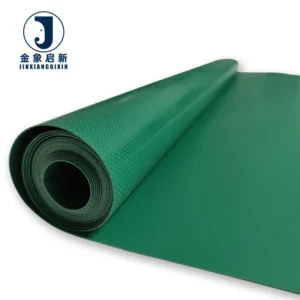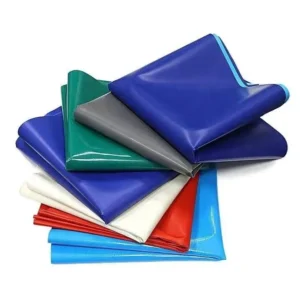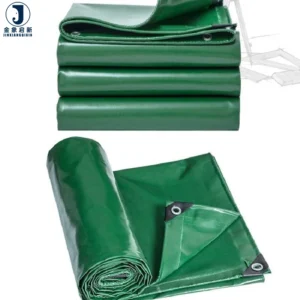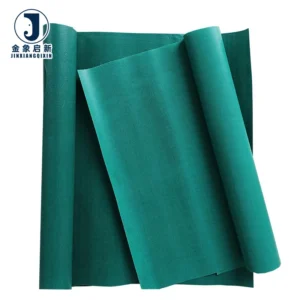
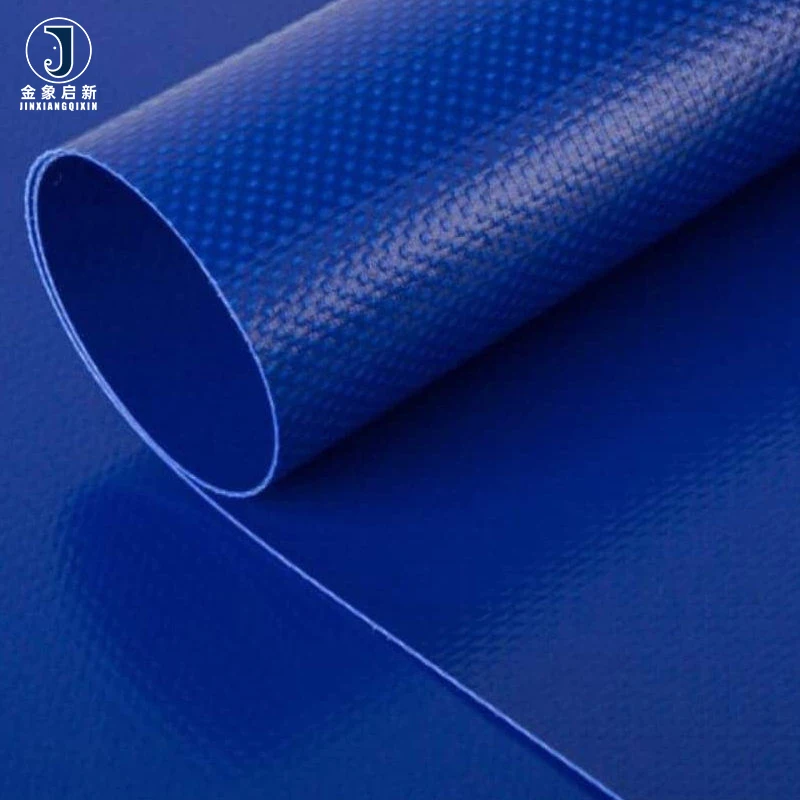
Coating Weight Precision — Process control over every GSM grade ensures the PVC coated tarpaulin roll you receive matches the material specification sheet, verified at every coating stage across three dedicated production lines.
Technical Specifications
| Parameter | Value |
|---|---|
| Product Type | PVC Coated Tarpaulin |
| Material Composition | Polyester Base Fabric + Double-Sided PVC Coating |
| Weight Range | 500gsm–1000gsm (available grades: 610gsm, 650gsm, 800gsm) |
| Coating Material | PVC |
| Surface Finish | Smooth, leather-like texture |
| Treatment Options | High frequency hot melt, Hot air welding, Sewing |
| Waterproof | Fully waterproof coated construction |
| Flame Retardant | Available in flame retardant grades — confirm the grade required for your market |
| Anti UV | Available with UV treatment — confirm the test basis required for your application |
| Additional Properties | Anti-mildew, Heavy metal free, Self-clean surface |
| Density | 1.15–2.00 g/cm³ (source value — verify against manufacturer catalog) |
| Tensile Strength | 50–80 MPa (source value — verify against manufacturer catalog) |
| Brittle Temperature | ≤ -50 to -60 °C (source value — verify against manufacturer catalog) |
| Softening Temperature | ≥ 80 °C (source value — verify against manufacturer catalog) |
| Melting Point | 212 °C (source value — verify against manufacturer catalog) |
| Edge Reinforcement | Reinforced edges on all four sides |
| Printing | Printable, customized branding available |
Application Suitability
| Application | Exposure & Requirement |
|---|---|
| Truck side curtain | Constant flexing at load points, road debris abrasion, continuous UV exposure, wind-driven rain ingress |
| Trailer top roof cover | Direct solar load, standing water after rainfall, thermal cycling between day and night |
| Pallet and equipment cover | Forklift contact abrasion, outdoor yard storage, dust and moisture exclusion |
| Outdoor event tent (blockout) | Crowd safety fire compliance requirements, rapid deployment and pack-down, full light exclusion |
| Awning fabric | Prolonged sun exposure, roller tension stress, colour fastness under solar load |
| Inflatable structure | Internal air pressure stress on seams, repeated inflation and deflation cycles |
| Construction temporary shelter | Site dust containment, wind uplift resistance, fire authority site compliance |
| Membrane and tension structure | Biaxial tension loading, architectural aesthetics, long-term weathering |
Why PVC Coated Tarpaulin GSM Coating Technology Determines More Than Just Weight
GSM tells you how much material is on the roll, but coating technology determines whether that material stays bonded to the base fabric under real field stress.
Technical buyers reviewing PVC coated tarpaulin roll specifications often focus on the stated weight and assume a higher GSM automatically means better field performance. The reality is that a poorly adhered coating on a heavy base fabric can delaminate at the weld line before the base fabric reaches its tensile limit. A lighter grade with controlled knife-coated adhesion can outperform a heavier one at every stress point. [NEED_CITE: coating adhesion test methods for PVC tarpaulin per ISO 2411]
The PVC coated tarpaulin gsm coating technology conversation needs to shift from weight alone to how coating weight interacts with base fabric denier, weave density, and the thermal behaviour of the PVC compound during fabrication.
How Double-Sided PVC Coating Affects Weld Behaviour
The base fabric sits at the core of every PVC coated tarpaulin roll, but it is the coating on each side that determines how the material responds to fabrication. During high-frequency hot melt or hot air welding, the PVC coating on each mating surface must reach its softening point simultaneously and fuse into a continuous bond. If the coating weight varies between the top and bottom surfaces, one side reaches flow temperature before the other, producing a weld that is weaker than the surrounding fabric. Consistent double-sided coating weight ensures the weld line performs as a single structural element rather than a failure point.
Coating Adhesion and the Relationship to Seam Failure
Coating adhesion is the force required to separate the PVC layer from the polyester base fabric. In a finished product — a truck side curtain, a tension structure panel, a welded duct — the load transfers from one fabric panel to the next entirely through the welded seam. If the adhesion between coating and base fabric is lower than the weld strength, the coating peels away from the base at the seam edge under load. [NEED_CITE: peel strength requirements for coated fabric seam integrity] The specification sheet for this PVC coated tarpaulin range documents the base fabric construction and coating method so fabricators can match their welding parameters to the material behaviour.
Reading the Specification Sheet Beyond the GSM Number
When technical buyers evaluate PVC coated tarpaulin roll stock, the GSM number is the starting point, not the selection criterion. The polyester base fabric denier and the warp and weft density determine the tensile and tear strength of the structural core. The coating weight and method determine surface properties — waterproofing integrity, UV stabiliser loading, and flame retardant compound distribution. A 650gsm roll built on a high-density base with controlled coating adhesion will deliver different field performance from a 650gsm roll built on a loose weave with heavy coating filler. The specification sheet for each grade in this range documents the base fabric parameters alongside the total weight, allowing buyers to compare material construction rather than GSM alone. [NEED_CITE: tensile and tear test methods for coated fabrics per ISO 1421] The brittle temperature and softening temperature parameters further define the thermal envelope within which the material can be fabricated and deployed.
The Hidden Cost of Specifying on Weight Alone
Fabricators who select PVC coated tarpaulin roll stock on GSM alone face consequences that only appear after fabrication and deployment. A roll that arrives below the stated weight means the coating layer is thinner than specified, reducing the UV stabiliser reserve and the flame retardant compound loading across the surface. Colour variation between rolls in the same order becomes visible only after panels are installed side by side on a truck curtain or awning frame. Welded seams that fail before the fabric itself are typically traced back to inconsistent coating weight affecting thermal behaviour during welding. [NEED_CITE: common failure modes in fabricated PVC tarpaulin products] Every one of these issues is avoidable when the material specification sheet documents coating weight, base fabric construction, and colour reference for traceability.
Why Source This PVC Coated Tarpaulin Range From Jinxiang
Deep process control over coating weight and adhesion comes from nearly thirty years focused exclusively on coated fabric production. Three full production lines with thirty-six sets of professional equipment support bulk roll output with consistent coating application across every production run. A ten-person R&D team handles material selection, custom GSM development, and sample preparation for new specifications. Dedicated QA and QC inspection at every coating stage means each roll is verified against the specification sheet before packing. Pre-shipment inspection covers weight verification, colour consistency, and coating surface quality across the full order.
Documentation & Verification
- Material specification sheet stating exact GSM, base fabric denier and weave, and coating type for every roll
- Test report for UV treatment and flame retardant grades supplied against the specific batch
- Pre-shipment inspection record documenting weight verification and surface quality check
- Colour reference card matched to each production batch for cross-roll consistency confirmation
- Roll packing list with individual roll identification for traceability from dispatch to deployment
- Certificate of origin and customs documentation prepared per destination market requirements
Fabrication, Handling & Storage
- High-frequency hot melt and hot air welding parameters must be matched to the specific GSM grade and coating compound
- Reinforced edges on all four sides provide secure anchor points for eyelet and tie-down hardware installation
- Store rolls upright on a flat surface to prevent permanent creasing in the PVC coating layer
- Allow cold-stored rolls to reach ambient temperature before unrolling to avoid coating crack at low flex
- Clean self-coat surface with mild detergent only — solvent-based cleaners can degrade the PVC coating finish
- Repair field damage by hot air welding a patch of matching GSM grade for structural continuity
Requesting a Quotation That Matches Your Specification
Provide the target GSM grade, the specific application and exposure conditions, and the required roll width so the material recommendation matches your fabrication process. If your market requires flame retardant or anti-UV compliance, specify the test standard or classification your end user requires so the correct treatment grade is quoted. Indicate whether you need roll stock only or finished panels with custom printing and edge reinforcement.
Frequently Asked Questions
Q: What is the relationship between GSM weight and tensile strength in this PVC coated tarpaulin range?
A: Tensile strength depends on the polyester base fabric denier and weave density as much as the total GSM. A higher GSM achieved by adding coating filler rather than increasing base fabric density will show higher weight but not proportionally higher tensile or tear performance. The specification sheet for each available grade documents both base fabric construction and total weight so buyers can evaluate material structure, not just the GSM number.
Q: Can flame retardant and anti-UV treatments be combined on the same roll?
A: Both treatments are available and can be specified together for a single roll. The specific flame retardant grade and UV test basis must be confirmed against your end-market requirements before production, as different classification systems require different compound formulations. Test reports for both treatments are supplied with the batch documentation when specified at the quotation stage.
Q: How does coating method affect weld and seam behaviour in fabrication?
A: The PVC coating method determines how the surface layer responds to thermal input during high-frequency or hot air welding. Consistent coating weight and compound formulation across both sides of the fabric ensures simultaneous melting and uniform bond formation. Variations in coating thickness or compound composition between the two surfaces produce asymmetric weld behaviour that can lead to premature seam separation under load.
Q: How is roll-to-roll colour consistency maintained across a multi-roll order?
A: Colour consistency is controlled through batch-level pigment matching and verified against the colour reference card documented in the material specification sheet. Each production batch carries its own colour reference so that rolls from the same order can be confirmed as matched before dispatch. Pre-shipment inspection includes a visual consistency check across all rolls in the order.
Q: What documentation accompanies each roll for verification on receipt?
A: Every roll ships with a material specification sheet stating the GSM, base fabric parameters, and coating type. Where flame retardant or anti-UV treatment is specified, a corresponding test report is included. A pre-shipment inspection record documents the weight and quality verification performed before packing, and a roll packing list provides individual roll identification for traceability.