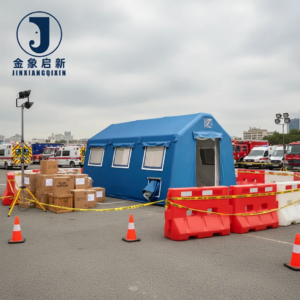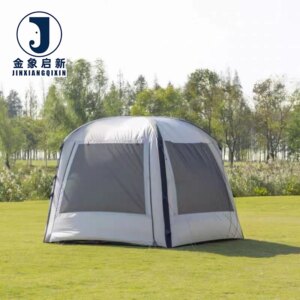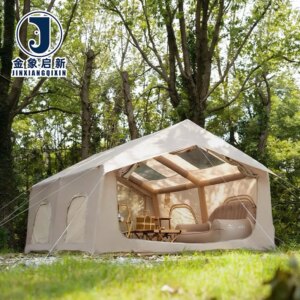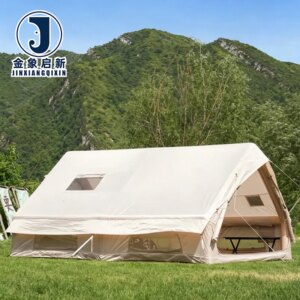
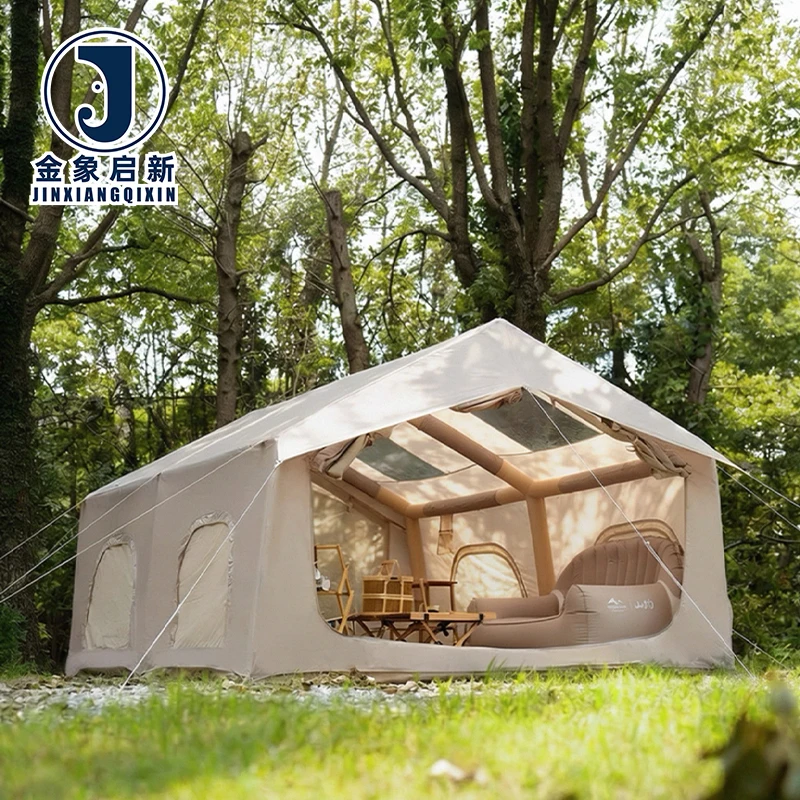
Coating Process Control — Every roll of PVC inflatable tent fabric produced here passes through three dedicated coating lines where base fabric tension, coating weight, and adhesion are monitored at every stage, ensuring that the material you receive matches the data sheet you approved.
Technical Specifications
| Parameter | Value |
|---|---|
| Product Type | Inflatable Tent |
| Core Material | PVC tarpaulin |
| Structure | Single layer inflatable with automatic opening mechanism |
| Waterproof | Yes — fully coated construction |
| UV-resistant | Available — test basis to confirm per grade |
| Tear-resistant | Yes — grade available on request |
| Flame Retardant | Available in flame retardant grades — confirm the grade required for your market |
| Anti-Static | Available — standard to confirm per application |
| Capacity | 1-12 Person |
| Customization | OEM & ODM, sample customization, pattern printing |
| Certifications | ISO 9001, ISO 14001, ISO 45001, CE |
Application Suitability
| Application | Exposure & Requirement |
|---|---|
| Construction site temporary shelters | Wind load, dust, rain, frequent inflation cycles, fire-retardant compliance for site approval |
| Emergency disaster relief deployment | Rapid inflation, harsh weather, ground abrasion, transport stress during repeated packing |
| Outdoor event management structures | UV exposure, crowd contact, repeated setup and teardown, visual appearance consistency |
| Remote industrial facility setup | Isolated location logistics, temperature extremes, limited repair capability on site |
| Equipment and material storage covers | Moisture ingress prevention, chemical exposure from stored goods, long-term inflation stability |
Why Material Data Sheets Matter More Than Quoted GSM for Inflatable Tent PVC Tarpaulin
A quoted GSM tells you weight, not performance — the base fabric denier, weave density, and coating adhesion strength together determine whether the inflatable structure holds under load.
Inflatable tent procurement often starts with a GSM figure on the quotation, but that number alone does not predict how the fabric will behave when inflated under wind load or flexed during repeated packing and deployment. Technical buyers who have dealt with coated fabric failures know that two rolls at the same GSM can perform very differently depending on how the coating was applied and what base fabric sits underneath [NEED_CITE: tensile and tear test methods for coated fabrics per ISO 1421]. This is why requesting a full material specification sheet — covering base fabric construction, coating method, and adhesion data — is the first step in evaluating any PVC inflatable tent fabric supplier.
Base Fabric Construction and Coating Method Define Structural Behaviour
The base fabric denier and weave pattern determine how load distributes across the inflatable tent membrane when internal air pressure pushes outward. A higher denier yarn in the warp direction resists the primary stress axis, while weft density controls tear propagation if the surface is punctured during site handling. The PVC coating method — whether knife coated, laminated, or calendered — directly influences peel strength between coating and base fabric, which in turn governs how well heat-welded seams hold under sustained inflation pressure. For Inflatable Tent PVC Tarpaulin manufacturer custom orders, specifying the coating method alongside GSM ensures that the structural performance matches the engineering requirement.
Flame Retardant and Anti-Static Chemistry for Site Compliance
Inflatable structures used on construction sites, at public events, or in mining environments often must meet specific fire safety classifications before they can be deployed. Flame retardant treatment for PVC tarpaulin involves additive chemistry that must be matched to the target market’s regulatory framework — what passes one jurisdiction’s test may not satisfy another [NEED_CITE: DIN 4102 fire classification for building materials]. Anti-static formulation is equally application-specific: environments with electrical equipment or flammable material storage require verified surface resistivity data, not just a label claim. Always request the test report that corresponds to the grade specified for your project.
Understanding GSM, Coating Weight, and Tensile Strength Relationships
GSM represents total fabric weight per square metre, combining both the polyester base fabric and the PVC coating layers. A heavier coating does not automatically mean higher tensile strength — if the base fabric has low denier or loose weave density, the added coating weight contributes mass without proportional structural gain. Knife coating typically achieves higher adhesion strength than lamination, which matters for inflatable tents where heat-welded seams carry continuous load. The relationship between coating weight and seam integrity is critical: under-inflation or over-inflation cycles concentrate stress at welded joints, and the coating-to-substrate bond must resist delamination through thousands of pressure cycles. Surface finish also plays a role — glossy finishes tend to shed dirt more effectively in outdoor event settings, while matte finishes may offer different heat-welding parameters that fabricators need to account for.
The Hidden Cost of Specifying Material Without Verification
Procurement teams that accept a supplier’s GSM claim without independent verification often discover discrepancies only after the inflatable tent is deployed in the field. Material that arrives lighter than specified may fail to hold inflation pressure under wind load, leading to structural sag or collapse during use. Flame retardant grades stated on paper but unsupported by test reports create compliance risk at site inspection — a failed fire marshal review can shut down an entire project. Batch-to-batch colour variation across rolls becomes visible when multiple inflatable units are positioned side by side at an event venue, forcing costly replacement or repainting [NEED_CITE: colour consistency standards for coated fabric batches]. Heat-welded seams that fail before the fabric itself indicates a coating adhesion problem that could have been caught with proper pre-shipment inspection documentation.
Why Technical Buyers Source Inflatable Tent PVC Tarpaulin Here
Three full production lines with dedicated coating equipment provide the capacity to fulfil bulk inflatable fabric orders without compromising process control at each stage. The 10-person R&D team develops custom material formulations and sample runs, allowing buyers to test specific coating weights and treatment combinations before committing to full production. Every roll undergoes inspection by dedicated QA and QC staff who verify GSM, coating adhesion, and visual consistency against the approved specification — not a random sampling approach. Pattern printing and OEM customisation are handled in-house, eliminating the coordination risk of outsourcing print work to a separate facility. Material specification sheets, test reports, and certification documentation are prepared per shipment, giving technical buyers the paper trail needed for engineering approval and regulatory submission.
Documentation & Verification
- Material specification sheet stating GSM, base fabric denier, weave density, and PVC coating method per roll
- Test report for UV resistance and flame retardant grades matching the specified performance level
- ISO 9001, ISO 14001, ISO 45001, and CE certificates accompanying each dispatch
- Pre-shipment inspection record with batch-specific quality verification data
- Roll packing list with individual roll identification for traceability
Fabrication, Handling & Storage
- Heat welding temperature and dwell time must match the PVC coating formulation — request our weld parameter guide for the specific coating method used on your order
- Store rolls horizontally on padded racks to prevent permanent creasing in the PVC coating layer
- Avoid dragging uncoated base fabric edges across abrasive surfaces during cutting and layout
- Inflate test units at ambient temperature before cold-weather deployment to check seam integrity
- Use only PVC-compatible cleaners — solvent-based products may degrade the coating surface finish
What to Include in Your Inflatable Fabric Inquiry
Provide the specific application environment and exposure conditions so we can recommend the appropriate coating weight and treatment package for your inflatable tent project. If your target market requires fire-retardant or anti-static certification, state the regulatory standard that applies so we can match the correct tested grade. Confirm whether you need roll stock for your own fabrication or finished inflatable units with OEM sizing, and indicate any colour or pattern printing requirements for sample development.
Frequently Asked Questions
Q: How do you verify GSM on arrival matches the quotation for inflatable tent fabric?
A: We provide a pre-shipment inspection record documenting measured GSM per roll against the stated specification. Buyers can perform independent verification using a calibrated scale and standard sample cutting method. Our material specification sheet lists the base fabric weight and coating weight separately, so you know exactly what contributes to the total GSM figure.
Q: What flame retardant grades are available for PVC inflatable tent material?
A: Flame retardant treatment is available in multiple grades depending on your market requirements. We provide the corresponding test report for the specified grade with each shipment. Confirm the fire safety classification your project or jurisdiction requires — such as DIN 4102, NFPA 701, or local building code standards — and we will match the formulation and documentation accordingly.
Q: What UV resistance test data do you provide for outdoor inflatable tent fabric?
A: UV-resistant treatment options are available and the test basis is documented per grade upon request. We supply test reports that indicate the exposure methodology used, allowing your engineering team to assess expected outdoor lifespan for the specific climate and installation conditions of your project site.
Q: How does PVC coating finish affect heat welding for inflatable tent fabrication?
A: Glossy and matte finish options respond differently to heat welding parameters. The coating formulation and surface texture influence the optimal temperature, pressure, and dwell time for seam formation. We provide weld parameter recommendations specific to the coating type on your order, and sample pieces are available for fabricators to run welding trials before full production.
Q: What is the sample development process for custom inflatable tent fabric specifications?
A: Our R&D team develops samples based on your specified coating weight, base fabric construction, colour, and treatment requirements. Samples are typically produced within days of specification confirmation. Once you approve the sample material, full production follows with in-process QA checks at each stage to ensure the delivered rolls match the approved sample properties.