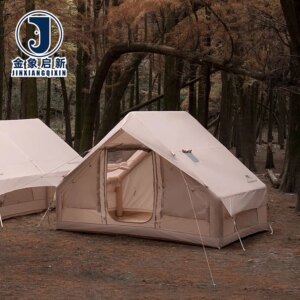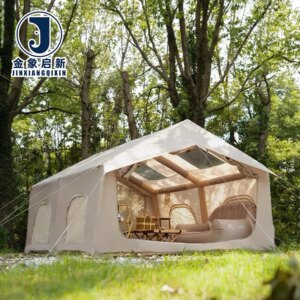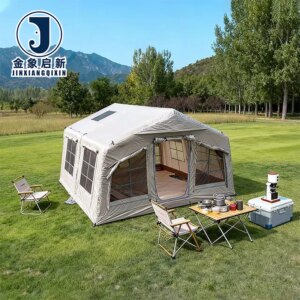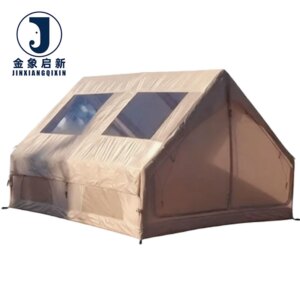
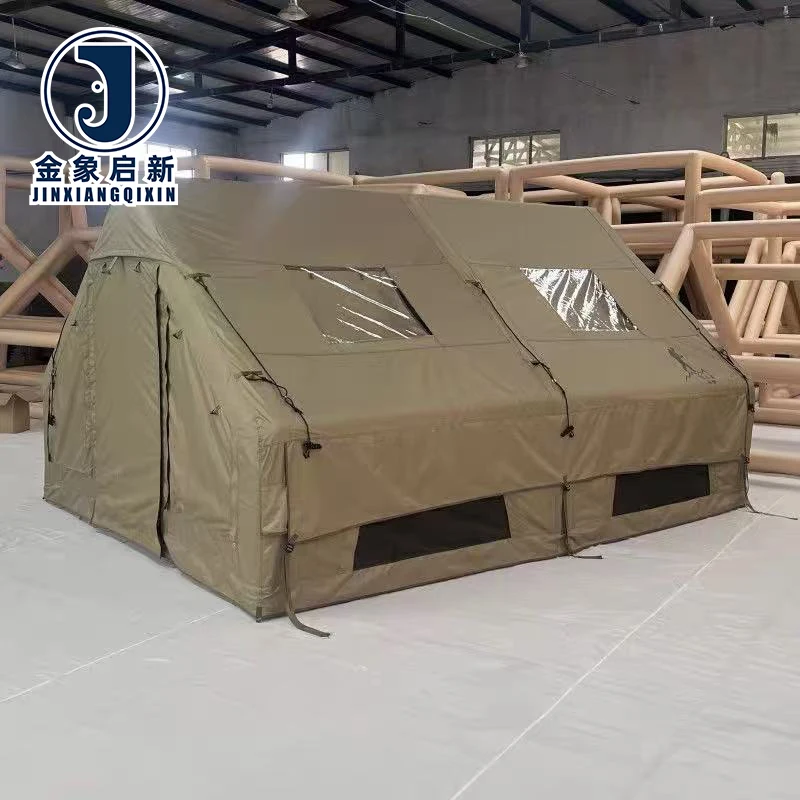
Deep Process Control Over Coating Adhesion — three full production lines and 36 sets of professional equipment maintain consistent PVC coating weight and airtight weld integrity across every inflatable shelter roll produced.
Technical Specifications
| Parameter | Value |
|---|---|
| Product Type | Inflatable Tent |
| Core Material | PVC Tarpaulin |
| Construction | Single-layer inflatable structure |
| Key Performance | Waterproof, UV-Resistant (test basis not stated), Tear-Resistant, Quick Automatic Opening |
| Flame Retardant Grade | Available in flame retardant grades — confirm the grade required for your market |
| Anti-Static | Available upon request — specify compliance standard for your application |
| Temperature Range | Four-season construction (specific range available on request) |
| Customization | OEM & ODM, sample customization, pattern printing |
| Production Facility | 9,180 m² with 3 full production lines |
| Processing Equipment | 36 sets of professional equipment |
| R&D Support | 10 technicians handling material selection and sample development |
| Quality Control | Full-process QA/QC with dedicated on-site staff |
| Certifications | ISO 9001, ISO 14001, ISO 45001, CE |
Application Suitability
| Application | Exposure & Requirement |
|---|---|
| Remote construction site temporary offices | Rapid inflation, wind load, prolonged solar exposure, dust ingress prevention |
| Disaster recovery equipment storage | Extended outdoor weathering, waterproof integrity, repeated deployment cycles |
| Mobile command centers for infrastructure maintenance | Variable climate operation, quick setup, reliable airtight chamber pressure |
| Temporary warehousing during logistics operations | Large-span coverage, UV exposure, abrasion from stored goods movement |
| Commercial emergency preparedness scenarios | Immediate deployment, structural stability under adverse weather, multi-use durability |
Why Airtight Weld Integrity Matters More Than Fabric Weight Alone
High-frequency welded seam performance determines whether an inflatable shelter holds pressure through its service life or fails at the joint first.
Procurement teams sourcing rapid-deploy shelters frequently specify PVC tarpaulin by weight alone, assuming heavier material guarantees structural reliability. In practice, airtight inflatable chambers place concentrated stress on every welded seam during inflation and under wind load. When the coating formulation or welding parameters are inconsistent, seams split before the fabric itself shows any sign of fatigue [NEED_CITE: tensile and tear test methods for coated fabrics per ISO 1421]. This failure pattern is especially common in single-layer inflatable tent structures where each seam carries the full internal pressure differential.
Coating Formulation and Airtight Chamber Performance
The PVC tarpaulin coating on this inflatable tent must bond completely with the base fabric to prevent micro-leakage at the molecular level. Coating adhesion directly affects how well the material holds air under continuous internal pressure. Poor adhesion between the PVC layer and the polyester base fabric leads to delamination at stress concentration points, particularly around welded seams where the material has been heated and reformed. Our coating process maintains uniform adhesion across the full roll width, ensuring that airtight performance does not degrade at the edges or along the length of the PVC tarpaulin inflatable tent material.
High-Frequency Welding for Structural Seam Integrity
High-frequency welding fuses the PVC coating layers together at the molecular level, creating a joint that can match or exceed the base fabric strength when executed correctly. The critical variables include welding temperature, pressure application time, and the alignment tolerance of the seam overlap. Our 36 sets of professional processing equipment include dedicated high-frequency welding stations monitored by QA staff who verify seam continuity during production. Each inflatable tent structure undergoes seam inspection at every weld point before assembly completion, catching defects that would otherwise surface as pressure loss in the field [NEED_CITE: high-frequency welding parameters for PVC coated fabrics].
Reading PVC Tarpaulin Specifications for Inflatable Applications
Single-layer inflatable construction demands that the PVC tarpaulin carry both the structural tensile load and the airtight sealing function simultaneously. The base fabric denier and weave density determine how the material resists tearing when punctured or subjected to point loads from tie-down points. Coating weight affects flexibility during folding and deployment — a heavier coating provides better waterproof integrity but increases stiffness, which can complicate packing and inflation behaviour. The balance between these properties defines whether an inflatable shelter deploys reliably in field conditions or requires excessive compressor pressure to reach full form. UV-resistant coating formulation — available in grades suitable for extended outdoor exposure — protects the PVC surface from solar degradation that causes chalking and embrittlement over prolonged use. Buyers should confirm the specific UV test standard required for their regional market and intended exposure duration.
The Hidden Cost of Weld Failure in Inflatable Structures
When a welded seam on an inflatable shelter fails during operation, the entire structure loses pressure and collapses. This is not a repairable defect in the field — the shelter becomes non-functional until it can be returned to a facility with high-frequency welding capability. The root cause often traces back to inconsistent welding temperature across the seam length or contamination of the weld zone during production [NEED_CITE: common failure modes in inflatable PVC structures]. Procurement specifications that focus solely on fabric weight without addressing weld testing protocols leave buyers exposed to this failure mode. Batch-specific quality inspection covering seam strength verification catches these defects before the inflatable tent leaves the production facility.
Why Procurement Teams Source Inflatable Tent Material Here
Deep process control over PVC coating adhesion ensures consistent airtight performance across every production run, verified through incoming material inspection on roll thickness and tensile strength before fabrication begins. A 10-technician R&D team handles custom sizing, pattern printing, and sample development for inflatable tent structures, with samples developed within days for evaluation. Dedicated QA/QC monitoring at every welding and assembly stage catches seam defects that would cause field pressure loss. The 9,180 m² facility with three full production lines supports bulk order volumes while maintaining pre-shipment inspection coverage on every unit. ISO 9001, ISO 14001, ISO 45001, and CE documentation accompanies each shipment for compliance validation in regulated industrial environments.
Documentation & Verification
- Material specification sheet stating PVC tarpaulin coating weight, base fabric type, and colour reference
- Batch-specific quality inspection report covering dimensional verification and seam strength test results
- UV and flame-retardant test reports provided where applicable grades are specified
- ISO 9001, ISO 14001, ISO 45001, and CE certification documentation included with shipment
- Pre-shipment 24-hour inflation test record verifying airtight structural integrity
- Certificate of origin and customs documentation for cross-border logistics support
Fabrication, Handling & Storage
- High-frequency welding parameters must match the specific PVC tarpaulin coating thickness for consistent seam adhesion
- Store rolled PVC tarpaulin material upright to prevent flat-spot deformation affecting inflation uniformity
- Avoid dragging single-layer inflatable structures across abrasive surfaces during deployment to protect coating integrity
- Clean PVC tarpaulin surfaces with mild detergent only — solvent-based cleaners degrade the coating bond layer
- Pre-shipment inflation testing under controlled conditions confirms airtight weld performance before field dispatch
- Pattern printing on inflatable tent panels requires surface preparation to ensure ink adhesion to PVC coating
What We Need to Specify Your Inflatable Tent Material
To recommend the correct PVC tarpaulin grade and construction for your inflatable shelter application, provide the intended deployment environment, expected exposure duration, and any regional compliance standards for fire classification or UV performance. Specify whether you require roll stock for your own fabrication or fully assembled inflatable tent units with welding and inflation testing completed. Include target dimensions, colour requirements, and whether pattern printing or branding is needed on the exterior surface.
Frequently Asked Questions
Q: How is airtight seam strength verified on inflatable tent structures during production?
A: Each high-frequency welded seam undergoes visual and mechanical inspection during assembly. A 24-hour inflation test under controlled conditions verifies that all welded joints maintain airtight integrity without pressure loss. Batch-specific inspection records documenting seam strength test results accompany every shipment for your quality records.
Q: What coating thickness and base fabric specification support repeated inflation and deflation cycles?
A: The PVC tarpaulin coating must maintain sufficient flexibility to withstand folding and re-inflation without cracking at the weld lines. Base fabric denier and weave density determine how the material handles the cyclic stress of pressurisation. Specify your expected deployment frequency so we can recommend the appropriate material grade for your use pattern.
Q: What UV-resistance test basis applies to this inflatable tent material for extended outdoor use?
A: UV-resistant coating formulation is available in grades matched to different exposure durations and regional solar intensity conditions. The specific test standard and exposure classification should be confirmed based on your target market requirements. Request the applicable UV test report when specifying material for prolonged outdoor deployment.
Q: How should I evaluate PVC tarpaulin GSM and coating weight for inflatable chamber pressure requirements?
A: Coating weight affects airtight sealing performance while base fabric weight determines structural tensile capacity. Both values must be assessed together rather than relying on total GSM alone. Provide your operating pressure specifications so we can recommend the correct balance of coating and base fabric for your inflatable shelter design.
Q: What documentation accompanies each shipment for material traceability and compliance validation?
A: Every shipment includes a material specification sheet, batch-specific quality inspection report, pre-shipment inflation test record, and relevant ISO or CE certification documents. Flame-retardant and UV test reports are provided where applicable grades have been specified. Certificate of origin and customs support documentation is available for international orders.