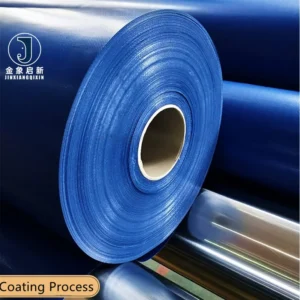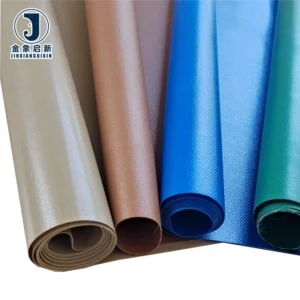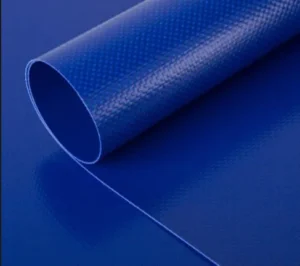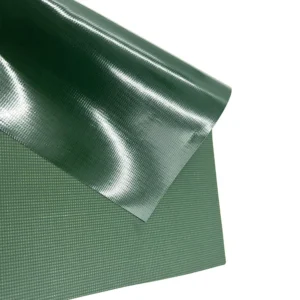
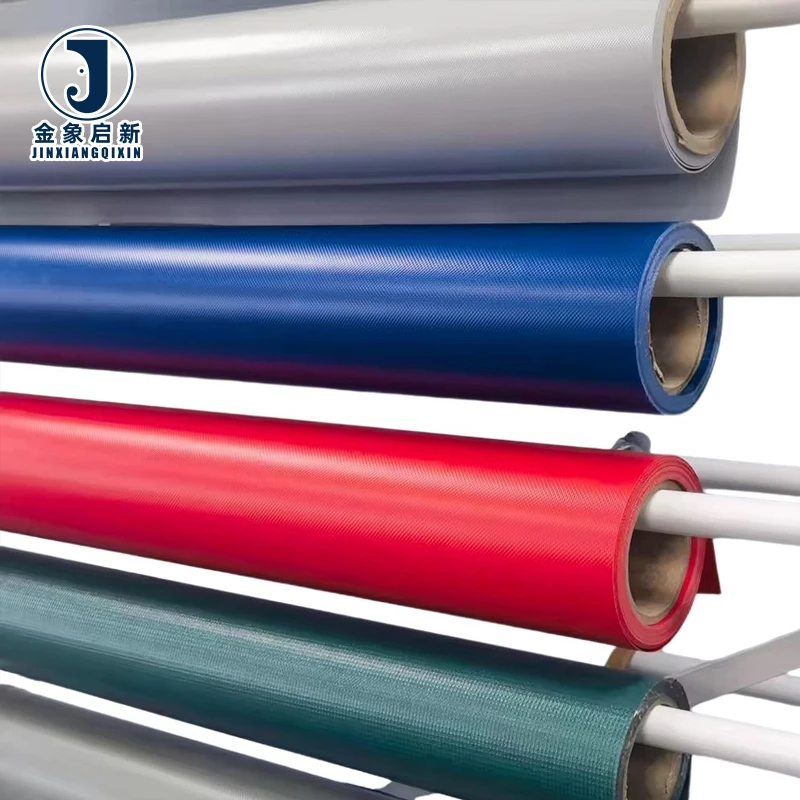
Deep Coating Control — Nearly 30 years of PVC formulation experience ensures the 1000D base fabric receives consistent coating weight and adhesion across every roll produced.
Technical Specifications
| Parameter | Value |
|---|---|
| Product Type | PVC Coated Tarpaulin Roll |
| Base Fabric Denier | 1000D |
| Coating Material | PVC |
| Blackout Property | Full blackout construction |
| Flame Retardant | Treatment applied (grade not stated in source — confirm required grade for your market) |
| UV Treatment | Anti-UV treatment applied (test basis not stated in source) |
| Antibacterial & Mildew Proof | Yes |
| Oil and Stain Resistance | Yes |
| Acid and Alkali Resistance | Yes |
| Temperature Resistance | High temperature and cold resistance |
| Anti-Oxidation | Yes |
| Flexibility | Highly flexible, crack resistant |
| Surface | Self-cleaning |
| Welding Options | HF, Hot Air, Sewing |
| Certifications | ISO, CE |
Application Suitability
| Application | Exposure & Requirement |
|---|---|
| Tensile and architectural membrane structures | Constant tensile load, UV exposure, wind-driven rain, structural weld integrity |
| Stadium and airport hangar canopies | Large-format panels, long-term weather cycles, fire code compliance, self-cleaning surface |
| Event and exhibition shade tents | Blackout performance for interior light control, repeated assembly and teardown flex |
| Portable storage structures | Wind load, abrasion at contact points, temperature fluctuation |
| Shade systems and shadings | Direct solar exposure, colour consistency across installed panels |
Why a Blackout 1000D PVC Coated Tarpaulin Roll Demands More Than a Spec Sheet
A blackout roll that leaks light at the seams defeats the purpose of the entire structure.
When fabricators order 1000D PVC coated tarpaulin roll for exhibition tents or stadium canopies, the focus often lands on base fabric denier and coating weight. Yet blackout performance depends equally on coating uniformity and weld behaviour. I have seen heavy-grade coated rolls pass every tensile test but fail the light-leak check because the coating thickness varied near the selvedge. For tensile structures where panels join under tension, a seam that transmits light also signals a potential weak line under load. [NEED_CITE: coating uniformity and light transmission testing methods for blackout PVC fabrics]
How 1000D Base Fabric Supports Structural Membrane Loads
The 1000D denier indicates the yarn mass per unit length in the base fabric, directly influencing how the substrate distributes tensile and tear forces. In tensile structures, the fabric carries biaxial stress — tension running both warp and weft simultaneously. A higher-denier yarn provides a stronger skeleton for the PVC coating to bond to, reducing the risk of coating delamination under sustained load. This 1000D PVC coated tarpaulin roll pairs that substrate strength with full blackout construction, so the material serves both structural and light-control functions in a single layer.
Coating Formulation and the Truth Behind Treatment Claims
The PVC coating on this roll carries anti-UV and flame retardant treatments, but the specific grade and test basis are not stated in the available documentation. [NEED_CITE: DIN 4102 fire classification for building materials and textile membranes] This matters because a stadium canopy in Europe may require B1 per DIN 4102, while a project in North America may reference NFPA 701. Before committing to a production run, request the test report that matches your local building code. The same discipline applies to anti-UV treatment — confirm the accelerated weathering test standard and the exposure hours tested, rather than accepting a general claim.
What Denier, Coating Weight and Weld Method Mean Together
Base fabric denier alone does not determine how a coated fabric performs in the field. The 1000D substrate provides the tensile skeleton, but the PVC coating weight and the bond between coating and yarn govern tear propagation resistance and weld strength. When panels are joined by high-frequency welding, the coating must melt uniformly to create a homogeneous seam — if the coating formulation is inconsistent, the weld line becomes the failure point before the fabric itself reaches its tear limit. Hot air welding offers more control for thicker coatings, while sewing remains suitable for applications where mechanical fastening is preferred or where seams are subsequently sealed. The self-cleaning surface reduces particulate adhesion, which helps maintain the fabric’s appearance over extended outdoor exposure without frequent washing.
The Hidden Cost of Specifying on Denier Alone
A fabricator once sourced what appeared to be an equivalent 1000D roll for a shade structure project, only to discover that the coating adhesion was lower than expected. During installation, the membrane was tensioned to design stress, and within months the coating began separating from the base fabric at high-stress points near the clamping edges. The denier was correct, but the coating bond strength — a property not visible on a simple spec sheet — was insufficient for the application. This is why material specification sheets stating GSM, base fabric denier, coating method and adhesion values matter before production begins, not after delivery. [NEED_CITE: tensile and tear test methods for coated fabrics per ISO 1421]
Why Fabricators Source This Material Here
The 10-person R&D team handles coating formulation review and can develop samples that match your project’s specific fire-rating and UV-resistance requirements before you commit to a full production run. Three full production lines with 36 sets of professional equipment mean that large-volume orders for tensile structure panels maintain batch-to-batch consistency. Dedicated QA/QC runs at every production stage, with 100% pre-shipment inspection verifying coating weight, colour uniformity and blackout integrity roll by roll. Custom widths and lengths are available for projects that need to minimise panel joins, reducing both material waste and on-site welding time. Sample development runs within days, allowing you to test weld parameters and light-leak performance before bulk production.
Documentation & Verification
- Material specification sheet stating GSM, 1000D base fabric denier, coating method and coating weight per roll
- Test reports for anti-UV performance and flame retardant grade applicable to the destination market
- Pre-shipment inspection record confirming coating adhesion and blackout integrity per roll
- Roll packing list with batch reference for colour and weight traceability
- ISO and CE certificates supporting the production quality management system
- Certificate of origin and customs documentation for international shipment
Fabrication, Handling & Storage
- HF welding parameters should be tested on sample strips of this 1000D roll before full-panel joining to confirm seam peel strength
- Hot air welding temperature and speed must match the PVC coating formulation to avoid scorching or incomplete bonding
- Store rolls upright on a flat surface to prevent edge compression marks that may show through on tensioned membrane panels
- Avoid unrolling in sub-zero conditions; allow the highly flexible PVC coating to acclimatise before handling to prevent surface stress
- Use only PVC-compatible cleaners on the self-cleaning surface to preserve the coating’s anti-UV and mildew-proof treatment
- When cutting panels from the roll, plan the nesting layout to maximise yield from the available width and minimise off-cut waste
What to Include in Your Enquiry
To ensure the 1000D PVC coated tarpaulin roll matches your project, specify the tensile load direction, panel dimensions and the fire-rating standard required by your local building authority. Indicate whether you need rolls in standard width or a custom width to reduce seam count, and confirm whether blackout performance must be verified by a specific light-transmission test. If colour matching across batches is critical for visible architectural panels, request a sample roll for approval before the production run begins.
Frequently Asked Questions
Q: How is 1000D denier verified and what does it mean for tensile strength?
A: Denier refers to the mass in grams of 9,000 metres of yarn. A 1000D yarn in the base fabric provides a high-strength substrate that, once coated with PVC, delivers substantial tensile and tear resistance. Verification involves weighing a measured length of base yarn. Request the base fabric specification sheet to confirm denier and weave density before ordering.
Q: Which flame retardant test standard applies to tensile membrane structures in my market?
A: Common standards include B1 per DIN 4102 in Europe, NFPA 701 in North America and M2 in France. The applicable grade depends on your local building code and the structure’s occupancy classification. Request the specific test report from our R&D team that corresponds to your project’s regulatory requirement before committing to a production run.
Q: What test basis supports the anti-UV treatment claim on this roll?
A: Anti-UV treatment is applied during coating, but the accelerated weathering test standard and exposure duration should be confirmed for your specific application. Request the UV test report detailing the method used, such as xenon arc or QUV testing. Our R&D team can advise on the formulation options that match your project’s expected outdoor exposure conditions.
Q: HF versus hot air welding — which method suits 1000D PVC coated tarpaulin seams?
A: High-frequency welding creates fast, homogeneous seams ideal for straight panel joins in tensile structures. Hot air welding offers more control for curved seams and field repairs on thicker coatings. Sewing with sealed stitch lines is used where mechanical fastening is preferred. Test weld samples from the roll to confirm peel strength before selecting the production method.
Q: How is batch colour consistency controlled across multiple rolls for large-format panels?
A: Colour consistency is maintained through controlled PVC coating formulation and in-process QA checks at every production stage. The pre-shipment inspection includes visual comparison across rolls in the same batch. For projects where panels are installed side by side, request a sample from the production batch for approval before the full order is dispatched.