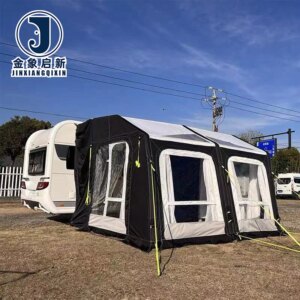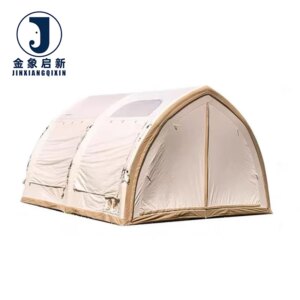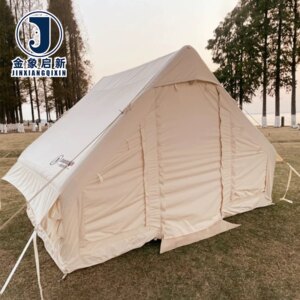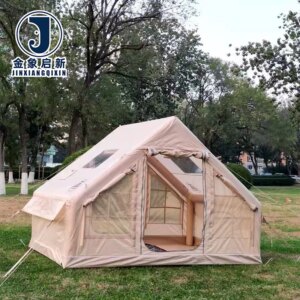
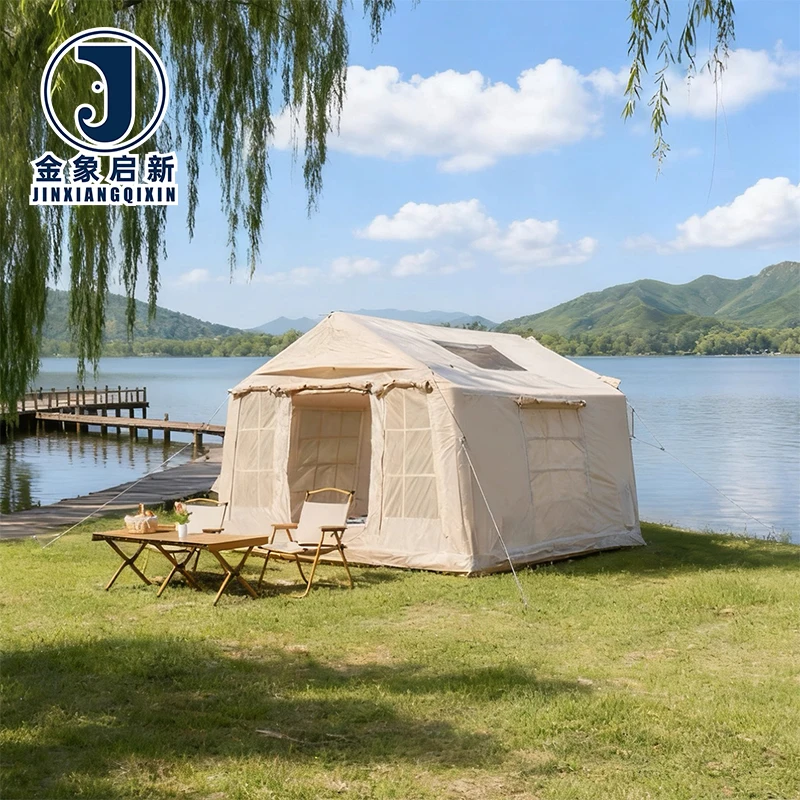
Coating Weight Control — Every roll of PVC tarpaulin for inflatable tent production passes dedicated QA inspection at each coating stage to ensure adhesion and weight consistency before leaving the facility.
Technical Specifications
| Parameter | Value |
|---|---|
| Product Type | Inflatable Tent |
| Core Material | PVC tarpaulin |
| Construction | Single layer |
| Capacity | 6-8 Person |
| Opening Mechanism | Quick automatic opening |
| Season Rating | Four-season |
| Waterproof | Yes |
| UV-resistant | Available in UV-resistant grades — confirm the standard required for your market |
| Tear-resistant | Yes |
| Flame Retardant | Available in flame retardant grades — confirm the grade required for your market |
| Anti-Static | Available in anti-static grades — confirm the standard required for your market |
| Customization | OEM & ODM, sample customization, pattern printing, material thickness adjustment, custom color matching |
| Production Facility | 9180 square meters |
| Production Lines | 3 full production lines |
| Processing Equipment | 36 sets of professional processing equipment |
| R&D Team | 10 technicians |
| Quality Control | Full-process QA & QC with 100% pre-shipment inspection |
| Standards | ISO9001, ISO14001, ISO45001, CE |
Application Suitability
| Application | Exposure & Requirement |
|---|---|
| Commercial outdoor equipment manufacturing | Repeated inflation cycles, internal air pressure stress, welded seam integrity under flex |
| Wholesale camping gear distribution | Roll-to-roll colour and weight consistency across container-volume orders for uniform retail inventory |
| Specialized four-season camping lines | Low-temperature flexibility, sustained UV exposure, moisture ingress prevention at seam and valve points |
| Industrial outdoor gear production | Compliance documentation for regulated markets, batch traceability, fire-retardant grade verification |
What "Certified" Inflatable Tent Fabric Means When No Test Report Follows the Claim
A material certificate without a traceable test standard leaves the manufacturer carrying the compliance risk, not the supplier.
When sourcing PVC-based inflatable tent fabric for commercial product lines, technical buyers frequently encounter quotations that state "UV-resistant" or "flame retardant" without referencing the underlying test method or classification. This gap surfaces later — at customs, during retailer compliance audits, or when a field failure triggers a product recall. The inflatable tent aftermarket supplier you select must be able to produce a test report that names the standard, the laboratory, and the batch tested [NEED_CITE: flame retardant classification standards for textile and coated fabric products]. Without that documentation, the performance claim is marketing language, not an engineering specification.
How PVC Coating Integrity Determines Air Retention in Inflatable Structures
Inflatable tent frames depend entirely on the airtightness of the coated fabric and the strength of welded seams. The PVC tarpaulin used in this application must maintain coating adhesion across the full surface area, because any delamination creates a micro-leak path that compromises inflation pressure. The single-layer construction requires the coating to perform as both the structural gas barrier and the environmental shield. Our 3-line production setup allows coating weight to be monitored and adjusted continuously, ensuring the inflatable tent fabric meets the porosity threshold required for sustained air-holding performance.
Weld Behaviour at Frame Flex Points Under Repeated Inflation Cycles
The joints where inflatable tube sections meet experience the highest cyclic stress during deployment and collapse. A weld that fails before the base fabric does indicates a mismatch between heat input, dwell time, and coating formulation. This Inflatable tent material is produced with controlled coating adhesion so that thermal welding parameters can be dialled in precisely by the fabricator. When the PVC layer bonds uniformly to the polyester base fabric, the welded seam carries load comparable to the parent material — reducing the likelihood of joint failure at the bend radius of inflatable arches [NEED_CITE: tensile and tear test methods for coated fabrics per ISO 1421].
Reading the Specification Sheet Beyond the GSM Figure
A single GSM number tells you the combined weight of base fabric and coating, but it does not reveal how that weight is distributed. Two rolls rated at the same GSM can have very different tear behaviour depending on whether the coating is applied heavily on one side or balanced across both. The denier of the base yarn and the warp-weft density determine how a tear propagates once initiated — a tight weave arrests tear spread, while a loose weave allows it to run. For inflatable tent structures, where puncture from ground contact or sharp equipment is a real-world risk, tear resistance is as critical as tensile strength. Surface finish — whether glossy or matte — also affects how the fabric interacts with printing inks for branding and how it sheds dirt during extended field use.
The Hidden Cost of Specifying Inflatable Tent Fabric on Price per Kilogram Alone
When procurement teams reduce fabric selection to cost per kilogram, they often discover the trade-off downstream. A lighter coating applied to cut material cost can result in pinhole leaks that only appear after the inflatable frame is pressurised. Colour variation between rolls in the same shipment forces the manufacturer to sort and match panels before cutting, adding labour and waste to the production floor [NEED_CITE: colour consistency standards for coated fabric batches]. A flame-retardant claim that lacks a grade may pass the initial sample review but fail the compliance check at the destination port, leaving an entire container of finished product blocked from sale. These costs compound — they are never visible on the original quotation.
Why Technical Buyers Source Inflatable Tent Fabric Through This Facility
Deep process control over PVC coating weight and adhesion is maintained across three full production lines, giving each roll a consistent foundation for welding and fabrication. The 10-person R&D team develops custom samples — including thickness adjustments, colour matching, and pattern printing — within days rather than weeks. Dedicated QA and QC personnel inspect every production stage, with 100% pre-shipment verification catching weight deviation and surface defects before the roll is packed. With 36 sets of professional processing equipment, batch capacity supports container-volume orders without extending lead times beyond what commercial production schedules require.
Documentation & Verification
- Material specification sheet stating GSM, base fabric denier, coating weight, and colour reference for each roll
- Test reports for UV-resistant and flame-retardant grades, available on request before order confirmation
- ISO9001, ISO14001, ISO45001, and CE certificates traceable by purchase order
- Pre-shipment inspection record covering weight verification, surface quality, and colour consistency
- Certificate of origin and customs documentation included for international shipment
- Roll packing list detailing quantity, dimensions, and batch number per container load
Fabrication, Handling & Storage
- Set heat-welding temperature and dwell time to match the PVC coating thickness for airtight inflatable tube seams
- Store rolls vertically on pallets to prevent flat-spot creasing that transfers to the cut panels
- Allow cold-stored rolls to acclimatise to workshop temperature before unrolling to avoid coating micro-cracking
- Use PVC-compatible solvent cleaners on glossy or matte surfaces to maintain coating integrity during post-production cleaning
- Plan cutting layouts to minimise offcut waste, accounting for the usable roll width and seam allowance
- Repair field punctures with PVC patch material matched to the original coating formulation for bond compatibility
What We Need to Prepare Your Inflatable Tent Fabric Quotation
Provide the target GSM or coating weight range, required roll width, and annual volume so we can align production scheduling and batch consistency. Specify the fire-retardant grade or UV-resistance standard mandated by your destination market, along with any colour references or pattern printing requirements. Confirm whether you need raw rolls for in-house fabrication or sample development before committing to a bulk order.
Frequently Asked Questions
Q: What GSM and base fabric denier options are available for inflatable tent fabric?
A: We produce PVC tarpaulin in multiple weight grades suited to inflatable tent structures. The appropriate GSM depends on your target inflation pressure, frame diameter, and end-use environment. Share your application parameters and we will recommend a specification with documented base fabric denier and coating weight, supported by a material data sheet for your review.
Q: Can fire-retardant or anti-static certification be provided with each shipment?
A: Yes. We supply inflatable tent fabric in flame-retardant and anti-static grades with test reports referencing the applicable standard. Confirm the classification your market requires — such as a specific building material fire class — and we will include the corresponding documentation with every dispatch for compliance verification.
Q: How is colour consistency maintained across rolls in the same order?
A: Every production run passes through 100% pre-shipment inspection where colour is verified against the approved reference. Our QA team checks roll-to-roll consistency before packing, ensuring panels cut from different rolls within the same container order match visually once assembled into finished inflatable tent products.
Q: What is the sample development timeline for custom thickness, colour, or print requirements?
A: Our 10-person R&D team typically develops custom samples within days, covering thickness adjustments, Pantone-matched colours, and pattern printing. This allows you to validate material behaviour, weld parameters, and visual appearance on your production line before authorising a full-batch order.
Q: What documentation is included for customs clearance and compliance verification?
A: Each shipment includes a certificate of origin, roll packing list, material specification sheet, and pre-shipment inspection record. ISO and CE certificates are provided and traceable to your order number, supporting customs clearance and retailer compliance audits at the destination market.