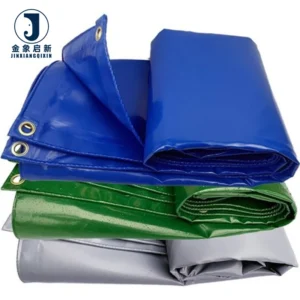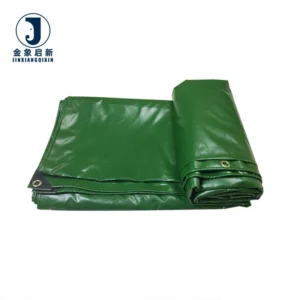
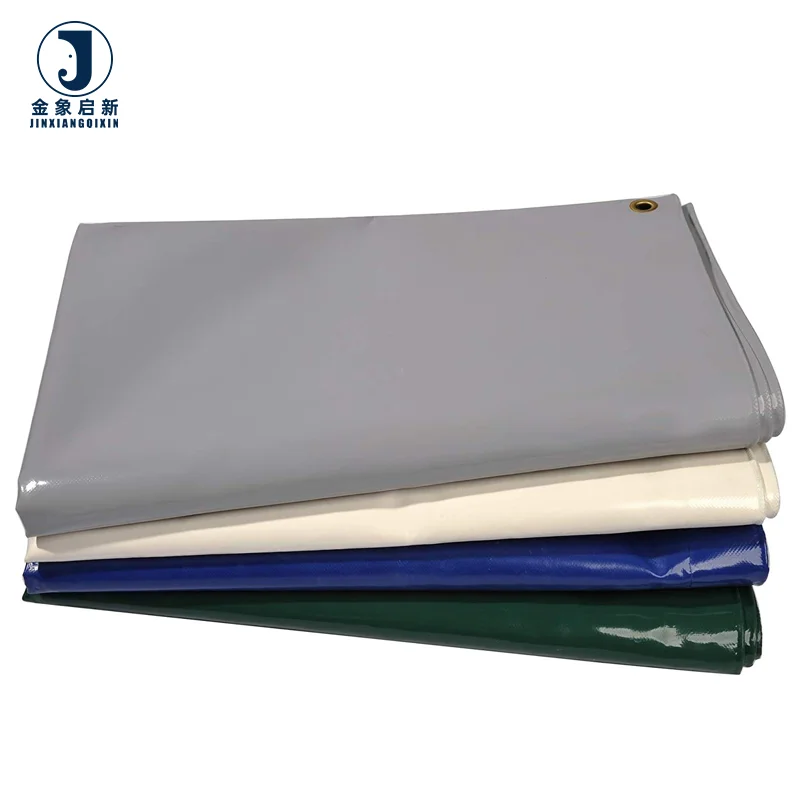
Deep Process Control — coating weight and adhesion are monitored at every production stage to ensure the stated GSM on the material specification sheet matches what arrives on your dock.
Technical Specifications
| Parameter | Value |
|---|---|
| Product Type | PVC Coated Tarpaulin |
| Material | PVC coated polyester |
| Weight Range | 350 / 400 / 420 / 500 / 600 / 650 / 750 / 900 GSM |
| Base Fabric Denier | 500D×840D / 500D×1000D / 1000D×1000D / 1000D×1300D / 1300D×1300D / 1000D×2000D |
| Mesh Count | 30×19 / 20×20 / 30×15 (varies by grade) |
| Total Thickness | 0.29 mm to 0.65 mm (varies by grade) |
| Tensile Strength (Warp) | 1650 N to 3900 N (varies by grade, test basis not stated) |
| Tensile Strength (Weft) | 1600 N to 3500 N (varies by grade, test basis not stated) |
| Flame Retardant Grade | Available in flame retardant grades — confirm the grade required for your market |
| UV Treatment | Anti-UV treatment available — confirm test basis for your specification |
| Waterproof | Water resistant / waterproof coated construction |
| Brittle Temperature | ≤ -50 to -60 °C |
| Softening Temperature | ≥ 80 °C |
| Melting Point | 212 °C |
| Edge Construction | Heat-sealed seamless edge wrapping, 5 mm rope, 3 cm aluminum alloy eyelets, reinforced corners |
| Certifications | ISO, CE |
Application Suitability
| Application | Exposure & Requirement |
|---|---|
| Truck and trailer side curtains | Constant flexing at load points, road spray, abrasion against cargo, UV exposure on highway routes |
| Tent and awning structures | Sustained UV and rain exposure, wind loading on seams, flame retardant compliance for public venues |
| Machine and equipment covers | Outdoor weathering, dust and moisture ingress protection, repeated removal and refitting |
| Pergola and canopy rain covers | Permanent outdoor mounting, UV degradation risk, thermal expansion at fixing points |
| Groundsheet and pond liners | Continuous water contact, soil chemistry, puncture from substrate irregularities |
| Construction stockpile covers | Wind uplift on large surface areas, site debris abrasion, flame retardant site requirements |
Why the PVC Coated Tarpaulin GSM Specification Alone Does Not Predict Field Performance
GSM tells you the weight per square metre, not how the load is distributed between base fabric and coating.
A heavier PVC coated fabric can still underperform if the coating accounts for most of the weight while the base fabric denier remains low. Technical buyers specifying PVC coated tarpaulin tensile strength for load-bearing covers often discover that a 650 GSM roll with a 1000D×1000D base outperforms a 750 GSM roll built on a 500D×840D weave. The coating adds mass but not structural integrity. Without reviewing both denier and mesh count alongside the GSM figure, material selection becomes a guess. [NEED_CITE: tensile and tear test methods for coated fabrics per ISO 1421]
Base Fabric Denier and Weave Density as the Real Strength Indicators
The base fabric in this PVC coated tarpaulin range spans from 500D×840D to 1000D×2000D constructions. Higher denier yarns in both warp and weft directions provide the tensile backbone that carries load when the fabric is tensioned across a trailer frame or tent ridge. Mesh count — the number of yarns per unit length in each direction — determines how evenly that load distributes. A 30×19 weave spreads force across more intersection points than a 20×20, reducing the chance of a single yarn failure propagating into a tear.
Coating Weight Verification Against the Quoted GSM
The PVC double-side coating on polyester base fabric creates a smooth, leather-like surface distinctly different from PE woven textures. Coating thickness ranges from 0.29 mm at the lighter grades to 0.65 mm at the 900 GSM grade. The coating provides waterproofing, UV shielding, and the surface that accepts heat-welded seams. What matters for PVC coated fabric tensile strength is that the coating weight is controlled independently of the base fabric — a process that requires dedicated QA at each production stage rather than relying on a single end-weight check. [NEED_CITE: DIN 4102 fire classification for building materials]
Thickness-to-GSM Mapping for Specification Cross-Checking
When the stated GSM and the measured thickness do not align with published values for a given denier, the discrepancy usually points to inconsistent coating weight across the roll. The mapping from 0.29 mm at 400 GSM through 0.44 mm at 600 GSM to 0.65 mm at 900 GSM provides a cross-check mechanism. Buyers who sample both weight and thickness on arrival can identify rolls where coating adhesion or distribution may not meet specification before fabrication begins.
What Happens When the Specification Does Not Match the Application
Selecting a lighter GSM grade for a truck side curtain that flexes thousands of times per journey leads to premature failure at welded seams — the point where the load concentrates most. Specifying a fabric without confirming the flame retardant grade for a tent destined for a market that requires NFPA 701 or DIN 4102 compliance can mean rejection at the installation site. [NEED_CITE: flame retardant testing standards for temporary structures] Colour variation between rolls in the same order becomes visible once panels are installed side by side on a large awning or canopy, forcing partial rework.
Why Technical Buyers Source This PVC Coated Fabric Here
Three full production lines and 36 sets of professional equipment support consistent coating weight control across bulk roll orders. The 10-person R&D team handles material selection, custom sizing, and sample development, allowing you to confirm denier and GSM suitability before committing to production volume. Dedicated QA/QC runs at every production stage with full inspection before dispatch, rather than spot-checking finished rolls. Custom width, colour, and pattern printing are available with sample approval, reducing the risk of batch mismatch on large orders. Material specification sheets ship with every order, stating exact GSM, base fabric denier, mesh count, and coating weight per roll.
Documentation & Verification
- Material specification sheet stating exact GSM, base fabric denier, and mesh count per roll
- Test report for UV resistance and flame retardant grades with applicable standard referenced
- Pre-shipment inspection record with roll-by-roll GSM and thickness verification
- ISO and CE certificates with production scope covering PVC coated polyester fabric
- Certificate of origin and customs documentation for international roll shipments
- Roll packing list with batch traceability across the full order
Fabrication, Handling & Storage
- Heat-weld seams using temperature and speed settings matched to the specific GSM grade and coating thickness
- Reinforce aluminum alloy eyelet corners with additional PVC patches on grades below 500 GSM for high-tension tie-down points
- Store rolls horizontally on pallets to prevent permanent creasing across the coated surface
- Allow cold-stored rolls to reach ambient temperature before unrolling to avoid coating micro-cracking
- Use PVC-compatible cleaners only — solvents may degrade the coating adhesion on the polyester base
- Plan cutting layouts to minimise waste, particularly on custom-width rolls where offcuts cannot be rejoined
Request a Specification Match for Your Application
Provide the intended application, expected mechanical loading, and environmental exposure conditions so the correct denier and GSM grade can be recommended. If your market requires a specific flame retardant classification or anti-UV test standard, state the applicable norm with your inquiry. Indicate whether you need roll stock in standard or custom widths, and whether finished cut sizes with edge finishing and eyelets are required.
Frequently Asked Questions
Q: How can I verify GSM and coating weight when the rolls arrive?
A: Cut a measured sample from each roll, weigh it on a calibrated scale, and compare the result against the material specification sheet shipped with your order. Thickness can be cross-checked with a micrometer against the published GSM-to-thickness mapping. Pre-shipment inspection records document these values before dispatch.
Q: Which flame retardant grades are available and what standards apply?
A: Flame retardant grades are available for this PVC coated fabric range — confirm the specific grade required for your target market, such as M2, B1 per DIN 4102, or NFPA 701. Request the applicable test report with your inquiry so the correct grade is matched to your compliance requirements before production.
Q: How is anti-UV treatment confirmed for long-term outdoor exposure?
A: Anti-UV treatment is available across the PVC coated tarpaulin range. Request the test basis and expected performance data for your specific climate zone and exposure duration. The treatment type and concentration vary by grade, so confirming your installation environment helps select the correct formulation.
Q: Should I hot-air weld or sew seams on this PVC coated polyester fabric?
A: Hot-air welding produces a bonded seam that matches the fabric strength and maintains waterproofing, making it preferable for truck curtains and tensioned structures. Sewing creates needle holes that compromise the coating barrier. On lighter GSM grades, welded seam parameters must be adjusted to avoid burning through the thinner coating layer.
Q: How do I choose the right base fabric denier for my tensile requirements?
A: Match the denier to the mechanical load: 500D×840D suits light covers and furniture wraps, 1000D×1000D handles truck side curtains and medium-duty awnings, and 1000D×2000D or 1300D×1300D is specified for high-tension structures and heavy equipment covers. Request a sample of the target denier to confirm suitability before placing a bulk order.