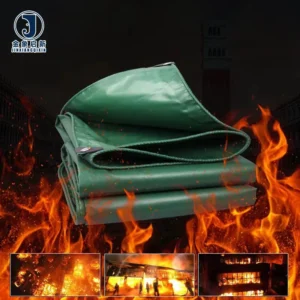
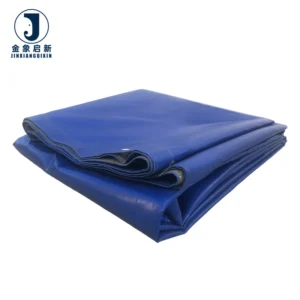
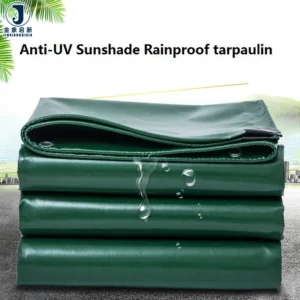
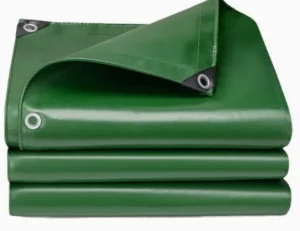
Coating weight control — every roll of Heavy Duty PVC Coated Tarpaulin 350-1000gsm Grade | Knife Coated undergoes stage-by-stage GSM verification against the quoted specification before dispatch.
Technical Specifications
| Parameter | Value |
|---|---|
| Product Type | PVC Coated Tarpaulin |
| Coating Material | PVC (double-sided coating) |
| Base Fabric Denier | 500D×840D / 500D×1000D / 1000D×1000D / 1000D×1300D / 1300D×1300D / 1000D×2000D |
| Mesh Count | 30×19 / 20×20 / 30×15 (varies by grade) |
| Total Thickness | 0.29mm / 0.32mm / 0.38mm / 0.44mm / 0.46mm / 0.55mm / 0.65mm |
| Weight (GSM) | 350gsm / 400gsm / 420gsm / 500gsm / 600gsm / 650gsm / 750gsm / 900gsm |
| Strong Warp | 1650N – 3900N (varies by grade, test standard not stated) |
| Strong Pick | 1600N – 3500N (varies by grade, test standard not stated) |
| Tensile Strength | 50–80 MPa (test standard not stated) |
| Brittle Temperature | ≤ -50 ~ -60 ℃ |
| Softening Temperature | ≥ 80 ℃ |
| Melting Point | 212 ℃ |
| Treatment | High frequency hot melt, hot air, sewing |
| Key Features | Waterproof, fire retardant (grade not stated), anti-UV (test basis not stated), heavy metal free, anti-mildew, flexible, self-clean |
| Edge & Eyelet Options | 3cm enlarged aluminum alloy eyelet, reinforced corners, 5mm thick rope without splicing, high temperature heat sealed seamless edge wrapping |
| Printing | Printable, customized |
| Color | Customizable |
| Certification | ISO, CE |
Application Suitability
| Application | Exposure & Requirement |
|---|---|
| Truck and trailer top covers | Constant UV exposure, dynamic road load, wind uplift stress, abrasion at tie-down contact points |
| Side curtain fabric for fleets | Repeated flexing cycles at curtain runners, friction against load edges, weather and road salt exposure |
| Container roof covers | Prolonged water pooling, thermal cycling, puncture risk from shifting cargo during transit |
| Outdoor event tents and awnings | Direct sun exposure, wind load on frame attachment points, repeated assembly and teardown stress |
| Inflatable and membrane structures | Internal air pressure load, seam integrity under continuous tension, UV and weather exposure |
| Construction and building enclosures | Debris impact, scaffolding abrasion, flame retardant requirement on occupied sites |
Why the Base Fabric Denier Matters More Than GSM Alone for PVC Coated Tarpaulin
A heavier coating does not compensate for a lighter base yarn when the fabric is pulled at the weld line.
Technical buyers often specify PVC coated tarpaulin by GSM and assume a higher number guarantees proportional strength. In practice, the base fabric denier and mesh count define how the material behaves under tensile load, while the coating weight primarily governs abrasion and puncture behaviour. A 650gsm roll built on a 500D×840D base will flex differently under dynamic road load than a 650gsm roll built on a 1000D×1000D base [NEED_CITE: relationship between base yarn denier and tensile performance in coated fabrics per ISO 1421]. When fleet operators specify truck side curtains, the flex cycles at the curtain runner demand high warp yarn count — coating thickness alone cannot prevent cracking at those stress points. Without matching denier to the actual load profile, fabricators end up replacing covers earlier than expected.
How Base Yarn Construction Drives Tensile Behaviour Across the PVC Coated Tarpaulin Range
The base fabric denier range from 500D×840D to 1000D×2000D directly determines the warp and weft tensile capacity. Heavier denier yarns carry higher tensile loads before elongation reaches the point where the PVC coating begins to crack. Mesh counts such as 30×19 or 20×20 define how tightly those yarns are woven, influencing both tear propagation resistance and the coating’s ability to penetrate and bond between fibres. For applications like trailer top covers where wind uplift exerts sustained tension across the full panel, specifying a grade with higher denier and tighter mesh provides a wider safety margin than selecting solely on GSM.
Coating Weight and Its Relationship to Abrasion and Seam Integrity
The double-sided PVC coating applied across the available GSM grades controls how the fabric resists surface wear and how well it accepts heat-sealed seams. When coating weight is distributed evenly through the base fabric weave, the hot-melt welding process achieves adhesion that approaches the base fabric strength. Where coating penetration is uneven — a risk when coating weight is pushed too high relative to the mesh opening size — the weld line becomes the failure point before the fabric itself reaches its tensile limit [NEED_CITE: heat seal peel strength testing methods for PVC coated polyester fabrics]. This is why material specifiers working on truck side curtains and inflatable structures need both the GSM and the mesh count to evaluate whether a given grade will weld reliably.
Reading the Specification Sheet: Denier, Mesh, Thickness and Tensile Together
Each grade within the PVC coated tarpaulin product family carries a specific combination of base denier, mesh count, thickness and tensile values that should be evaluated as a set rather than in isolation. The thickness range from 0.29mm to 0.65mm correlates with both coating weight and base fabric density — a 900gsm grade at 0.65mm thickness built on 1000D×2000D yarn delivers fundamentally different tear resistance than a 900gsm grade at similar thickness built on lighter denier yarn. Tensile values from 1650N to 3900N in the warp direction reflect this interaction. Technical buyers comparing grades should request the full parameter set for each roll and verify that the denier, mesh and GSM all align with the application stress profile [NEED_CITE: tensile and tear test methods for coated fabrics per ISO 1421].
The Hidden Cost of Specifying PVC Coated Tarpaulin on GSM Alone
When a procurement team approves a PVC coated tarpaulin grade based only on quoted GSM, the material may arrive meeting the weight benchmark but performing below expectation under load. A lighter denier base fabric coated to a target GSM can deliver the correct scale reading while offering lower tear propagation resistance than a heavier denier fabric at the same weight. On truck covers, this mismatch surfaces first at the flex points where the load shifts during transit — the coating cracks and the base yarns separate before the expected service period ends. For construction enclosures, selecting a grade without confirming the flame retardant classification can result in site inspection failure even when the fabric meets the weight specification. These failures are costly not because the material is defective, but because the specification was incomplete [NEED_CITE: common failure modes in PVC coated tarpaulin installations under dynamic load].
Why Material Verification Matters at Every Stage of Your PVC Coated Tarpaulin Order
Process control over coating weight and adhesion starts at the base fabric stage, where yarn denier and weave density are verified before coating begins. Three full production lines and 36 sets of professional equipment support consistent output across the PVC coated tarpaulin grade range. The 10-person R&D team handles material selection, matching denier and coating weight to specific application requirements and developing samples within days for custom specifications. A dedicated QA/QC protocol runs at every production stage with 100% inspection before shipment, including roll-by-roll GSM and weight verification. Nearly 30 years of focused coated fabric production underpins the process discipline that keeps batch-to-batch consistency within tolerance.
Documentation & Verification
- Material specification sheet stating exact GSM, base fabric denier, weave and coating method for each roll
- Test reports for UV and flame-retardant grades issued with applicable standard reference where treatment is specified
- Pre-shipment inspection record with roll-by-roll GSM and weight verification against quoted specification
- ISO and CE certificates with traceability to production batch and shipment documentation
- Certificate of origin provided for customs clearance and downstream compliance requirements
- Roll packing list with individual roll dimensions, net weight and colour reference for incoming inspection
Fabrication, Handling & Storage
- High frequency hot melt welding suits the double-sided PVC coating — set temperature and dwell time to the specific GSM grade
- Hot air welding works for on-site repairs and seam joining on heavier grades up to 0.65mm thickness
- Reinforced corners with 3cm aluminum alloy eyelets distribute tie-down load across the base fabric weave
- Store rolls upright on a flat surface to prevent creasing that compromises the coating adhesion at fold lines
- Avoid dragging cut panels across abrasive surfaces — the self-clean coating surface can be scratched by sharp aggregate
- Clean with mild detergent and soft brush; solvent-based cleaners may degrade the PVC coating over repeated use
What to Include When Requesting a Quotation
Provide the application scenario and exposure conditions — whether the fabric will be used for truck side curtains, static covers, inflatable structures or construction enclosures. Specify the flame retardant grade or UV treatment level required by your target market regulations. State the required roll width, colour reference and whether you need finished panels with eyelets or roll stock only. If you require samples for weld testing or colour approval before bulk production, include that in your initial enquiry so lead times can be planned accordingly.
Frequently Asked Questions
Q: How should we verify GSM matches the quoted specification on arrival?
A: Cut a measured sample from each roll using a standard template, weigh it on a calibrated scale, and compare the result against the stated GSM on the material specification sheet. Our pre-shipment inspection record includes roll-by-roll weight verification, giving you a baseline to confirm against your incoming inspection data.
Q: What flame retardant standards are available for this PVC coated tarpaulin?
A: Fire retardant treatment is available across multiple grades — confirm the specific classification required by your market, such as building material or transport vehicle standards. We issue test reports with the applicable standard reference for each treated batch supplied.
Q: How does PVC coating compare to PE tarpaulin on long-term weathering?
A: PVC coated tarpaulin uses a double-sided coating bonded to a polyester base fabric, providing higher tensile strength and better heat-seal seam integrity than woven PE. UV stabilization treatment is available — request the test basis applicable to your exposure conditions when specifying.
Q: When should we choose hot air welding over high frequency hot melt?
A: High frequency hot melt delivers the strongest seams on flat-panel fabrication where the press can apply even pressure. Hot air welding is preferred for on-site repairs, curved seams, and joining panels where the double-sided PVC coating thickness makes high-frequency penetration difficult.
Q: Can you supply custom widths and colours for roll stock orders?
A: Custom widths and colour references are available across the PVC coated tarpaulin grade range. Provide your target colour reference, required roll width and annual volume so we can confirm minimums, batch consistency parameters and lead times for your production schedule.