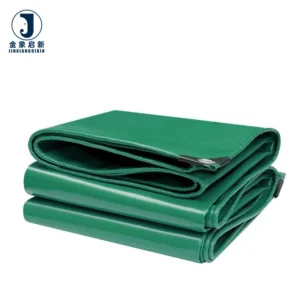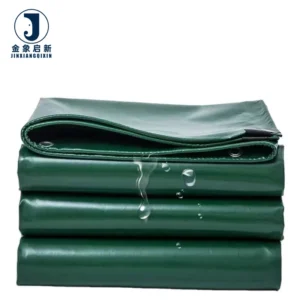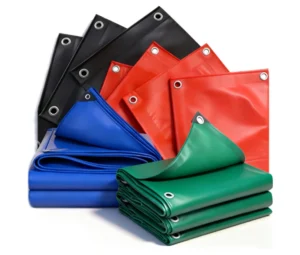
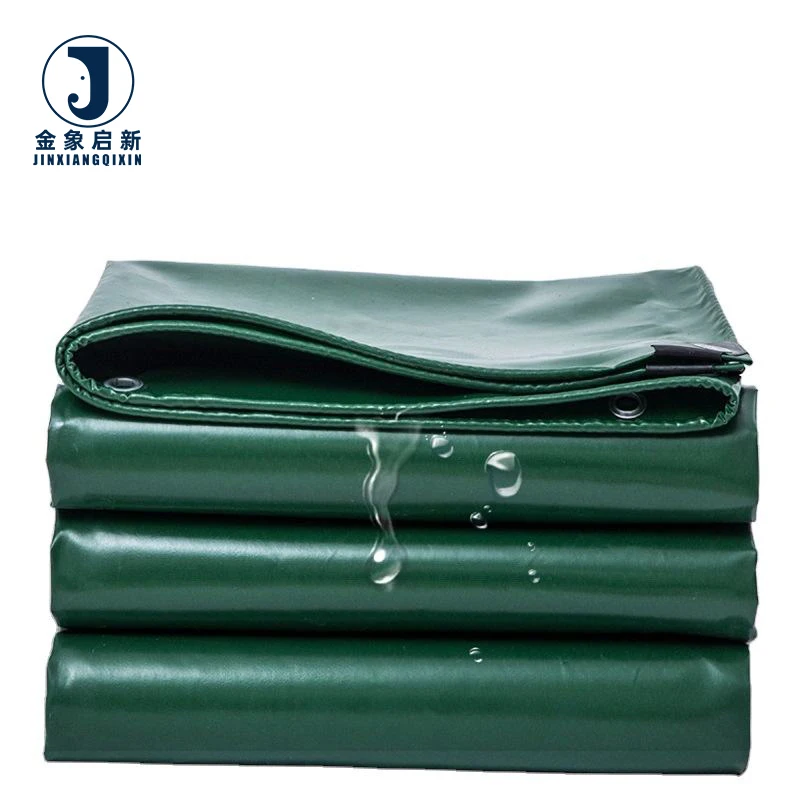
Deep process control over coating weight — Every roll of PVC coated tarpaulin for flatbed trailer use passes through dedicated QA checkpoints where coating adhesion and GSM are verified before leaving the line.
Technical Specifications
| Parameter | Value |
|---|---|
| Product Type | PVC Coated Tarpaulin Roll |
| Coating Material | PVC |
| Construction | Double-faced |
| Water Resistance | Water resistant |
| UV Treatment | Anti-UV (test basis not stated) |
| Flame Retardant Grade | Flame retardant (grade not stated) |
| Color Options | Multiple colors available |
| Certification | ISO, CE |
Application Suitability
| Application | Exposure & Requirement |
|---|---|
| Flatbed trailer load covering | Constant road abrasion, wind flex, UV exposure at highway speeds |
| Lumber transport protection | Moisture ingress, splinter puncture risk, repeated tie-down tension |
| Side curtain fabrication | Cyclic folding and unfolding, weld seam integrity under flex fatigue |
| Freight logistics fleet covers | Multi-climate weather exposure, loading yard handling abrasion |
What "Flame Retardant" Actually Means Without a Certified Grade Behind It
A flame retardant claim without a test standard attached is a marketing statement, not a specification you can build a fleet procurement around.
Fleet operators and transport equipment builders routinely receive PVC coated tarpaulin rolls labeled flame retardant, only to discover at the compliance audit that no test report accompanies the shipment. The loading yard safety officer asks which standard the material meets — NFPA 701, DIN 4102 B1, or a regional transport code — and the datasheet provides no answer. [NEED_CITE: flame retardant classification systems for transport and construction textiles] This gap between claimed performance and documented proof is one of the most frequent reasons PVC coated tarpaulin for flatbed trailer applications gets rejected at site inspection, forcing operators to source replacement material under urgent timelines.
How the Base Fabric and Coating Bond Determines Weld Integrity
The separation between base fabric and PVC coating is where most flatbed trailer tarpaulin systems fail first, not at the fabric surface. When the coating method achieves strong mechanical adhesion to the woven substrate, high-frequency or hot-air welding produces a seam that resists peeling even as the load flexes during transit. A PVC coated tarpaulin roll destined for side curtain or load cover fabrication must deliver consistent weld strength across the entire roll width, because a weak bond in one section will separate under the cyclic stress of road vibration and tie-down tension.
Why Double-Faced Construction Matters for Load-Bearing Covers
Single-coated fabrics leave one side of the base fabric exposed to abrasion from the cargo itself — lumber splinters, steel edge burrs, and pallet corners all contact the underside during transport. Double-faced PVC coating wraps both sides of the woven substrate, providing uniform abrasion resistance regardless of which face bears the contact load. This construction also improves overall stiffness and dimensional stability, reducing the flutter and billowing that accelerate fatigue cracking in flatbed trailer applications exposed to highway-speed airflow.
Reading Beyond the GSM Number on Your Quotation
GSM tells you the total weight per square meter, but it does not tell you how that weight is distributed between base fabric and coating — and that distribution governs the mechanical behavior of the PVC coated tarpaulin roll in service. A higher base fabric denier with a tighter weave delivers superior tear propagation resistance at eyelet and tie-down stress points, while a heavier coating layer improves water resistance and surface abrasion tolerance. Knife coating typically produces a thicker, more uniform coating film compared to dip or spray methods, yielding better peel strength at welded seams. Understanding this relationship between base fabric construction and coating weight is essential for technical buyers specifying material for fleet-scale procurement. [NEED_CITE: tensile and tear test methods for coated fabrics per ISO 1421]
The Hidden Cost of Specifying on Price Per Kilogram Alone
When procurement decisions reduce coated fabric selection to cost per kilogram, the delivered roll often arrives lighter than the GSM stated on the original quotation. The material may pass a visual check but fails within months because the coating thickness was reduced to hit the target price, leaving the base fabric underprotected against UV degradation and mechanical abrasion. Colour variation between rolls in the same shipment compounds the problem — once fabricated and installed side by side on a fleet of trailers, the inconsistency becomes visible to the end customer. [NEED_CITE: common coating weight variances in imported PVC tarpaulin rolls] Batch-to-batch GSM verification and side-by-side colour swatch approval before dispatch are the controls that prevent these outcomes.
Why Technical Buyers Source This Fabric Here
Three full production lines running dedicated PVC coating processes allow this facility to maintain batch-consistent coating weight across multi-roll orders. The 10-person R&D team develops custom colour matches and sample rolls within days, so buyers can validate weld parameters and colour approval before committing to bulk production. Dedicated QA inspection at every production stage — from base fabric incoming check through coating weight measurement to final roll packing — ensures that the PVC coated tarpaulin roll leaving the facility matches the specification agreed at quotation. Pre-shipment inspection records document GSM, colour consistency, and coating adhesion for every roll in the order, giving procurement teams the traceability needed for fleet compliance documentation.
Documentation & Verification
- Material specification sheet stating base fabric denier, coating method, and verified GSM per roll
- Test reports for UV treatment and flame retardant grade matched to target market requirements
- Pre-shipment inspection record confirming coating adhesion and colour consistency across all rolls
- ISO and CE certificates supporting cross-border procurement compliance
- Roll packing list with individual roll weights and dimensions for receiving verification
- Certificate of origin for customs clearance in destination markets
Fabrication, Handling & Storage
- Hot-air welding temperature must match the PVC coating formulation on this double-faced roll for full peel strength
- Reinforced hem zones at tie-down points require additional coating layer or fabric insert to resist tear propagation
- Store rolls horizontally on pallets to prevent permanent creasing in the PVC coating surface
- Allow rolls to acclimatize to ambient temperature before unrolling in cold conditions to avoid coating micro-cracking
- Use PVC-compatible cleaners only — solvent-based products will degrade the coating surface and reduce water resistance
- Plan cutting layout to minimize waste from the roll width and reduce the number of welded seams in finished covers
Before You Request a Quote
Provide the specific trailer models and cargo profiles the fabricated covers will serve, along with the flame retardant or UV treatment standards required by your operating market. Confirm whether you need roll stock in standard widths for your own fabrication line or cut-to-finished-size covers with eyelets and hem reinforcement. If colour consistency across multiple rolls is critical for fleet appearance, request a production swatch for approval before bulk coating begins.
Frequently Asked Questions
Q: How can I verify the stated GSM matches what arrives on my dock?
A: Request a pre-shipment inspection record documenting the actual measured GSM for each roll in your order. Upon receipt, cut a measured sample from the roll end and weigh it on a calibrated scale. Any discrepancy beyond the agreed tolerance should be reported immediately with photographic evidence before fabrication begins.
Q: Which flame retardant grade applies to flatbed trailer covers in my market?
A: Requirements vary by region — some transport authorities reference NFPA 701, while European construction-adjacent logistics yards may require DIN 4102 B1 classification. Confirm the specific standard your operating jurisdiction mandates, then request a test report issued by an accredited laboratory against that standard before approving the material specification.
Q: What test basis supports the anti-UV treatment claim on this roll stock?
A: Anti-UV treatment is applied during the coating process, but the duration of effective protection depends on the specific additive package and concentration used. Request a UV exposure test report — such as xenon arc or QUV accelerated weathering data — that documents the number of hours tested and the retention percentage of tensile strength after exposure.
Q: How do you maintain colour consistency when I order multiple rolls?
A: Colour matching is controlled through standardized pigment formulation and in-line coating weight monitoring during production. Before bulk runs, a sample swatch is produced for buyer approval. Pre-shipment inspection includes side-by-side visual comparison of all rolls in the order to flag any batch variation before dispatch.
Q: What welding parameters should I use for fabricating double-faced PVC coated tarpaulin?
A: Welding temperature, pressure, and dwell time depend on the coating thickness and formulation specific to this roll. Request the manufacturer’s recommended hot-air or high-frequency welding parameters, then run test welds on sample pieces to verify peel strength before proceeding to full production fabrication.