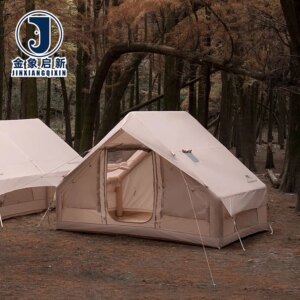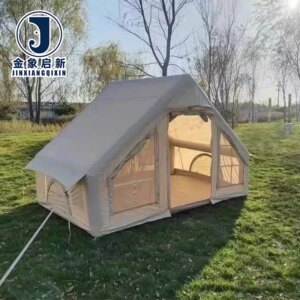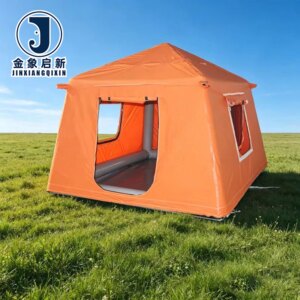
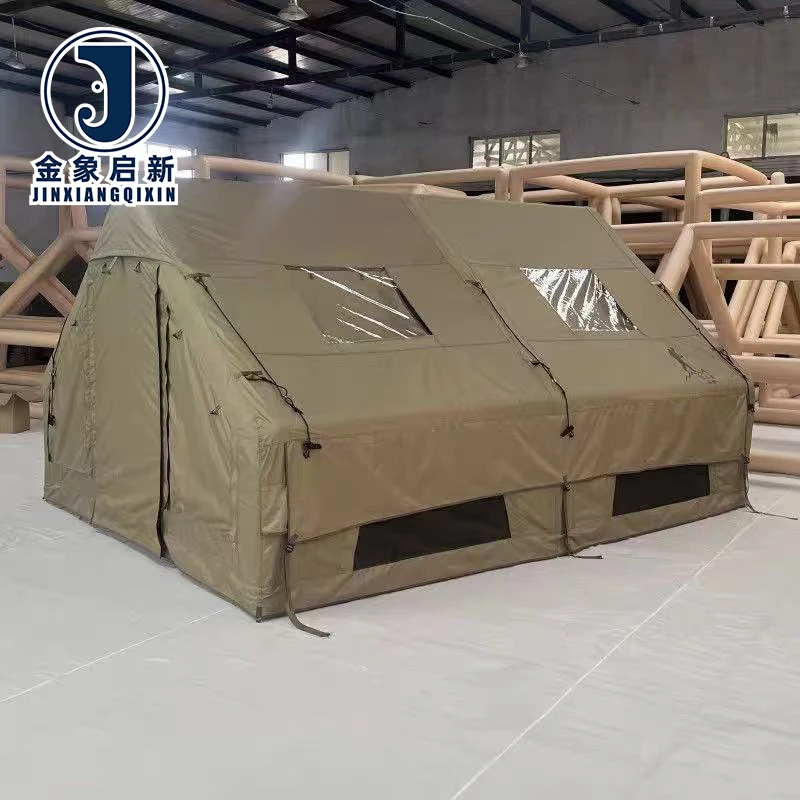
Coating Weight Control — Deep process oversight across three full production lines ensures every roll of inflatable tent fabric PVC coated meets the stated specification before leaving the facility.
Technical Specifications
| Parameter | Value |
|---|---|
| Product Type | Inflatable Tent |
| Core Material | PVC Tarpaulin |
| Key Performance | Waterproof (grade not stated in source), UV-resistant (test basis not stated in source), Tear-resistant (grade not stated in source) |
| Structure | Single layer |
| Capacity | 4-6 person |
| Opening Mechanism | Quick automatic opening |
| Customization | OEM & ODM (sample customization, pattern printing) |
| Production Facility | 9,180 m² with 3 full production lines |
| Processing Equipment | 36 sets of professional processing equipment |
| R&D Team | 10 technicians |
| Quality System | Full-process QA & QC inspection |
| Certifications | ISO9001, ISO14001, ISO45001, CE |
Application Suitability
| Application | Exposure & Requirement |
|---|---|
| Commercial-grade inflatable tent manufacturing | Repeated inflation and deflation cycles demanding coating adhesion and seam integrity |
| Adventure tourism and organized camping operations | Prolonged outdoor exposure requiring UV-resistant treatment and waterproof reliability |
| Equipment rental businesses | Frequent setup and breakdown cycles requiring tear-resistant fabric with durable welded seams |
| Industrial event organizers | Quick-deployment shelter systems needing quick automatic opening and batch colour consistency |
Why "Waterproof" Means Little Without Coating Weight Verification
Waterproof claims hold only when the coating weight and base fabric adhesion are verified roll by roll before dispatch.
When sourcing inflatable tent fabric PVC coated for commercial production, the gap between a quoted specification and the material that arrives on the factory floor is where warranty claims originate. I have reviewed field returns where the coating delaminated at the air-beam seam after fewer deployment cycles than expected — the root cause traced back to a coating weight that fell below what was needed for the inflation stress load. Without a pre-shipment inspection record tied to each roll, buyers absorb that risk silently. [NEED_CITE: coating adhesion test methods for PVC tarpaulin per ISO 1421]
How Coating Formulation Affects Inflatable Structure Performance
The PVC coating on inflatable tent fabric must maintain flexibility across repeated inflation cycles without cracking or losing adhesion to the base fabric. The formulation balances plasticiser content against tensile demand — too rigid a coating fractures at fold points during packing, while too soft a compound migrates and weakens over successive seasons. For commercial inflatable tent production, this balance determines whether a tent shell survives its first year of rental deployments or begins generating seam repair tickets.
Weld Seam Behaviour Under Inflation Stress
Air-beam construction concentrates mechanical load at every welded joint. The seam strength must match or exceed the tensile capacity of the base fabric itself; otherwise the weld line becomes the failure point each time the structure is pressurised. Inflatable tent fabric PVC coated for this application requires consistent coating thickness so that hot-air or high-frequency welding parameters remain stable across the production run. [NEED_CITE: tensile and tear test methods for coated fabrics per ISO 1421]
Reading the Specification Sheet Beyond the Headline GSM
A single GSM figure does not describe how the fabric will behave when cut, welded, and inflated. Base fabric denier and weave density determine how tears propagate once initiated at a stress point — a high-denier yarn in a tight weave arrests tear spread more effectively than a lighter yarn at the same overall weight. Coating method also matters: knife-over-edge coating produces a uniform film that welds predictably, while laminated constructions may show variable peel strength at the interface. Understanding these relationships lets a technical buyer evaluate a material specification sheet for genuine inflatable tent suitability rather than relying on weight alone.
What Happens When Batch Consistency Slips
Colour variation between rolls in a single production batch becomes visible the moment tent shells are displayed side by side at a trade show or rental yard. Beyond aesthetics, inconsistent coating weight across rolls forces fabricators to adjust welding temperature and pressure mid-run, increasing the probability of seam defects. For equipment rental businesses ordering replacement inventory, a roll that does not match the previous batch creates visible patching that undermines brand perception. [NEED_CITE: batch consistency challenges in PVC coated fabric production]
Why Procurement Verification Matters Here
Each roll undergoes 100 percent pre-shipment inspection covering coating weight, colour reference, and dimensional tolerance — verified against the agreed specification before packing. The 10-person R&D team develops pre-production samples within days so that inflatable tent fabric PVC coated to your exact requirement is confirmed before mass production begins. Three full production lines with 36 sets of processing equipment maintain throughput without sacrificing the process control that keeps coating adhesion and base fabric integrity within tolerance. Every order ships with documentation traceable to the specific production batch.
Documentation & Verification
- Material specification sheet stating coating weight, base fabric denier, and colour reference per roll
- UV-resistance test report supplied when treatment is specified, confirming the test basis used
- Pre-production sample with signed approval record before bulk coating run commences
- Pre-shipment inspection record covering coating adhesion, weld seam strength, and dimensional checks
- ISO9001, ISO14001, ISO45001, and CE certificates supporting downstream compliance documentation
- Certificate of origin and customs documentation included with every export shipment
Fabrication, Handling & Storage
- Hot-air welding temperature must be matched to the PVC coating weight to avoid delamination at air-beam seams
- Store rolls vertically on padded racks to prevent permanent creasing in the single-layer construction
- Cut pattern layout should account for the available roll width to minimise off-cuts and welded joints
- Use PVC-compatible cleaners only — solvent-based agents can soften the coating and reduce waterproof integrity
- Low-temperature transport requires gradual acclimatisation before unrolling to prevent coating micro-cracking
What to Include in Your Enquiry
Specify the inflation pressure range your tent design operates under so the correct base fabric denier and coating weight can be recommended. Confirm the UV-resistance test basis your target market requires and whether any flame-retardant grade applies to your end-use jurisdiction. Indicate the roll width, colour reference, and annual volume so that production scheduling and batch consistency can be planned from the first run.
Frequently Asked Questions
Q: How is coating weight verified on arrival to ensure the inflatable tent fabric PVC coated matches the quotation?
A: Every roll is weighed and measured during pre-shipment inspection against the stated specification. The inspection record ships with the consignment so you can cross-reference coating weight, base fabric denier, and colour upon receipt. Any deviation is flagged and resolved before dispatch, not after the material reaches your factory.
Q: What UV test basis supports the outdoor lifespan claims for commercial inflatable tent applications?
A: UV-resistant treatment is available for inflatable tent fabric — confirm the specific test standard required for your market, such as ISO 4892 or equivalent. When specified, the corresponding test report is included in the shipment documentation so you can present verified data to your downstream clients and end users.
Q: How is batch-to-batch colour consistency maintained across rolls for inflatable tent production runs?
A: Colour matching is controlled at the coating stage using reference standards checked under standardised lighting. Rolls within a single production batch are inspected side by side before packing to confirm visual consistency. For repeat orders, previous batch references are retained so that new production aligns with your existing inventory.
Q: What customization options are available for pattern printing, sizing, and OEM branding on inflatable fabric?
A: The 10-person R&D team handles pattern printing, custom roll widths, and OEM branding directly on the fabric surface. Pre-production samples are developed within days for your approval before mass production begins, ensuring the inflatable tent fabric PVC coated to your design meets both visual and performance requirements.
Q: What documentation is provided to support compliance and quality verification for downstream commercial clients?
A: Each shipment includes a material specification sheet, pre-shipment inspection record, applicable test reports, and ISO9001, ISO14001, ISO45001, and CE certificates. This documentation package supports your own quality audits and provides traceable evidence for commercial clients who require supply chain compliance before approving your inflatable tent products.