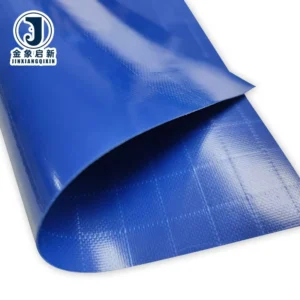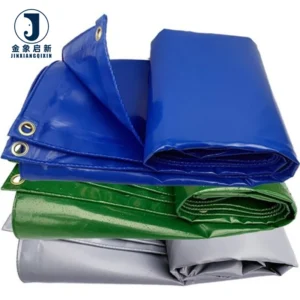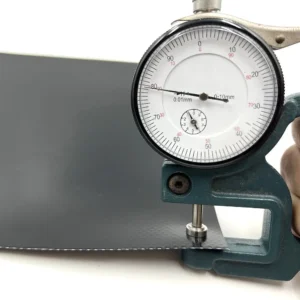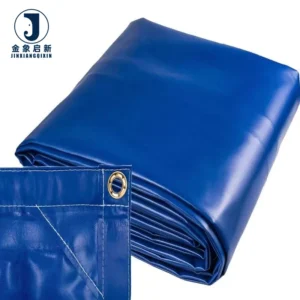
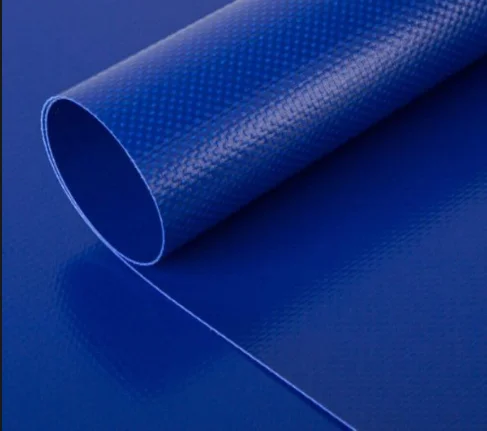
Deep Coating Control — Knife coating weight verified at every stage against the stated GSM, ensuring roll-to-roll adhesion consistency for fabricators who demand predictable weld behaviour.
Technical Specifications
| Parameter | Value |
|---|---|
| Product Type | PVC Knife Coated Tarpaulin Roll |
| Coating Method | Knife Coated |
| Coating Material | PVC (Polyvinyl Chloride) |
| Welding Compatibility | HF Welding / Hot Air Welding / Sewing |
| Flame Retardant | Available in flame retardant grades — confirm the grade required for your market |
| UV Resistance | UV stabiliser treatment available — request test basis for your target climate |
| Mildew Resistance | Mildew proof treatment applied |
| Chemical Resistance | Oil, stain, acid and alkali resistant |
| Temperature Behaviour | High temperature and cold resistant (specific range available on request) |
| Surface Finish | Self-cleaning, anti-oxidation treated |
| Waterproofing | Fully waterproof coated construction |
| Certifications | ISO, CE |
Application Suitability
| Application | Exposure & Requirement |
|---|---|
| Tensile & Membrane Architectural Structures | Continuous UV exposure, wind uplift tension, precise weld behaviour required at seam intersections |
| Airport Hangar & Stadium Fabric Envelopes | Fire-retardant compliance mandated by building codes, large panel welding with batch colour consistency |
| Truck & Trailer Side Curtain Fabric | Constant flexing at load points, road abrasion, weather and UV exposure during transit |
| Portable Storage & Shade Systems | Seasonal deployment and tear-down, puncture risk from frame contact, UV degradation over time |
| Large Format Technical Textile Fabrication | Roll stock cut and welded by fabricators requiring consistent GSM and coating adhesion across every roll |
Why Coating Adhesion Matters More Than GSM Alone for PVC Knife Coated Tarpaulin
A heavy GSM reading means nothing if the PVC layer delaminates from the base fabric at the first flex cycle.
Many buyers specify by weight and assume strength follows. I have seen coated fabric rolls arrive meeting the quoted GSM, yet the welded seams peel apart under load because the knife coating did not penetrate the base weave adequately [NEED_CITE: coating adhesion and peel strength test methods for PVC coated fabrics]. The result is a material that tests well on a scale but fails in the field at exactly the point the structure flexes most. Knife coating, when controlled properly, forces PVC into the interstices of the base yarn rather than sitting on top, creating a mechanical bond that holds through repeated stress cycles.
How Knife Coating Builds the Structural Bond
The knife coating method draws a precise PVC layer across and into the base fabric under controlled blade pressure and gap settings. Unlike simple lamination, this process embeds the coating compound within the yarn structure. For PVC knife coated tarpaulin rolls destined for tensile structures or truck curtains, this embedded bond is what keeps seams intact when the fabric flexes under wind load or road vibration. The adhesion strength is determined not by coating thickness alone, but by how thoroughly the PVC fills the weave interstices during the coating pass.
Welding Predictability Across HF, Hot Air and Sewing
Fabricators working with this material need confidence that their chosen joining method will produce consistent results roll after roll. High-frequency welding relies on the dielectric properties of the PVC coating, which must be uniform in thickness and plasticiser content. Hot air welding demands that the coating softens at a predictable temperature without bubbling or degrading. Sewn seams require a coating that does not crack along the needle line. Our knife coating process controls plasticiser migration and coating weight distribution to support all three methods, giving fabricators flexibility without changing their material source [NEED_CITE: high-frequency versus hot-air welding performance on PVC coated polyester fabrics].
Reading the Specification Sheet Correctly
Base fabric denier and mesh count define the skeleton of the material; the coating weight defines its skin. A high-denier yarn in an open weave may produce a light GSM despite strong tensile properties, while a dense low-denier weave under heavy coating yields high GSM but may lack tear resistance. The knife coating weight must be evaluated alongside the base fabric construction to understand true performance. When reviewing PVC knife coated tarpaulin material properties, GSM and coating weight should always be read as a pair, not in isolation. Anti-UV and flame retardant treatments are available in specific grades — request the test standard applicable to your market before confirming an order, as claims without documentation leave compliance to chance [NEED_CITE: flame retardant classification systems for architectural textile membranes].
The Hidden Cost of Unverified Material Claims
A roll that arrives lighter than the quoted specification is not just a commercial loss — it is a structural risk. Thinner coating reduces weld penetration depth, meaning seams fail before the fabric body does. Batch colour variation between rolls becomes visible only after installation, when panels sit side by side on a tensile structure or truck curtain. Flame retardant grades claimed without a supporting test report can halt a building inspection or void an insurance requirement. These failures surface weeks or months after delivery, when returns are impractical and project deadlines have passed [NEED_CITE: pre-shipment inspection protocols for coated technical textiles].
Why Fabricators Source This Material Here
Deep process control over knife coating parameters means coating weight and adhesion are verified during production, not just checked on a sample at the end. Three full production lines with dedicated QA at every stage ensure that bulk roll orders maintain the same coating consistency as the approved sample. A 10-person R&D team develops custom GSM, width and treatment combinations within days, so fabricators can confirm weld behaviour on a sample before committing to volume. Every roll undergoes 100% pre-shipment inspection against the material specification sheet, and documentation — including test reports for applicable grades — ships with the order. Nearly three decades of focused coated fabric production underpin this process control.
Documentation & Verification
- Material specification sheet stating base fabric denier, weave, and verified coating weight per roll
- UV and flame retardant test reports provided with grade and standard clearly referenced
- Pre-shipment inspection record confirming GSM, colour and coating consistency across the batch
- Roll packing list detailing gross weight, net weight and roll dimensions for logistics planning
- ISO and CE certificates included with every international shipment
- Certificate of origin and customs documentation prepared to destination country requirements
Fabrication, Handling & Storage
- HF welding parameters must be tuned to the specific coating weight of each roll batch for consistent seam strength
- Hot air welding temperature should be calibrated against the knife coated PVC surface before full production runs
- Sewn seams require UV-stable thread compatible with the PVC coating to prevent needle-line cracking over time
- Store rolls upright on pallets in a dry, shaded area to prevent surface marking and edge compression damage
- Unroll cold-weather stock in a conditioned space before fabrication to avoid coating stiffness and cracking during handling
- Clean surfaces with mild detergent only; solvent-based cleaners can degrade the self-cleaning coating layer
What to Include in Your Enquiry
Specify the application and the environmental exposure conditions the fabric will face, including UV intensity and any fire code requirements for your market. State the required roll width, annual volume, and whether you need the material supplied as roll stock or cut to panel size. If colour consistency across multiple rolls is critical for side-by-side installation, note this explicitly and request a pre-production sample for approval before bulk manufacture.
Frequently Asked Questions
Q: How is GSM verified on arrival and what tolerance applies roll to roll?
A: Every roll is weighed and measured during pre-shipment inspection against the stated specification. The inspection record travels with the shipment. If your application requires a tighter GSM tolerance than standard production allows, specify this at enquiry stage so the production team can adjust coating weight targets and verify on a sample roll before bulk runs.
Q: Which flame retardant grades are available and what test standard backs each claim?
A: Flame retardant treatment is available in grades matched to different market requirements. We provide the test report stating the specific standard and classification achieved. Confirm which fire code your project must meet at enquiry stage, and we will supply the corresponding grade with full documentation before you commit to a production order.
Q: What is the UV test basis and how does it relate to outdoor service life?
A: UV stabiliser treatment is incorporated during the coating process. The test basis and exposure duration data are available on request and vary by grade. Share your installation climate and expected exposure conditions so we can recommend the appropriate UV treatment level and supply the supporting test documentation for your specification.
Q: HF versus hot air versus sewing — which welding method suits which application?
A: HF welding produces the strongest and cleanest seams on knife coated PVC, suited to tensile structures and architectural membranes. Hot air welding is practical for field repairs and smaller fabrications. Sewing is used where mechanical fastening is preferred. The coating weight and plasticiser formulation affect each method differently, so test your parameters on a sample before full production.
Q: How is colour consistency controlled across multiple rolls in the same order?
A: Colour is controlled through masterbatch dosing during the coating stage, with in-process checks against the approved colour reference. For projects where panels are installed side by side, we recommend requesting a pre-production sample from the actual production batch to confirm colour match before the full order runs through the line.