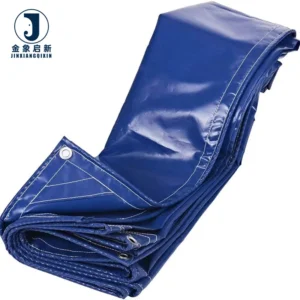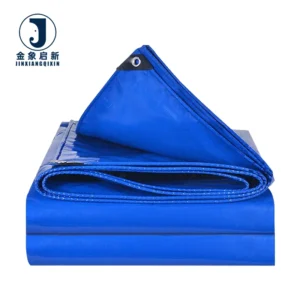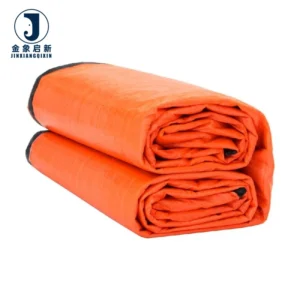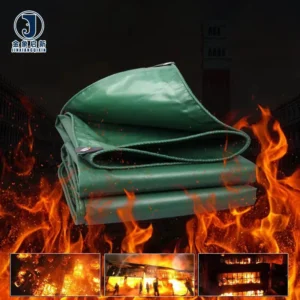
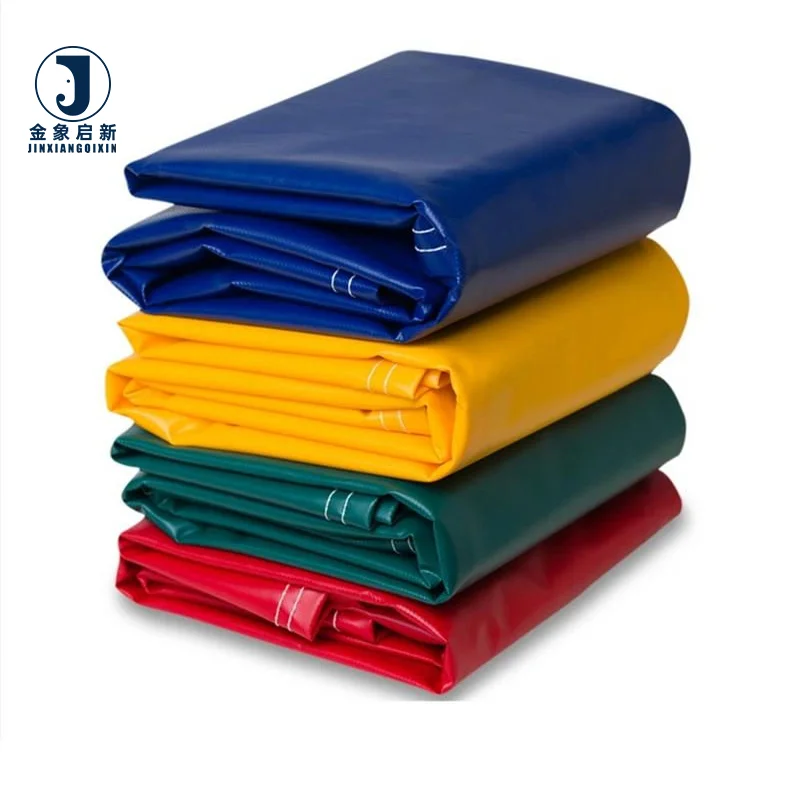
Coating Adhesion Control — Every roll of PVC coated tarpaulin 1000D denier base fabric is produced under strict hot-melt process monitoring to ensure consistent coating weight and fabric-to-coat bonding before it leaves the line.
Technical Specifications
| Parameter | Value |
|---|---|
| Product Type | PVC Coated Tarpaulin |
| Base Fabric Denier | 1000D×1000D |
| Mesh Count | 20×20 |
| Weight (GSM) | 600 GSM |
| Total Thickness | 0.44 mm |
| Coating Material | Double-sided PVC over polyester base |
| Tensile Strength (warp) | 2500 N |
| Tensile Strength (weft) | 2200 N |
| Flame Retardant | Available in flame retardant grades — confirm the grade required for your market |
| UV Treatment | Anti-UV treatment available — confirm test basis for your target climate |
| Waterproof | Yes, fully sealed PVC coating |
| Anti-Mildew | Yes |
| Temperature Range | Brittle ≤ -50 °C to -60 °C; Softening ≥ 80 °C; Melting point 212 °C |
| Edge Treatment | 5 mm rope without splicing, high-temperature heat-sealed seamless edge wrapping |
| Eyelet Options | 3 cm enlarged aluminium alloy buttonhole, brass eyelets at 1 m intervals |
| Reinforcement | Reinforced corners on all sides |
| Key Features | Heavy metal free, flexible, printable for custom branding, self-clean surface |
Application Suitability
| Application | Exposure & Requirement |
|---|---|
| Truck side curtain | Constant flexing at load points, road debris abrasion, UV and rain exposure |
| Trailer top roof | Standing water pooling, wind uplift stress, thermal expansion cycles |
| Container roof cover | Salt-air corrosion in port environments, heavy rainfall, mechanical handling damage |
| Outdoor event tent (block-out) | Crowd contact, repeated assembly and teardown, direct sun exposure |
| Inflatable structure fabric | Internal air pressure stress, dynamic folding and unfolding, puncture risk |
| Construction temporary shelter | Scaffolding contact, wind load, dust and chemical splash |
Why Denier and Weave Density Matter More Than GSM Alone
A 600 GSM PVC coated tarpaulin 1000D denier base fabric carries its strength in the yarn structure, not just the coating weight.
Technical buyers often see a quotation listing a target GSM and assume that number alone defines durability. In practice, the base fabric denier and mesh count determine how the material responds when a truck side curtain flexes under highway wind load or when a tensile structure bears sustained tension. A lighter-denier yarn with a higher mesh count can reach the same GSM as a heavier-denier yarn with a looser weave, yet the two fabrics behave very differently under tear propagation and seam stress. [NEED_CITE: tensile and tear test methods for coated fabrics per ISO 1421] Specifying by denier and density together — rather than by coating weight in isolation — is how fabricators avoid discovering that the weld line fails before the fabric does.
Base Fabric Architecture and Load Response
The 1000D×1000D polyester yarn in this PVC coated tarpaulin 1000D denier base fabric provides a balanced tensile platform across both warp and weft directions. A 20×20 mesh count spaces the yarns to allow adequate PVC penetration during coating, which directly influences peel strength at heat-sealed joints. When fabricators weld panels for side curtains or membrane structures, the coating must bond to itself through the mesh gaps — a denser weave can restrict this flow and reduce seam adhesion.
Coating Weight and Fabrication Behaviour
At 600 GSM with a total thickness of 0.44 mm, this grade sits in the mid-heavy range where high-frequency hot melt and hot air welding both perform well. The double-sided PVC coating over the polyester base provides sufficient material volume for strong thermal bonds without the excessive stiffness that heavier grades introduce during folding and roll handling. For inflatable and membrane structure applications, this balance between flexibility and tensile capacity allows the fabric to conform to curved frames while maintaining dimensional stability under sustained air pressure or wind load. [NEED_CITE: DIN 4102 fire classification for building materials]
Temperature Boundaries in Field Service
The stated brittle temperature of ≤ -50 °C to -60 °C and softening point of ≥ 80 °C define the operational envelope for cold-climate transport and hot-weather construction use. Below the brittle threshold, the PVC coating loses flexibility and becomes prone to cracking at fold lines — a concern for fleet operators running winter routes. Above the softening temperature, the coating becomes pliable enough that tensioned installations may creep under sustained load. The melting point at 212 °C confirms the thermal headroom available during high-frequency welding without risk of base fabric damage.
The Hidden Cost of Specifying on Weight Alone
When a buyer specifies a target GSM without confirming the underlying denier and weave, the delivered rolls may meet the weight check but underperform at the seams. PVC coated tarpaulin 1000D denier base fabric specified only by weight can mask a substitution to lighter yarn with compensating coating thickness, which increases stiffness and reduces tear resistance at flex points. [NEED_CITE: seam failure in coated fabrics under cyclic loading] Truck side curtains fabricated from such material often show weld-line separation within the first season of service, while the body of the fabric remains intact. Colour variation between rolls sourced from different base fabric batches compounds the problem when panels are installed side by side on a single trailer.
Procurement Confidence Through Process Control
Every production run of this PVC coated fabric is backed by in-house coating weight and adhesion monitoring across three full production lines. The 10-person R&D team handles material selection and sample development so fabricators can validate welding parameters and colour match before committing to a production order. Dedicated quality checks at each stage — base fabric inspection, coating application, and finished roll review — ensure that the denier, mesh count and GSM on the specification sheet match what arrives at the fabrication floor. Pre-shipment inspection covers every roll, not a statistical sample.
Documentation & Verification
- Material specification sheet listing 1000D×1000D denier, 20×20 mesh and 600 GSM per roll
- Test report for flame retardant and anti-UV grades supplied with the applicable standard reference
- Pre-shipment inspection record confirming coating weight and dimensional accuracy before dispatch
- ISO and CE certificates provided for compliance and import documentation
- Roll packing list with net weight and roll count for container loading verification
Fabrication, Handling & Storage
- High-frequency welding at 0.44 mm thickness requires calibrated dwell time to achieve full coating penetration
- Brass eyelets at 1 m spacing distribute tie-down loads across the 1000D base fabric without pull-through
- Heat-sealed edge wrapping prevents delamination at cut edges during repeated rolling and unrolling
- Store rolls upright on pallets to avoid flat-spotting the 600 GSM coating under self-weight
- Clean with mild detergent only; solvent-based cleaners can degrade the PVC surface and reduce print adhesion
Requesting a Technical Quotation
Provide your application type, expected mechanical and environmental exposure, and the fire safety classification required in your target market. Specify whether you need roll stock at standard width or custom slit dimensions, and indicate annual volume to align production scheduling. If colour matching or printed branding is required, request a pre-production sample to confirm shade consistency and print adhesion before the full order runs.
Frequently Asked Questions
Q: How is the 1000D denier and 600 GSM verified before shipment?
A: Each roll undergoes a weight and denier check during pre-shipment inspection. The material specification sheet accompanying your order documents the confirmed GSM, base fabric denier and coating weight for every individual roll, so you can reconcile what was quoted against what arrives at your facility.
Q: Which flame retardant grade can be supplied for my market?
A: Flame retardant treatment is available in multiple grades. Confirm the classification required for your jurisdiction — such as DIN 4102, NFPA 701 or local building code — and the applicable test report will be included with your shipment documentation.
Q: What welding method works best with this 0.44 mm thickness?
A: Both high-frequency hot melt and hot air welding are suitable for this grade. We recommend running a sample panel to establish optimal temperature and dwell time settings for your equipment, ensuring the coating fully penetrates the 20×20 mesh for maximum seam adhesion.
Q: Can I order custom widths with consistent colour across rolls?
A: Custom widths are available subject to production line capability. For multi-roll orders installed side by side, we schedule all rolls from the same coating batch to maintain colour uniformity and provide a sample for your approval before the full production run.