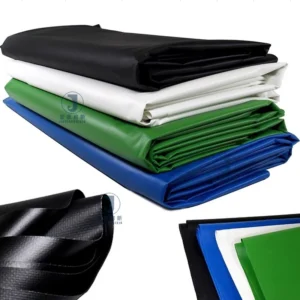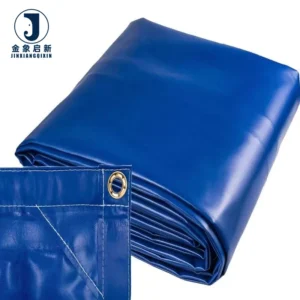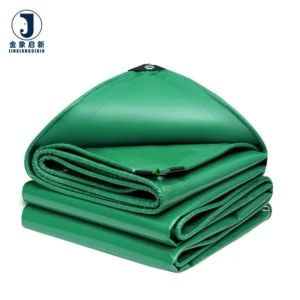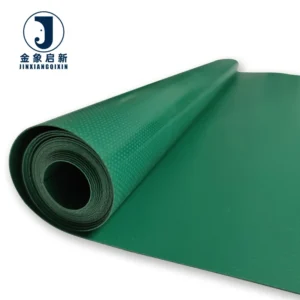
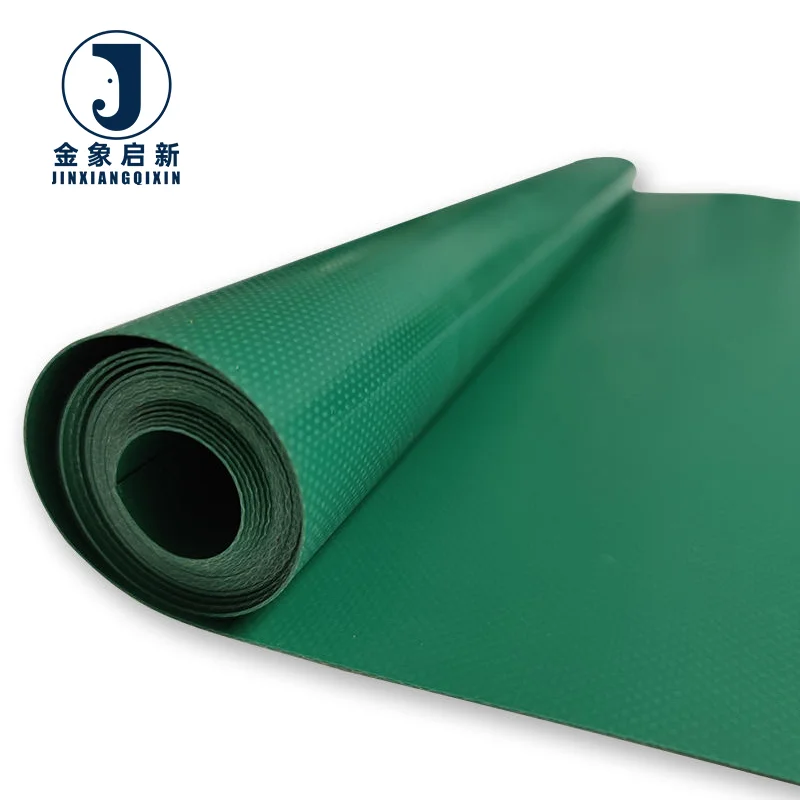
Coating Weight Control — every roll of PVC Coated Tarpaulin Roll undergoes in-process coating weight checks so the GSM you specify is the GSM that ships.
Technical Specifications
| Parameter | Value |
|---|---|
| Product Type | PVC Coated Tarpaulin Roll |
| Material Construction | Polyester base fabric with double-sided PVC coating |
| Weight Range | 350 GSM, 400 GSM, 420 GSM, 500 GSM, 600 GSM, 650 GSM, 750 GSM, 900 GSM |
| Yarn Count Options | 500D×840D / 500D×1000D / 1000D×1000D / 1000D×1300D / 1300D×1300D / 1000D×2000D |
| Weave Density Options | 30×19 / 20×20 / 30×15 |
| Thickness Range | 0.29 mm to 0.65 mm |
| Tensile Strength (Warp) | 1650 N to 3900 N depending on grade (test basis not stated) |
| Tensile Strength (Weft) | 1600 N to 3500 N depending on grade (test basis not stated) |
| Feature | Water resistant, waterproof, anti-UV (test basis not stated), flame retardant (grade not stated) |
| Edge Finishing | High temperature heat sealed seamless edge wrapping |
| Corner Reinforcement | Reinforced corners on all sides |
| Eyelet Options | 3 cm enlarged aluminum alloy buttonhole |
| Rope | 5 mm thick rope without splicing |
| Brittle Temperature | ≤ -50 ~ -60 °C |
| Softening Temperature | ≥ 80 °C |
| Melting Point | 212 °C |
| Certification | ISO, CE (specific certificate numbers available on file) |
Application Suitability
| Application | Exposure & Requirement |
|---|---|
| Truck side curtains and trailer covers | Constant flexing at load points, road debris abrasion, UV and weather exposure requiring weld integrity |
| Industrial shelter and construction enclosures | Wind loading, rain ingress prevention, flame retardant compliance on active work sites |
| Tent and awning structural panels | Tensile loading at ridge and pole points, prolonged UV exposure, colour consistency across panels |
| Machine and equipment covers | Contact with oils and dust, repeated installation and removal, puncture resistance at corners |
| Terrace pergola and balcony rain covers | Permanent outdoor mounting, thermal cycling between seasons, water pooling on flat sections |
Why Denier Matters More Than GSM When Specifying PVC Coated Tarpaulin Material Coating Technology
Tensile and tear performance are determined by the base fabric denier and weave density — not by coating weight alone.
A roll quoted at 600 GSM built on a 1000D×1000D base fabric at 20×20 mesh count will behave very differently under load than a 600 GSM roll built on a lighter weave with heavier coating. The coating adds weight and weather protection, but the yarn structure carries the mechanical load. Technical buyers specifying PVC coated tarpaulin material coating technology GSM denier progressions need the full picture: base fabric, mesh count, and measured tensile values — not a single weight figure. [NEED_CITE: tensile and tear test methods for coated fabrics per ISO 1421]
How Base Fabric Denier Scales Across the Grade Range
The polyester base fabric progresses from 500D×840D at the lighter 350 and 400 GSM grades through to 1000D×2000D at 900 GSM. Each step in denier correlates with a measurable increase in warp and weft tensile strength. This progression gives fabricators a rational basis for selecting roll stock by mechanical requirement rather than guessing from a weight label. The PVC coated tarpaulin material coating technology GSM denier relationship is the foundation for specifying weld parameters, eyelet spacing, and load-bearing panel dimensions.
Coating Adhesion and Edge Seal Integrity
Double-sided PVC coating applied over the polyester substrate must maintain adhesion through repeated flexing, thermal cycling, and mechanical stress. The heat-sealed edge wrapping applied to each roll addresses the most common failure point in fabricated covers — the cut edge where coating and base fabric can separate. [NEED_CITE: coating adhesion and delamination failure modes in PVC polyester laminates] When seams fail before the fabric body, the cause is usually edge separation at a flex point rather than coating breakdown across the panel surface.
Reading the Specification Sheet: Thickness, Density, and Thermal Boundaries
Total thickness ranges from 0.29 mm at 400 GSM to 0.65 mm at 900 GSM. Thickness alone does not determine strength, but it directly affects hot-air welding behaviour — thicker grades require higher temperature or slower feed rates to achieve full coating fusion at the seam. The brittle temperature of ≤ -50 to -60 °C and softening temperature of ≥ 80 °C define the operational envelope. Fabricators working in cold climates should note that the material remains flexible well below freezing, while installations subject to direct summer sun on dark colours approach the softening boundary and may require mechanical fastening rather than relying solely on welded joints. The PVC coated tarpaulin material coating technology GSM denier data sheet should always be read alongside these thermal parameters before setting production tooling.
The Hidden Cost of Specifying on Weight Without Checking the Weave
A cover fabricated from a roll that meets the quoted GSM but uses a lower-denier base fabric with compensating coating weight will pass the incoming weight check but fail at the flex point within months of service. Welded seams on such material tend to peel rather than fuse, because the heavier coating layer creates a thicker bond line that does not penetrate the lighter yarn structure. Colour variation between rolls sourced from different production runs compounds the problem when panels are installed side by side on a single truck or shelter frame. [NEED_CITE: batch-to-batch colour variation in coated fabric roll stock] These failures are not visible at incoming inspection — they only appear under field load and thermal cycling.
Why Technical Buyers Source This PVC Coated Tarpaulin Material Here
Three full production lines with 36 sets of professional equipment provide the capacity for consistent roll-to-roll output across large orders, reducing the batch variation that causes colour and thickness mismatch.
A 10-person R&D team handles material selection, custom sizing, and sample development in days rather than weeks, allowing fabricators to validate weld parameters and colour match before committing to production volumes.
Dedicated quality control at every production stage with full pre-shipment inspection means coating weight, thickness, and colour are verified per roll — not sampled from a single roll and assumed for the batch.
The PVC coated tarpaulin material coating technology GSM denier specifications are documented on a material sheet that travels with the shipment, so incoming quality teams can cross-check denier, mesh count, and measured GSM against the purchase order.
Sample development for custom widths, colours, and treatment grades is completed within days, giving buyers the evidence they need before placing a container order.
Documentation & Verification
- Material specification sheet listing GSM, base fabric denier, coating type, and colour reference per roll
- UV and flame retardant test reports provided where applicable — confirm the grade required for your market
- Pre-shipment inspection record confirming thickness and colour consistency across all rolls in the order
- ISO and CE certificates on file with roll packing list and certificate of origin at dispatch
- Coating weight verification measured per roll against the quoted GSM before release
Fabrication, Handling & Storage
- Set hot-air welding temperature based on the specific grade thickness — 0.29 mm grades fuse faster than 0.65 mm grades
- Heat-sealed edge wrapping should be preserved during cutting to maintain delamination resistance at panel seams
- Store rolls horizontally on racking to prevent flat spots that create visible creases when unrolled for fabrication
- Allow cold-stored rolls to reach ambient temperature before unrolling to avoid coating micro-cracking at low temperatures
- Reinforced corners and 3 cm aluminum eyelets should be positioned to distribute tie-down load across the base fabric weave
- Plan cutting layouts around the available roll width to minimise offcut waste and reduce the number of welded joints per panel
Before You Request a Quote
Provide the end-use application, the mechanical and environmental exposure conditions, and the target market compliance requirements so the correct grade and treatment can be specified. Confirm whether you need roll stock for your own fabrication line or finished cut-to-size panels with edge finishing and eyelets. If colour matching across multiple rolls is critical for the installation, request a production sample before the full order enters production.
Frequently Asked Questions
Q: How is GSM verified on arrival, and what base fabric denier corresponds to each weight grade?
A: Each roll is checked for coating weight during production, and a pre-shipment inspection record confirms the measured GSM before dispatch. The 350, 400, and 420 GSM grades use a 500D×840D base, 500 GSM uses 500D×1000D, 600 GSM uses 1000D×1000D, 650 GSM uses 1000D×1300D, 750 GSM uses 1300D×1300D, and 900 GSM uses 1000D×2000D.
Q: What test standard supports the flame retardant claim, and which grade applies to which GSM?
A: Flame retardant treatment is available across the range, but the specific grade must be confirmed for your market and application. Request the test standard and classification applicable to your region — different markets require different certifications, and the grade should be specified at inquiry stage to ensure correct formulation.
Q: How does the PVC coating method affect weld behaviour and seam strength?
A: The double-sided PVC coating fuses under hot-air welding to create a bonded seam. Thicker grades require adjusted temperature and feed speed settings to achieve full penetration. The heat-sealed edge wrapping prevents delamination at cut edges, which is the most common point of seam failure in fabricated covers.
Q: What thermal parameters should fabricators consider when setting welding equipment?
A: The material softens at ≥ 80 °C and becomes brittle at ≤ -50 to -60 °C. Welding temperature should be set above the softening point but below the 212 °C melting point. Thicker grades such as 900 GSM at 0.65 mm require more heat input or slower feed rates than lighter 400 GSM grades at 0.29 mm.
Q: Can custom widths, colours, and surface finishes be produced on roll stock orders?
A: Custom width, colour, and finish options are available depending on order volume and lead time. A production sample is developed within days so you can verify colour match, surface texture, and weld compatibility before the full batch enters production.