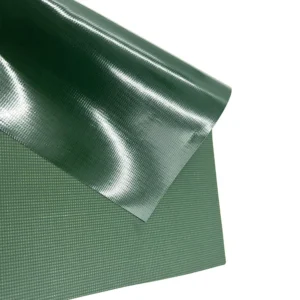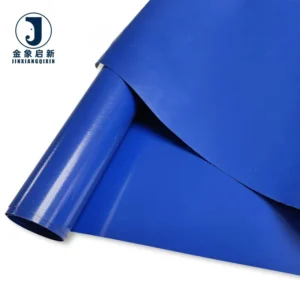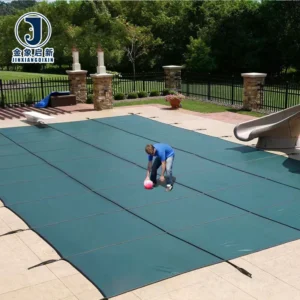
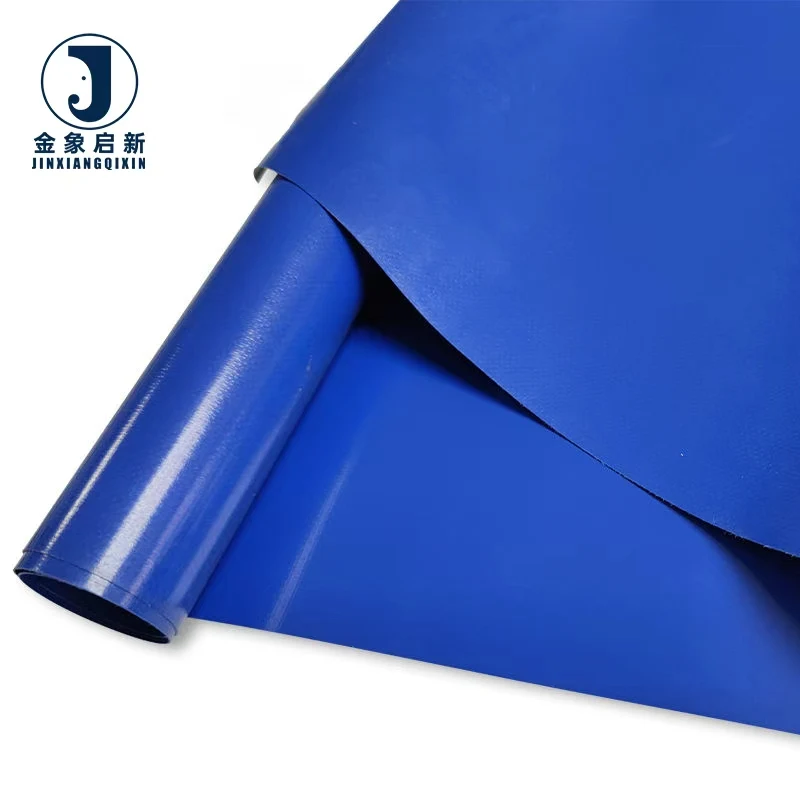
Deep Coating Process Control — every roll of PVC coated tarpaulin fabric has its GSM, base fabric denier and coating weight verified at each production stage before leaving our facility.
Technical Specifications
| Parameter | Value |
|---|---|
| Product Type | PVC Coated Tarpaulin Roll |
| Base Fabric Denier | 500D, 1000D, up to 2000D |
| Weight (GSM) | 400–500 g/m² (medium), 700–1000 g/m² (heavy-duty), 1100–1500 g/m² (super heavy) |
| Total Thickness | 0.35–0.45 mm (medium), 0.70–1.0 mm (heavy-duty), 1.2–1.5 mm (super heavy) |
| Tensile Strength (N/5cm) | Warp 1500–3000 / Weft 1200–2800 (varies by grade) |
| Coating Method | Dipping coating on PES mesh fabric |
| Base Fabric Weave | Knitting and plain weave options |
| Surface Finish | Available in glossy or matte finish |
| Roll Width | 6 ft, 8 ft, 10 ft, 12 ft or custom |
| Roll Length | 100 yards, 100 meters, or custom |
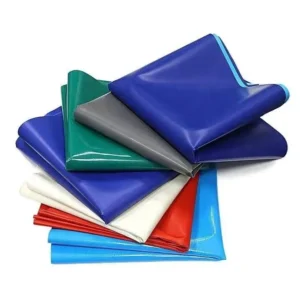
| Color Options | Blue, Blue/Orange, Green, Grey, Black, Clear, Orange, or custom |
| UV Treatment | Available — confirm the grade required for your market (test basis not stated) |
| Flame Retardant | Available in flame retardant grades — confirm the standard required for your market |
| Anti-Mildew | Mildew proof and anti-aging treatment |
| Welding | Heat-welded seams |
Application Suitability
| Application | Exposure & Requirement |
|---|---|
| Truck and trailer side curtains | Constant flexing at tie-down points, road debris abrasion, sustained UV and weather exposure |
| Tensioned membrane structures | Long-term tensile load, wind uplift, UV stability across large unsupported spans |
| Industrial pipe and equipment canopies | Chemical splash, prolonged outdoor weathering, heat-welded seam integrity at joints |
| Tent and awning fabrication | Repeated folding and unfolding, colour consistency across panels, surface finish for printing |
| Inflatable structure fabric | Internal air pressure, seam adhesion under stress, airtight weld lines |
| Construction site covers | Puncture from sharp materials, wind loading, water runoff over extended periods |
Why GSM Alone Does Not Define PVC Coated Tarpaulin Fabric Performance
GSM tells you what the roll weighs — not how the coating bonds to the base fabric or whether the denier suits your stress profile.
Technical buyers frequently specify PVC coated tarpaulin fabric by GSM only, then find the material tears at the weld line or delaminates under load [NEED_CITE: tensile and tear test methods for coated fabrics per ISO 1421]. A 900 GSM roll woven from 500D yarn behaves very differently under tension than a 900 GSM roll woven from 1000D yarn with a heavier coating. The coating weight, the base fabric construction, and the adhesion between layers all contribute to real-world performance, yet none of these are captured by a single GSM number on a quotation.
Base Fabric Denier and Its Role in Tensile Behaviour
The denier of the polyester base fabric directly governs how load distributes across warp and weft directions. A 1000D base with plain weave construction delivers higher tear propagation resistance than a 500D base at the same GSM, because the thicker yarns bridge cuts before they spread. When PVC coated tarpaulin fabric is used for side curtains or tensioned structures, selecting the correct denier prevents seam-line failures that no amount of coating weight can compensate for.
Coating Method and Layer Adhesion
Dipping coating on PES mesh fabric ensures the PVC compound penetrates the yarn interstices, creating mechanical interlock rather than surface-only adhesion [NEED_CITE: coating adhesion test methods for PVC-coated polyester fabrics]. This matters when the fabric is heat-welded: if the coating sits on top of the weave without penetrating, the weld line can peel apart under flexing loads. The dipping process also allows precise control of coating weight per side, which is critical when gloss or matte finish requirements differ between the exposed and inner surfaces.
Reading Tensile and Tear Values Across Grade Tiers
Medium, heavy-duty and super-heavy grades show progressive increases in both warp and weft tensile figures, but the ratio between directions matters as much as the absolute number. A fabric with high warp strength but low weft strength will tear preferentially across the roll when used in applications with multi-directional loading. Matching the tensile profile to the actual stress vectors of the application — rather than selecting on peak warp value alone — prevents premature field failures.
The Hidden Cost of Specifying on Weight Without Verification
Roll stock that arrives lighter than the quoted GSM creates problems beyond the material itself. Fabricators cutting panels to engineered dimensions find the finished product fails load tests, while fleet operators replacing side curtains discover the new fabric does not match the abrasion resistance of the previous batch [NEED_CITE: pre-shipment weight verification standards for coated fabric rolls]. When multiple rolls in a single container vary in coating weight, colour shifts become visible once panels are installed side by side, forcing rework on completed installations.
Why Procurement Teams Source PVC Coated Fabric Here
Our 10-person R&D team handles material selection and sample development, matching base denier and coating weight to your specific application rather than shipping a generic grade. Three full production lines with 36 sets of professional equipment support bulk roll output with consistent on-time delivery across orders. Every roll undergoes 100% inspection before dispatch, with in-process QA at coating, curing and winding stages. Custom widths, colours and surface finishes are developed within days for sample approval before full production runs. Deep process control over coating weight and adhesion has been refined over decades of focused production on coated fabric.
Documentation & Verification
- Material specification sheet stating exact GSM, base denier and coating type per roll
- Test reports for UV and flame retardant grades supplied where applicable
- Pre-shipment inspection record with weight verification against quoted GSM
- ISO and CE certificates available for target-market compliance confirmation
- Roll packing list with colour reference and batch traceability data
- Certificate of origin and full customs documentation included
Fabrication, Handling & Storage
- Heat-weld seams using temperature settings matched to the dipping-coated PVC layer thickness
- Allow heavy-grade rolls to acclimatise before unrolling in cold conditions to prevent coating crack
- Store rolls upright on pallets to avoid flat-spotting the coated surface under self-weight
- Use compatible PVC welding tape for field repairs on the coated surface
- Plan panel layout to minimise cross-roll welds on wide-format membrane structures
- Clean glossy finish surfaces with neutral pH agents to preserve coating integrity
What to Include in Your Enquiry
Provide the intended application, exposure conditions and any fire-retardant or anti-static standards your market requires. Specify the roll width, length and annual volume so we can confirm lead time and production scheduling. If colour consistency across multiple rolls is critical, share your RAL or Pantone reference and request a pre-production sample for approval.
Frequently Asked Questions
Q: What GSM range is available and how does it relate to tensile and tear strength?
A: PVC coated tarpaulin fabric is offered in medium (400–500 GSM), heavy-duty (700–1000 GSM) and super-heavy (1100–1500 GSM) grades. Higher GSM generally increases tensile capacity, but the base fabric denier and weave construction determine tear propagation resistance. We provide a material specification sheet stating exact GSM, denier and coating weight so you can match the grade to your structural requirements.
Q: Can you supply test reports for anti-UV and flame retardant treatment?
A: UV treatment and flame retardant grades are available, and test reports are supplied with shipment documentation where applicable. Before ordering, confirm the specific standard your project requires — such as DIN 4102, NFPA 701 or M2 — so we match the correct treatment grade and provide the relevant certification for your compliance audit.
Q: How do you ensure colour consistency across multiple rolls in one order?
A: All rolls within a single order are produced from the same coating batch under controlled conditions. Our pre-shipment inspection includes side-by-side colour comparison before packing. For projects requiring exact colour matching to a RAL or Pantone reference, we produce a sample roll for your approval before running the full order quantity.
Q: What base fabric denier options are available and which suits my application?
A: Base fabric is available in 500D, 1000D and up to 2000D with knitting or plain weave construction. Higher denier suits applications with multi-directional loading or puncture risk, such as truck side curtains and construction covers. Lower denier reduces weight for tent and awning fabric where flexibility and packing volume matter. Our R&D team recommends the optimal denier based on your stress profile.