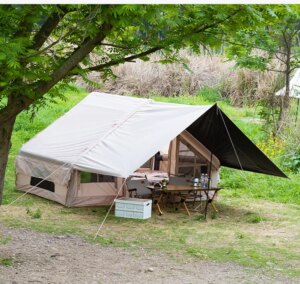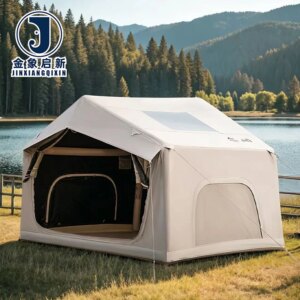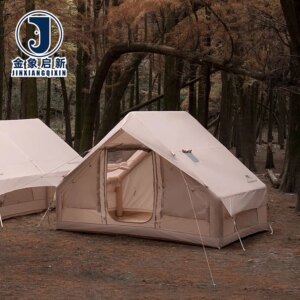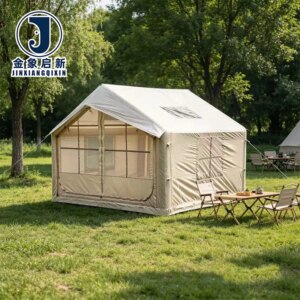
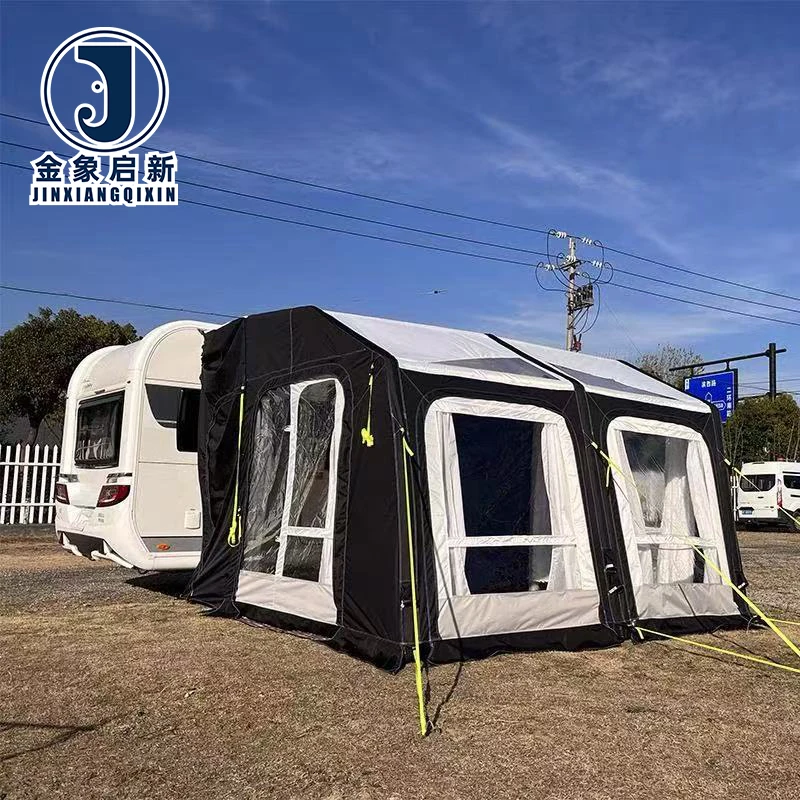
Process-Controlled Coating — Every roll of PVC tarpaulin produced on our three dedicated lines undergoes continuous adhesion and weight checks, ensuring the waterproof integrity and seam-welding consistency that inflatable emergency shelters demand in uncontrolled field conditions.
Technical Specifications
| Parameter | Value |
|---|---|
| Product Type | Inflatable Tent Fabric / Inflatable Shelter |
| Core Material | PVC Tarpaulin |
| Key Performance | Waterproof, UV-resistant (test basis not stated), Tear-resistant |
| Product Forms | Extended Type, Single Layer Construction |
| Customization | OEM & ODM — sample customization, pattern printing, custom sizing |
| Production Facility | 9,180 m² with 3 full production lines and 36 sets of professional equipment |
| R&D Capability | 10 technicians supporting material selection and sample development |
| Quality System | Full-process QA/QC with 100% pre-shipment inspection |
| Certifications | ISO9001, ISO14001, ISO45001, CE |
Application Suitability
| Application | Exposure & Requirement |
|---|---|
| Emergency response centers | Prolonged rain, wind-driven debris, rapid inflation cycles, UV exposure in open staging areas |
| Temporary storage during disaster recovery | Continuous weather exposure, ground moisture contact, load-bearing on inflated beam structures |
| Mobile command posts for engineering projects | Frequent deployment and teardown, abrasion from transport, four-season temperature fluctuation |
| Auxiliary workspace for outdoor industrial operations | Chemical dust, UV degradation over extended deployment, weld-seam stress at flex points |
| Remote industrial installations | Year-round weather cycles, limited maintenance access, structural integrity under sustained inflation pressure |
Why UV-Resistant Claims Fail Without Documented Test Evidence
A UV-resistant label without a stated test duration or standard leaves the buyer carrying the entire verification risk.
Inflatable shelters deployed for disaster relief or remote site operations face continuous solar exposure that degrades PVC coating plasticisers over time. When the coating embrittles, micro-cracks propagate along the beam seam lines — the exact zones under highest mechanical stress. Buyers frequently receive material that passed a brief laboratory exposure rather than a test protocol reflecting months of field deployment [NEED_CITE: accelerated UV weathering test standards for PVC coated fabrics]. Requesting documented UV test results before placing a bulk order eliminates this gap between the quotation claim and the material that actually arrives on site. PVC Inflatable Tent Fabric must carry verification proportional to its intended deployment duration.
Coating Composition and Waterproof Integrity
The PVC tarpaulin used in this inflatable shelter relies on a continuous coating layer bonded to the base fabric to deliver waterproof performance. Unlike laminated constructions where water can migrate between layers, a fully coated PVC structure prevents moisture penetration through both the face and the seam-welded joints. This matters for inflatable shelters because every inflation beam and panel junction is heat-welded, and any coating discontinuity becomes a leak path under sustained internal pressure. The single-layer construction keeps transport weight manageable while maintaining the coating thickness needed for reliable water exclusion in rain-driven emergency scenarios.
Balancing Weight and Structural Durability in Inflatable Design
Single-layer extended-type construction represents a deliberate trade-off between portability and mechanical endurance. Inflatable air-beam shelters concentrate stress at the welded junctions where beams meet panels, and the PVC tarpaulin must resist tear propagation from these high-load zones without adding excessive roll weight that complicates field logistics. The extended-type format provides continuous panel runs that reduce the total number of welded seams in the final structure, lowering the statistical probability of seam-line failure during inflation and sustained wind loading. Specifying the correct PVC Inflatable Tent Fabric grade requires understanding how the base fabric denier and coating weight interact at these critical junction points [NEED_CITE: tear propagation behaviour in coated fabrics under biaxial stress].
How GSM, Base Fabric Denier and Coating Method Interact
GSM alone does not determine how the material will perform in an inflatable structure. The base fabric denier and weave density govern tensile and tear strength, while the coating weight controls waterproof integrity, UV absorption capacity and heat-welding behaviour. A heavier coating does not compensate for a low-denier base fabric when the inflated beam is subjected to lateral wind loads. The coating method — whether knife-over-roll, dip or calender — affects the bond strength between PVC and yarn, which directly influences how the material responds to repeated inflation and deflation cycles. Buyers specifying PVC Inflatable Tent Fabric should request a material specification sheet that states GSM, base fabric denier and coating weight as separate values rather than accepting a single aggregate number, because each parameter governs a different failure mode in the deployed shelter.
The Hidden Cost of Under-Specified Inflatable Fabric
When material is selected on price per square metre without verifying the relationship between base fabric density and coating adhesion, the consequences emerge at the worst possible moment — during inflation in adverse weather. Seams that appeared sound in the factory can delaminate when the internal beam pressure combines with external wind loading, because the coating bond strength was never matched to the structural demand. Batch-to-batch inconsistency in coating weight means that one roll may weld perfectly while the next requires parameter adjustment, delaying production and increasing scrap rates [NEED_CITE: coating weight variance and its effect on heat-welding parameters in PVC tarpaulin]. For inflatable tent manufacturers, the cost of a single failed deployment in the field far exceeds the savings from accepting unverified material specifications.
Why Technical Buyers Source Inflatable Tent Fabric Here
Our R&D team of 10 technicians handles material selection, sample development and pattern printing specifically for inflatable structure applications, reducing the iteration cycle between design and approved prototype. Three full production lines with 36 sets of professional equipment provide the capacity to fulfil bulk roll orders without compromising the coating consistency that inflatable beam welding demands. Full-process QA/QC with 100% pre-shipment inspection means every roll is verified against the stated GSM and coating specification before it leaves the facility, eliminating the surprise of underweight material on arrival. ISO9001, ISO14001, ISO45001 and CE certifications are held against the specific production scope, and documentation is provided to match. Samples are developed within days for custom requirements, allowing buyers to validate welding parameters and material behaviour before committing to full production volumes.
Documentation & Verification
- Material specification sheet stating GSM, base fabric denier and coating weight for the exact inflatable tent grade ordered
- UV test report with stated duration or standard where UV-resistant treatment is specified for the order
- Pre-shipment inspection record confirming batch-to-batch coating consistency across all rolls in the shipment
- ISO9001, ISO14001, ISO45001 and CE certificates matched to the specific production facility and product scope
- Roll packing list detailing individual roll dimensions, weight and colour reference for traceability
Fabrication, Handling & Storage
- Heat-welding parameters should be calibrated to the specific PVC tarpaulin coating weight to prevent seam delamination at beam junctions
- Store rolls upright on pallets in shaded conditions to prevent compression marking on the single-layer extended-type construction
- Avoid dragging cut panels across abrasive surfaces before inflation, as tear resistance depends on intact coating-to-fabric adhesion
- Use compatible PVC-based repair patches and solvent cements matched to the coating composition for field maintenance
- Allow cold-stored rolls to reach ambient temperature before unrolling to prevent coating micro-cracking during fabrication
Requesting the Right Specification for Your Project
To receive an accurate material recommendation, share the intended deployment environment, expected duration of continuous outdoor exposure and any fire-safety or compliance requirements for your target market. Specify whether you need rolls for your own fabrication line or finished cut-and-welded inflatable structures, along with required dimensions, colour references and any pattern printing needs. Confirming these details upfront allows our technical team to propose the correct PVC Inflatable Tent Fabric grade and prepare samples for your welding parameter validation.
Frequently Asked Questions
Q: What is the GSM and base fabric denier of the PVC tarpaulin used in this inflatable tent?
A: The exact GSM and base fabric denier depend on the inflatable shelter grade specified for your application. We provide a material specification sheet stating these values separately for the product you order, along with coating weight and base fabric construction details. Request the data sheet during inquiry to verify the material matches your structural and portability requirements.
Q: What test standard or duration supports the UV-resistant claim for prolonged outdoor exposure?
A: UV-resistant treatment is available for PVC Inflatable Tent Fabric, and we recommend requesting the test report that documents the exposure standard and duration used. This allows you to verify whether the tested period aligns with your expected deployment timeframe. Discuss your specific exposure conditions with our technical team to confirm the appropriate treatment level.
Q: How does single-layer PVC construction compare to double-layer in terms of tensile and tear behaviour at inflatable seam points?
A: Single-layer construction reduces overall weight and simplifies heat-welding, but places greater demand on the base fabric denier and coating adhesion at seam junctions. The correct specification balances tear resistance with transport portability. Our R&D team can provide sample material for weld testing so you can validate seam performance under your specific inflation pressure and wind-load conditions.
Q: Can material thickness and colour be customised for OEM inflatable structure projects, and what is the sample lead time?
A: OEM and ODM customization is available including material thickness variation, custom sizing and pattern printing. Samples are developed within days for custom requirements, allowing you to evaluate coating behaviour, colour accuracy and welding compatibility before approving full production. Contact our technical team with your specification to initiate the sample process.