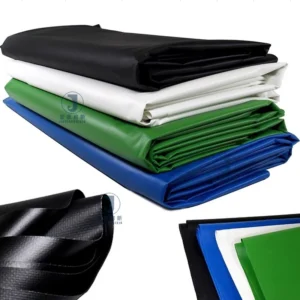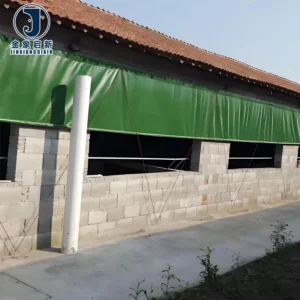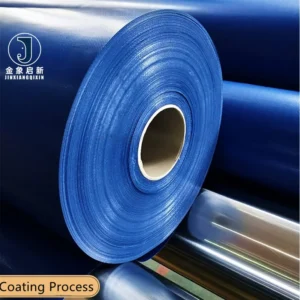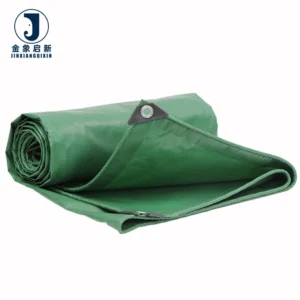
Coating Adhesion Control — Nearly 30 years of process refinement in PVC coating weight and fabric-to-coating adhesion, verified per roll against the stated 650 GSM specification.
Technical Specifications
| Parameter | Value |
|---|---|
| Specification | PVC Tarpaulin Glossy 650GSM 1000D1000D 2323 1.50*50M/R |
| Product Type | PVC Coated Tarpaulin Roll |
| Base Fabric Denier | 1000D×1000D |
| Weave Count | 23×23 |
| Weight | 650 GSM |
| Coating Material | PVC |
| Surface Finish | Glossy (matte available) |
| Roll Width | 1.50 m |
| Roll Length | 50 m |
| Temperature Range | -15°C to 70°C |
| Waterproof | Yes |
| UV Treatment | Customized (test basis not stated in source) |
| Flame Retardant | FR treated (grade not stated in source) |
| Anti-Mildew | Anti-fungal treated |
| Working Life | 3–10 years depending on usage environment |
| Standards | ISO 14001, ISO 45001, CE, RoHS |
Application Suitability
| Application | Exposure & Requirement |
|---|---|
| Truck side curtains | Constant flexing at fold points, road debris abrasion, UV and rain exposure, heat-welded hem integrity under tension |
| Tent and awning panels | Wind load tension on seams, prolonged UV exposure, repeated packing and deployment cycles |
| Pond and reservoir liners | Permanent water contact, soil chemistry, puncture risk from substrate irregularities |
| Equipment and site covers | Outdoor weathering, mechanical handling abrasion, tie-down stress at reinforced points |
| Inflatable and membrane structures | Internal air pressure tension, welded seam gas-tightness, surface cleanliness for adhesion |
Why a Stated 650 GSM Does Not Guarantee Structural Performance
GSM measures coating weight, not the tensile or tear capacity of the finished PVC coated tarpaulin 650 gsm knife coated fabric.
Technical buyers reviewing quotations often see GSM as the single performance indicator, yet two rolls both labelled 650 GSM can behave differently under load if the base fabric denier, weave density, or coating adhesion method diverge. A lighter base fabric with heavier coating may reach the target weight while offering less resistance to tear propagation at stress points. Weld failures in the field frequently trace back to inconsistent coating-to-fabric adhesion rather than the coating weight itself [NEED_CITE: tensile and tear test methods for coated fabrics per ISO 1421]. The relationship between base fabric construction and coating weight determines how the material performs once it leaves the roll and enters fabrication.
How 1000D×1000D Denier and 23×23 Weave Define Load Behaviour
The 1000D×1000D base fabric in this PVC coated tarpaulin 650 gsm knife coated material provides a balanced warp and weft structure. Each yarn carries the same denier, meaning tensile capacity is consistent in both directions — a factor that matters when fabricators cut panels at angles or weld seams that run against the warp. The 23×23 mesh count sets the number of yarns per inch in each direction, creating a tight weave that limits the distance a tear can travel before encountering the next yarn intersection.
Coating Adhesion and Its Role in Weld Line Integrity
Coating weight alone does not determine how well the PVC bonds to the base fabric. The knife coating process used for this material forces PVC compound into the interstices of the 23×23 weave, creating a mechanical lock between coating and yarn. When a fabricator heat-welds two panels together, the weld strength depends on the coating’s ability to melt and fuse without separating from the base fabric underneath. Poor adhesion causes the coating to delaminate at the weld edge under load, even if the GSM reading on arrival matched the specification sheet [NEED_CITE: DIN 53354 test method for coating adhesion on technical textiles].
Interpreting the Specification Set for Fabrication Planning
The 650 GSM weight, combined with 1000D×1000D denier and 23×23 mesh, places this material in a mid-to-heavy duty bracket where tensile and tear performance are governed by the base fabric rather than the coating thickness. Knife coating delivers higher adhesion strength than lamination, which matters for applications where welded seams carry structural load — truck side curtains that flex in transit or inflatable structures holding internal pressure. The -15°C to 70°C operating range defines the thermal envelope: below -15°C the PVC compound stiffens and becomes susceptible to impact cracking, while above 70°C the coating softens, reducing dimensional stability under tension. Glossy finish sheds water and dirt more readily than matte, but matte surfaces provide better ink adhesion for printed branding and reduce glare in awning applications. Roll width at 1.50 m and length at 50 m determine cutting layout efficiency — narrower widths mean more longitudinal seams on large covers, each seam adding weight and a potential failure line.
The Hidden Cost of Overlooking Coating-to-Fabric Bond Strength
When a welded seam fails before the fabric body does, the root cause is often adhesion inconsistency between the coating and the base yarn. The load concentrates at the weld edge where the fabric flexes most, and if the coating separates from the yarn at that line, the entire seam unravels. Fabricators who set heat-weld parameters based only on GSM and surface finish may find that a roll with adequate weight still produces weak welds because the coating did not fully penetrate the weave during manufacturing [NEED_CITE: weld strength testing protocols for PVC coated fabrics]. Batch-to-batch variation in adhesion compounds the problem: a weld temperature that worked on the last shipment may underperform on the next if the coating formulation or cure cycle shifted.
Why Technical Buyers Source This Fabric Here
Deep process control over coating weight and adhesion comes from nearly 30 years of focused production on PVC coated fabric, not from a general-purpose line. Three full production lines and 36 sets of equipment allow this 650 GSM grade to run on dedicated capacity, reducing the risk of cross-contamination between coating formulations. A 10-person R&D team handles material selection and sample development, producing trial rolls within days so fabricators can validate weld parameters before committing to a bulk order. Dedicated QA/QC runs at every production stage, with 100% inspection before shipment — each roll is checked against the material specification sheet for GSM, denier, and surface quality. The result is roll-to-roll consistency in colour and weight across a single order, critical when panels from different rolls are welded side by side on large covers.
Documentation & Verification
- Material specification sheet per roll stating 650 GSM, 1000D×1000D denier, and PVC coating type
- Test reports for UV stability and flame retardant grades supplied where applicable to confirm treatment level
- Pre-shipment inspection record confirming roll count, weight, surface quality, and colour consistency
- Certificate of origin, ISO 14001, ISO 45001, CE, and RoHS certificates included in dispatch documentation
- Packing list with roll dimensions, net weight, and colour reference for receiving and customs clearance
Fabrication, Handling & Storage
- Set heat-weld temperature based on sample testing of the 650 GSM glossy coating to confirm adhesion before bulk welding
- Store rolls upright on pallets in shaded areas to prevent flat-spot deformation of the 1.50 m width against the core
- Allow rolled material to acclimatise to workshop temperature before unrolling to avoid stress creasing in cold PVC coating
- Use sharp rotary blades when cutting the 1000D×1000D base fabric to prevent yarn pull and frayed edges at cut lines
- Clean glossy surfaces with mild detergent only — solvent-based cleaners can soften the PVC coating and compromise weld adhesion
What to Include in Your Enquiry
Specify the end-use application and the environmental exposure conditions the finished product will face, including any fire classification required by local building or vehicle safety codes. Confirm whether you need the glossy finish as standard or a matte surface for printing or reduced glare. State your target roll width and annual volume so that production scheduling and colour matching can be planned across your order cycle.
Frequently Asked Questions
Q: How can I verify the 650 GSM weight when the rolls arrive?
A: Each roll ships with a material specification sheet stating the target GSM. On receipt, cut a measured sample from the roll edge, weigh it on a calibrated scale, and compare the result to the stated 650 GSM. Our pre-shipment inspection records document the weight check performed before dispatch, giving you a baseline to compare against your incoming measurement.
Q: Which flame retardant test standard applies to my market?
A: Flame retardant treatment is available, but the applicable test standard depends on your end-use market and regulatory framework. Confirm the grade required — such as B1 per DIN 4102, M2, or NFPA 701 — and request the corresponding test report with your shipment. We supply test documentation where applicable so you can verify compliance before fabrication.
Q: What test basis supports the UV treatment claim?
A: UV treatment is customised to the target exposure level, and the test basis varies by end-use requirement. When specifying UV stabilisation, state the exposure hours or standard your market requires so the treatment level can be matched and confirmed through a test report supplied with the shipment documentation.
Q: How should I set welding parameters for this 650 GSM fabric?
A: Request a sample roll or swatch to test heat-weld temperature, pressure, and dwell time on your equipment before running production. The 650 GSM coating with glossy finish requires specific temperature settings to achieve full fusion without delamination. Weld strength depends on coating-to-fabric adhesion, so validate peel strength on your sample before committing to bulk fabrication.
Q: How is colour consistency maintained across multiple rolls in one order?
A: Colour matching is controlled at the compounding stage, with reference samples checked at each production run. Rolls within a single order are produced in the same batch where possible, and our QA team verifies colour against the stated reference before packing. This reduces visible variation when panels from different rolls are installed side by side.