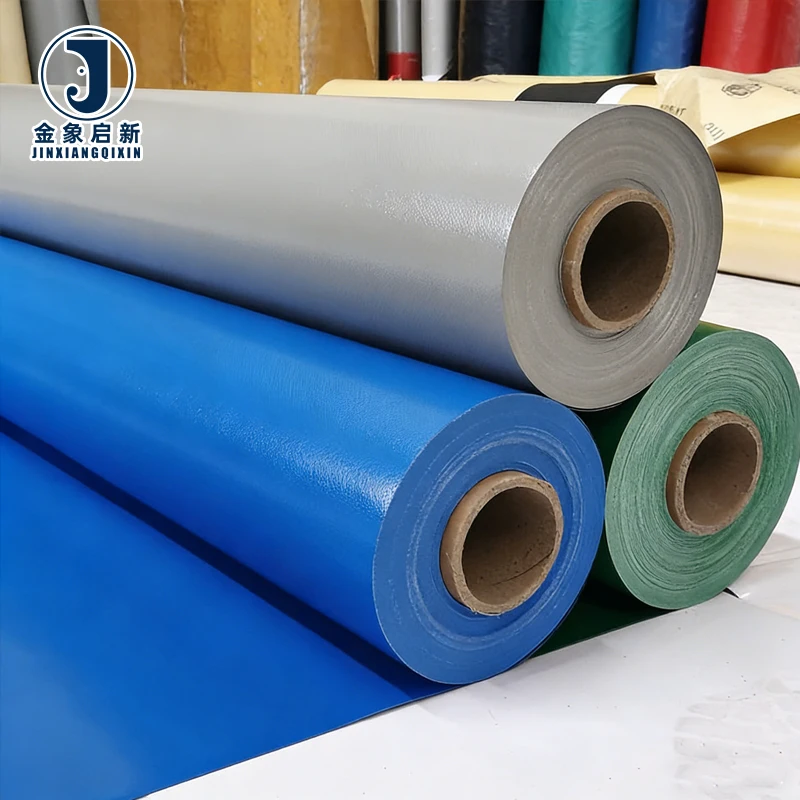
Coating Weight Control — verified GSM per roll backed by pre-shipment inspection records and material specification sheets, ensuring the PVC coated tarpaulin roll weight you order is the weight you receive.
Technical Specifications
| Parameter | Value |
|---|---|
| Product Type | PVC Tarpaulin Roll |
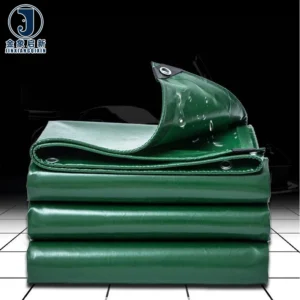
| Material | PVC coated high-strength polyester mesh fabric |
| Coating Technology | Laminated technology & Hot-melt coating technology |
| Weight Options | 350gsm / 420gsm / 500gsm / 550gsm / 600gsm / 750gsm |
| Total Thickness | 0.32mm / 0.35mm / 0.4mm / 0.45mm / 0.5mm / 0.65mm |
| Roll Width | 2m / 2.1m |
| Roll Length | 75m (2m width) / 50m (2.1m width) |
| Surface Finish | Glossy or Matt surface (available per order) |
| Color Options | Blue / Red / Yellow / Light Blue / Grey (customizable) |
| Waterproofing | Double-sided waterproof coated construction |
| Anti-Mildew | Treated for mildew resistance |
| Cold Crack Resistance | Yes |
| Anti-Static | Anti-static treatment applied (standard not stated in source) |
| UV Treatment | Sunproof treatment applied (test basis not stated in source) |
| Color Fastness | High color fastness (test basis not stated in source) |
| Flame Retardant | Available in flame retardant grades — confirm the grade required for your market |
| Service Life | 3–7 years under normal circumstances (source value — verify against application conditions) |
| Customization | Custom color, custom printing, custom sizing |
| Certification | ISO, CE |
Application Suitability
| Application | Exposure & Requirement |
|---|---|
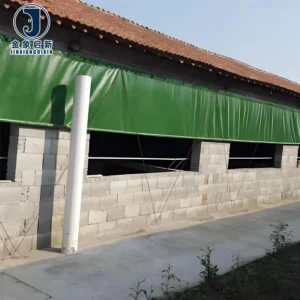
| Tent and awning fabrication | Repeated assembly and disassembly, sustained UV exposure, need for reliable weld seams at structural stress points |
| Truck awning and lorry cover manufacturing | Road abrasion, constant flexing at load-bearing points, weather exposure during transport |
| Cargo ship cover production | Salt spray environment, prolonged moisture contact, high tensile loads from wind and tie-down tension |
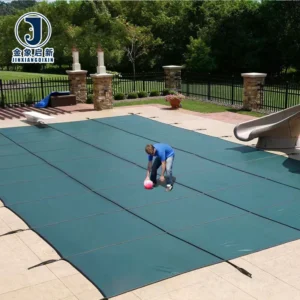
| Fish tank and pool lining | Permanent water immersion, mildew-prone environment, puncture risk from substrate contact |
| Inflatable and membrane structure fabric | Air pressure retention, seam integrity under inflation cycles, UV exposure on exposed surfaces |
Why Coating Adhesion Determines More Than GSM in a PVC Tarpaulin Roll
A roll that meets its stated GSM can still delaminate at the weld line if the coating bond to the base fabric is inadequate.
Many technical buyers specify PVC coated tarpaulin roll GSM as the primary filter, yet coating weight alone does not predict how the material behaves when heat-welded or flexed repeatedly. When the PVC layer separates from the polyester mesh under stress, the seam fails before the fabric itself — leaving a truck awning split open or a tent panel peeling at the joint. [NEED_CITE: coating adhesion test methods for PVC-polyester laminates per ISO 2411] The relationship between hot-melt coating penetration and long-term peel strength is what separates a roll that fabricates cleanly from one that generates scrap at every weld station.
Hot-Melt Coating Penetration and Base Fabric Bonding
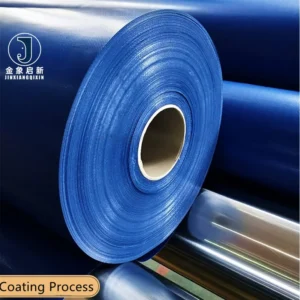
Hot-melt coating technology forces the PVC compound into the interstices of the high-strength polyester mesh under heat and pressure, creating a mechanical lock between coating and yarn. This bond directly affects how the PVC tarpaulin fabric material properties perform during thermal welding — when two layers are fused together, the joint strength depends on whether the coating stays anchored to its own base fabric rather than lifting away. Laminated technology provides an alternative bonding approach where pre-formed PVC films are adhered to the mesh, offering different peel-strength characteristics suited to specific fabrication methods. The choice between these two coating methods should align with your welding equipment parameters and the seam configuration your product demands.
Surface Finish Selection for Weld Performance and Aesthetics
The choice between glossy and matt surface finish affects more than appearance on the finished structure. Glossy surfaces tend to release heat differently during high-frequency or hot-air welding, which can require adjustment of dwell time and pressure at the weld head. Matt surfaces offer reduced glare on installed structures and may accept printed branding with sharper edge definition. [NEED_CITE: effect of surface texture on RF welding parameters for coated polyester fabrics] When ordering multiple rolls for a single project, specifying the same finish across the batch ensures consistent weld behavior and uniform visual appearance once panels are joined side by side.
How GSM, Thickness, and Base Fabric Weave Interact to Define Strength
The PVC coated tarpaulin roll GSM specification tells you the total mass per square metre, but tensile and tear performance depends on how that mass is distributed between base fabric and coating. A 500gsm roll with a dense, high-denier polyester mesh and thin coating layers will resist tearing differently than a 500gsm roll with a lighter base and thicker coating. The six available grades — from 350gsm at 0.32mm through to 750gsm at 0.65mm — span the range from lightweight tent panels to heavy-duty cargo covers, but selecting the right grade requires understanding both the coating thickness and the mesh construction beneath it. Wider rolls at 2m and 2.1m allow fabricators to minimize seam count on large panels, reducing the number of welded joints where stress concentrates during use.
The Cost of Overlooking Roll-to-Roll Consistency
When an order of multiple rolls arrives with visible color variation between them, the consequences extend beyond aesthetics. A truck awning assembled from mismatched rolls shows banding across its surface once installed, and a tent manufacturer cannot swap panels between batches without creating visible patchwork. [NEED_CITE: color consistency tolerance standards for coated fabric batches] Beyond color, inconsistent coating weight between rolls means that welding parameters dialed in on one roll may produce weak seams on the next, forcing fabricators to re-test settings at the start of every new roll — adding downtime and scrap. These problems compound when the material is already cut and welded before the inconsistency becomes visible.
Why Fabricators Choose This PVC Coated Tarpaulin Range
Coating process control built over nearly three decades of focused production means the GSM stated on your quotation is verified against inspection records before dispatch. Three full production lines with 36 sets of professional equipment support bulk roll orders with consistent lead times across all six weight grades. The 10-person R&D team handles custom color matching, surface finish selection, and sample development — producing samples within days so you can test weld parameters before committing to a full order. Dedicated QA and QC at every production stage with full pre-shipment inspection catches coating weight deviations and color drift before rolls leave the facility. Material specification sheets accompany every shipment, documenting the exact GSM, base fabric details, coating method, and color reference for your records.
Documentation & Verification
- Material spec sheet stating exact GSM, base fabric construction, and coating method for each roll
- Pre-shipment inspection records confirming coating weight and adhesion quality per batch
- UV and flame retardant test reports supplied where applicable to the specified grade
- Roll packing list with individual roll weights and dimensions for receiving verification
- Certificate of origin and customs documentation included with each international shipment
- Color reference documentation ensuring batch-to-batch consistency across repeat orders
Fabrication, Handling & Storage
- Hot-air welding temperature and speed should be tested on each GSM grade, as 350gsm and 750gsm rolls require different heat input profiles
- Store rolls upright on their cores to prevent flat spots that create visible creases in the PVC coating surface
- Allow cold-stored rolls to reach ambient temperature before unrolling to avoid coating crack in low-temperature conditions
- Use rotary cutters rather than shears on 600gsm and 750gsm grades to achieve clean edges for welding preparation
- Glossy surface rolls should be handled with clean gloves to prevent fingerprint marks that persist after installation
- Plan panel layout on 2.1m × 50m rolls to minimize offcut waste when cutting large truck awning or tent panels
Planning Your PVC Tarpaulin Roll Specification
To ensure the material matches your fabrication process and end-use environment, provide the application type and the specific mechanical or environmental loads the finished product will face. Indicate your target market so that any fire-retardant or compliance requirements can be matched to the correct test standard before production. Specify the roll width and approximate annual volume to confirm availability and lead time for your required GSM grade and surface finish.
Frequently Asked Questions
Q: How is GSM verified and what documentation accompanies each roll shipment?
A: Every roll is weighed and measured against the stated GSM before dispatch. A pre-shipment inspection record confirms the result, and a material specification sheet documents the base fabric construction, coating method, and exact weight. This documentation ships with your order so you can cross-check on receipt. [NEED_CITE: standard pre-shipment inspection procedures for coated fabric rolls per ISO 9001]
Q: What is the relationship between GSM grade and tensile or tear strength in PVC coated polyester?
A: GSM reflects total weight of coating plus base fabric, but tensile and tear strength depend heavily on the polyester mesh denier and weave density beneath the coating. A higher GSM does not automatically mean higher strength — request the full material spec sheet to see how each grade distributes weight between base fabric and coating layers.
Q: Laminated vs hot-melt coating — which method suits your fabrication process?
A: Hot-melt coating penetrates the polyester mesh for strong mechanical bonding suited to applications with repeated flexing and welding. Laminated technology bonds pre-formed PVC films to the mesh, offering different peel characteristics. Share your welding method and end-use conditions so the appropriate coating technology can be recommended for your PVC tarpaulin fabric material properties requirements.
Q: How do glossy and matte finishes affect weld strength and seam behavior?
A: Surface finish influences how heat transfers during thermal welding. Glossy surfaces may require adjusted dwell times compared to matte finishes, and seam appearance differs between the two. We recommend running weld tests on samples of both finishes before specifying your production order to confirm the optimal parameters.
Q: What fire-retardant and anti-static test standards can be supplied on request?
A: Flame retardant grades are available, and the applicable test standard depends on your market and application. Confirm the specific classification required — such as the fire rating demanded by your local building code or mining safety regulation — so that the correct grade and supporting test report can be provided with your shipment.