Precision Coating Weight Control — Every roll of PVC coated tarpaulin undergoes dedicated QA/QC at each production stage, ensuring the stated GSM matches the delivered material for lumber transport applications.
Technical Specifications
| Parameter | Value |
|---|---|
| Product Type | PVC Truck Cover |
| Base Fabric Denier | 1000 × 1000D |
| Mesh Count | 20×20 / 18×18 (options) |
| Weight (GSM) | 610 gsm / 16 oz / 14 oz (multiple grades available — confirm the grade for this item) |
| Coating Material | PVC |
| Total Thickness | 0.70–1.0 mm (source value — verify against manufacturer catalog) |
| Color | Black / Blue (options) |
| Temperature Range | -35 ~ 70 °C |
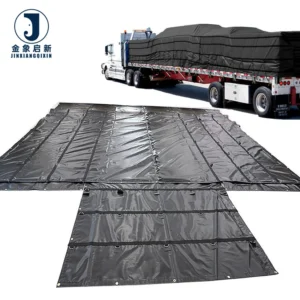
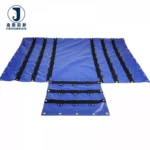
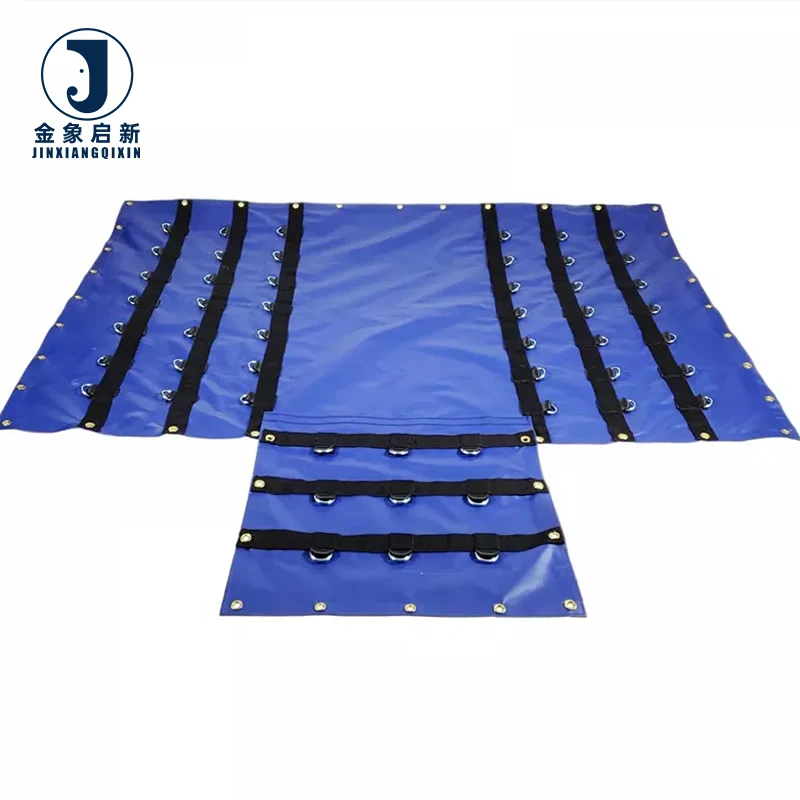
| Dimensions | 24′ × 27′ with 8 ft. drop |
| Hardware | 3 Rows of D-Rings |
| Acid Resistance | Stated (test basis not stated) |
| Construction | Welded seams, reinforced hems |
| Key Features | Waterproof, UV resistant, acid-resistant |
Application Suitability
| Application | Exposure & Requirement |
|---|---|
| Flatbed lumber hauling | Rainwater ingress, UV radiation at highway speeds, road debris impact on load surface |
| Stacked timber and wall panels | Abrasion from load shift during braking and cornering, tie-down stress at D-ring points |
| Construction material transport | Prolonged outdoor storage under cover, dust and chemical exposure at job sites |
| Long-load protection on trailers | Constant flexing at load edges, wind uplift force on tarp underside during transit |
Why GSM Alone Fails to Predict Tarpaulin Performance on the Road
The relationship between base fabric denier, mesh count, and coating weight determines real-world tensile behaviour — not GSM in isolation.
When a flatbed operator specifies a PVC truck tarpaulin for lumber transport, the quotation often states a single GSM figure. Yet two fabrics at identical GSM can differ substantially in tear propagation resistance if one uses a looser mesh count with heavier coating to compensate. [NEED_CITE: tensile and tear test methods for coated fabrics per ISO 1421] The 1000 × 1000D base fabric in this PVC coated truck tarpaulin material and coating technology delivers its structural integrity through yarn denier first, with the PVC coating adding weather protection and weight rather than primary strength. Buyers who verify only total GSM on arrival may accept a roll where coating weight inflated the figure while base fabric density was reduced — a trade-off that surfaces when the tarp flexes under load movement and seams bear concentrated stress. Understanding the PVC coated truck tarpaulin material and coating technology behind each specification allows procurement teams to request the right documentation and avoid costly field failures.
Base Fabric Architecture and Tensile Contribution
The 1000 × 1000D polyester base fabric provides the load-bearing skeleton of this PVC coated truck tarpaulin material and coating technology. Denier refers to the linear mass density of the yarn — heavier yarns resist breaking under tension but also create a stiffer hand feel. The available 20×20 and 18×18 mesh counts represent different weave densities, where a tighter 20×20 construction distributes stress across more yarn intersections per square inch. This matters at the D-ring tie-down rows, where three rows of hardware concentrate pulling force into localised fabric zones. A denser mesh count limits tear propagation from these stress concentrations outward into the field of the tarp.
Coating Adhesion and Welded Seam Behaviour
PVC coating applied to both faces of the 1000 × 1000D base fabric must bond firmly enough to resist delamination during repeated flexing. [NEED_CITE: peel adhesion test methods for PVC coated polyester fabrics] When a lumber tarp flexes over stacked timber during highway transport, the coating experiences cyclic tension and compression at every load undulation. If coating adhesion is insufficient, micro-cracks develop along weld lines first — the heat-welded seams become the weakest point rather than the fabric itself. The PVC coated truck tarpaulin material and coating technology relies on consistent coating weight distribution to ensure that thermal welding parameters produce uniform fusion across the entire seam length, particularly at reinforced hems where multiple layers overlap.
Reading the Specification Sheet Beyond Total Weight
A 610 gsm rating tells you the combined mass of base fabric and PVC coating per square metre, but it does not reveal the ratio between them. A fabric achieving 610 gsm through heavy coating on a lighter base fabric will feel stiffer and may crack at low temperatures before a fabric reaching the same GSM with a heavier base and thinner coating. The -35 to 70 °C temperature range stated for this PVC coated truck tarpaulin material and coating technology reflects the plasticiser formulation in the PVC compound — at the lower boundary, the coating must remain flexible enough to fold and deploy without cracking. Specifiers evaluating multiple GSM grades (610 gsm, 16 oz, 14 oz) should request the coating-to-fabric weight ratio to understand which component dominates the total mass.
The Hidden Cost of Specifying on Price Per Kilogram Alone
When procurement teams evaluate PVC truck tarpaulin rolls purely on cost per kilogram, suppliers may reduce base fabric denier or mesh density while maintaining quoted GSM through excess coating filler. The result arrives looking correct on a scale but fails in the field — weld seams peel apart at flex points, D-ring pull-outs enlarge into tears, and the coating surface cracks during cold-weather deployment. [NEED_CITE: common failure modes in PVC coated tarpaulin at welded seams] For lumber transport operators, a single load damaged by water ingress through a failed seam costs far more than the price difference between a properly specified roll and a value-engineered one. Batch-to-batch inconsistency compounds this: rolls from the same order may vary in coating weight, producing visible colour shifts when installed side by side on adjacent trailers.
Why Material Buyers Source This PVC Coated Tarpaulin Here
Deep process control over coating weight and adhesion ensures that every roll of this PVC coated truck tarpaulin material and coating technology meets the stated GSM specification before it leaves the facility. Three full production lines and 36 sets of professional equipment support bulk roll orders with consistent coating application across the entire run. A 10-person R&D team handles material selection and sample development, allowing buyers to evaluate base fabric and coating combinations before committing to volume. Dedicated QA/QC operates at every production stage with full inspection before shipment, catching adhesion or weight deviations early. Sample rolls for custom GSM grades or colour matching are developed within days, reducing the evaluation cycle for new material qualification.
Documentation & Verification
- Material specification sheet stating exact GSM, 1000 × 1000D base fabric denier, and coating weight per roll
- UV resistance test report supporting the outdoor exposure claim for this PVC truck cover fabric
- Pre-shipment inspection record confirming GSM and coating adhesion against the quoted specification
- ISO and CE certificates validating the production quality management system
- Roll packing list with individual roll weights for receiving verification at your warehouse
Fabrication, Handling & Storage
- Heat-weld seams at temperatures matched to the specific PVC coating thickness on this 610 gsm grade fabric
- Reinforce D-ring attachment zones with additional PVC patches to distribute tie-down load across the 1000 × 1000D base fabric
- Store rolls horizontally on padded racks to prevent permanent creasing of the PVC coating surface
- Allow cold-stored rolls to acclimatise before unrolling to avoid cracking the PVC coating below -35 °C
- Use mild detergent for cleaning — avoid solvent-based products that attack the plasticiser in the PVC coating
- Cut panels from rolls following the weave direction to maintain tear resistance alignment with load stress
Requesting a Technical Quotation for Your Application
Provide your target GSM grade from the available options (610 gsm, 16 oz, 14 oz) along with the mesh count preference and colour requirement for your lumber transport fleet. Specify whether you need finished tarps cut to your trailer dimensions with D-ring hardware installed, or roll stock for in-house fabrication. Confirm any fire-retardant or chemical resistance requirements for your operating environment so we can match the appropriate coating formulation. Share your annual volume and delivery schedule to receive accurate lead time and production planning details.
Frequently Asked Questions
Q: How is GSM measured and how does it relate to coating weight versus base fabric weight?
A: GSM represents the total mass of base fabric plus PVC coating per square metre, measured by cutting a standard sample area and weighing it. The base fabric denier and mesh count determine the structural component, while the PVC coating adds weather protection mass. Two fabrics at the same GSM can have very different strength profiles depending on the ratio. Request a breakdown of coating weight versus base fabric weight on the specification sheet for accurate comparison.
Q: What is the difference between 20×20 and 18×18 mesh count in tensile and tear performance?
A: A 20×20 mesh count places more yarn intersections per unit area than 18×18, distributing load stress across a denser grid. This generally improves tear propagation resistance, particularly around hardware attachment points like D-rings. The 18×18 option uses a slightly more open weave, which can reduce weight in the base fabric component. The choice depends on whether your primary concern is maximum tear resistance or weight optimisation for handling.
Q: How does PVC coating adhesion affect welded seam strength at flex points?
A: During heat welding, the PVC coating on two panels must fuse completely while the base fabric remains structurally intact beneath. If coating adhesion to the base fabric is weak, the weld zone becomes a delamination point under cyclic flexing — the coating separates from the yarn before the weld itself fails. Consistent coating weight and proper thermal control during welding are both essential to produce seams that match or exceed the parent fabric strength.
Q: What UV test basis supports the outdoor exposure claim for this fabric?
A: UV resistance depends on the stabiliser package blended into the PVC coating formulation during production. The specific test method and exposure duration should be stated on the test report provided with your order. Request documentation showing the test standard used, the irradiance level, and the retention percentage of tensile strength after the exposure period. Confirm the grade required for your market before placing the order.
Q: Can the coating formulation be adjusted for specific temperature or chemical exposure requirements?
A: The PVC compound can be modified with different plasticiser types and ratios to shift the low-temperature flexibility boundary or improve resistance to specific chemical environments. The stated -35 to 70 °C range reflects the standard formulation. If your application involves exposure below this range or contact with particular chemicals, provide the operating conditions so the R&D team can evaluate whether an adjusted formulation or alternative grade is needed for your PVC coated truck tarpaulin material and coating technology requirements.