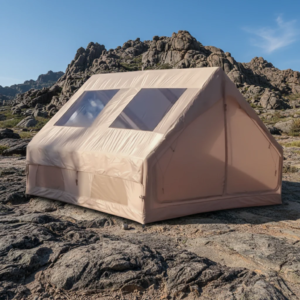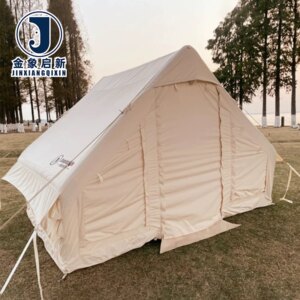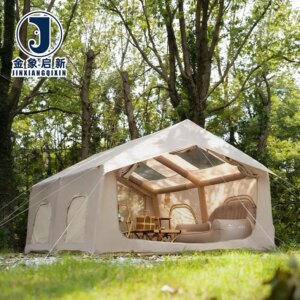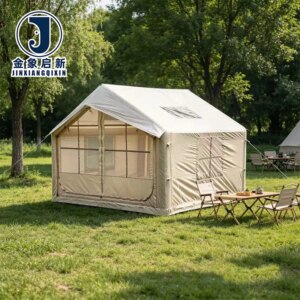
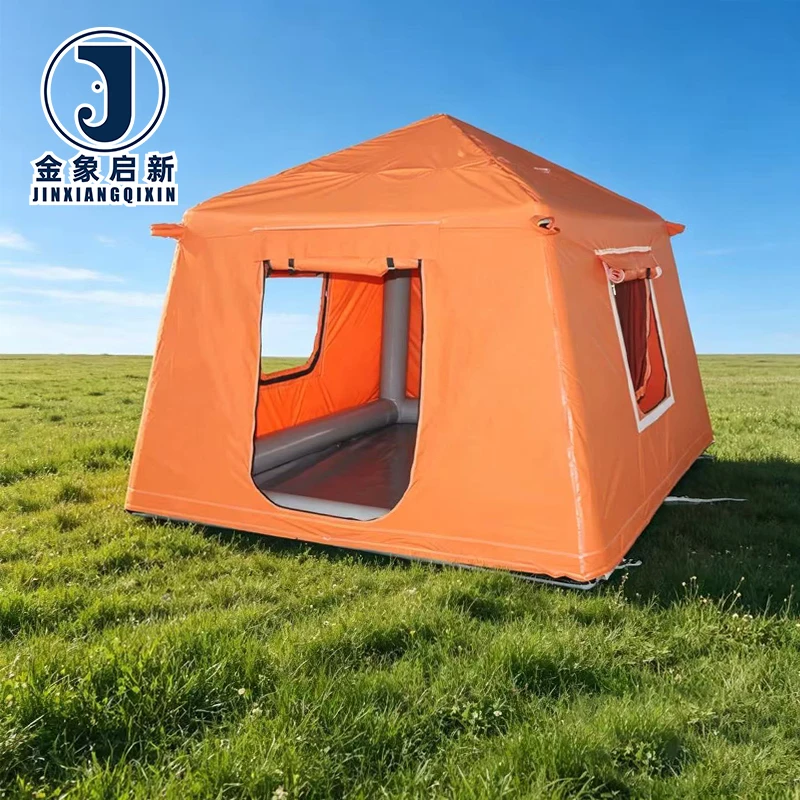
Coated Fabric Expertise — Nearly three decades of coating process control applied to 420D Oxford inflatable tent fabric, ensuring weld integrity and batch-to-batch consistency across every roll produced on our three dedicated lines.
Technical Specifications
| Parameter | Value |
|---|---|
| Product Type | Inflatable Tent Fabric |
| Base Fabric | 420D Oxford |
| Construction | Single Layer Coated |
| Design Geometry | Extended Type |
| Opening System | Quick Automatic Opening |
| Capacity Range | 5-8 Person |
| Season Rating | 4-Season |
| Customization | OEM & ODM (Sample customization, pattern printing) |
| Standards | ISO9001, ISO14001, ISO45001, CE |
| Flame Retardant | Available in flame retardant grades — confirm the grade required for your market |
| UV Treatment | Available with anti-UV treatment — confirm test basis required for your application |
Application Suitability
| Application | Exposure & Requirement |
|---|---|
| Construction site temporary shelters | Continuous UV exposure, wind loading on inflated beams, abrasive dust contact at ground level |
| Disaster relief emergency facilities | Rapid deployment under adverse weather, repeated inflation cycles, transport abrasion |
| Logistics mobile storage units | Forklift proximity, ground moisture, tension stress at anchoring points |
| Field operations base camps | Multi-season temperature variation, extended inflation periods, high-wind flex stress on seams |
Why Welded Seams Fail Before the Fabric Does in Inflatable Structures
Seam failure on inflatable tents traces back to coating adhesion, not base fabric strength.
When an inflatable beam flexes under wind load, the welded joint endures cyclic stress that a flat-lying tarpaulin never sees. I have seen heavy-grade coated rolls fail at the weld line while the field fabric remained intact — the coating simply delaminated from the base weave under repeated inflation pressure. For Inflatable Tent Fabric built on 420D Oxford, the bond between coating and yarn must survive thousands of pressurization cycles without micro-cracking. [NEED_CITE: tensile and peel strength test methods for coated fabrics per ISO 1421]
Base Fabric Denier and Tear Propagation
The 420D Oxford base fabric provides a specific denier weight per yarn that directly governs how a puncture or cut propagates under tension. Higher denier yarns resist tear spread, which matters when an inflatable beam is pressurized and any fabric damage can zip open under internal pressure. The weave density works alongside denier — a tightly woven 420D Oxford limits the distance a tear can travel before encountering the next yarn intersection, containing damage locally rather than allowing catastrophic beam deflation.
Coating Adhesion Under Cyclic Inflation
Single-layer coated construction on this Inflatable Tent Fabric must maintain adhesion through repeated pressurization and deflation. Each inflation cycle stretches the coating against the base fabric, and poor adhesion leads to delamination at weld zones first. The coating method determines how thoroughly the polymer penetrates the Oxford weave — insufficient penetration leaves a mechanical bond that separates under flex stress, while proper impregnation creates a bond that fails cohesively within the coating itself rather than at the interface. [NEED_CITE: coating adhesion and peel test protocols for inflatable structures]
How GSM, Denier, and Construction Interact for Inflatable Applications
The 420D denier specifies the mass per 9,000 meters of yarn, which governs individual yarn strength but tells you nothing about the finished fabric without knowing the weave count and coating weight. A 420D Oxford with a loose weave and thin coating will underperform a tighter weave at the same denier. For inflatable tent beams, the coating must fill the weave interstices completely to create an airtight barrier while maintaining enough flexibility to fold and deploy repeatedly. The extended type design geometry distributes fabric tension across a broader area, reducing peak stress concentrations at beam junctions where most failures originate. Surface finish — whether glossy or matte — affects both UV reflectance and the adhesion of printed branding or pattern customization applied during OEM production.
The Hidden Cost of Specifying Inflatable Fabric by Denier Alone
Purchasing decisions based solely on 420D denier without verifying coating adhesion and weld parameters lead to field failures that appear as fabric defects but originate at the manufacturing stage. Batch-to-batch color variation across rolls forces tent manufacturers to reject entire production runs when panels are sewn or welded side by side. Flame retardant grades claimed without a supporting test report result in failed site inspections when the structure is deployed in a regulated environment. Weld parameters optimized for one coating formulation may not transfer to another, producing seams that pass initial peel tests but degrade after months of inflation cycling. [NEED_CITE: DIN 4102 fire classification for building materials and temporary structures]
Why Procurement Teams Source This Fabric Here
Deep coating process control across three full production lines ensures the 420D Oxford receives consistent coating weight and adhesion from first roll to last within an order. A dedicated 10-technician R&D team develops custom samples within days, allowing OEM buyers to validate weld parameters and color matches before committing to volume. Strict full-process quality inspection with dedicated QA and QC staff catches adhesion drift, color shift, and coating weight variation before rolls leave the 9,180 square meter facility. Thirty-six sets of professional processing equipment handle everything from base fabric coating through pattern printing and sample cutting under one roof. ISO9001, ISO14001, ISO45001, and CE certification documentation ships with every order, supporting compliance audits at the destination market.
Documentation & Verification
- Material specification sheet confirming 420D Oxford base fabric denier, coating type, and color reference
- Test reports for UV and flame retardant treatments where applicable, matched to your market requirements
- Pre-shipment inspection record documenting 100% QA/QC check across all rolls in the order
- ISO9001, ISO14001, ISO45001, and CE certificates for compliance verification
- Roll packing list with individual roll identifiers for traceability
Fabrication, Handling & Storage
- Heat welding parameters must be matched to the single-layer coating formulation on the 420D Oxford to avoid delamination at beam joints
- Store rolls horizontally on padded racks to prevent permanent creasing that weakens the coated surface at fold lines
- Use compatible cleaning agents that do not dissolve or soften the coating when removing site dirt from deployed inflatable structures
- Allow cold-stored rolls to reach ambient temperature before unrolling to prevent coating micro-cracking on the 420D Oxford base
- Plan cutting layouts to minimize cross-grain panels in extended type designs where tension distribution favors warp-aligned seams
Request a Material Specification for Your Inflatable Project
Provide your target inflation pressure range, expected deployment cycle frequency, and the regulatory environment where the finished structure will operate. Specify whether you require rolls for your own fabrication line or finished cut-and-welded panels, along with color references and any pattern printing requirements. Confirm the flame retardant or anti-UV grade your market demands so we can supply the matching test documentation with your Inflatable Tent Fabric order.
Frequently Asked Questions
Q: How is the 420D Oxford base fabric denier verified on arrival against the quotation?
A: Every roll ships with a material specification sheet stating the base fabric denier, coating type, and weight. Our QA team performs pre-shipment inspection against these stated values. If your receiving protocol requires independent lab verification, we can arrange third-party testing before dispatch and include the report in your documentation package.
Q: What coating method is used, and how does it affect weld and seam strength for inflatable structures?
A: The single-layer coating is applied to fully penetrate the 420D Oxford weave, creating an airtight barrier with strong substrate adhesion. This determines how well heat-welded seams withstand repeated inflation cycles. We provide recommended welding temperature and dwell time parameters matched to the specific coating formulation so your fabrication team achieves consistent peel strength.
Q: Are flame-retardant or anti-UV treatments available with test reports and certified grades?
A: Both treatments are available, but the required grade depends on your destination market and application. Specify the standard your project demands — such as a particular flame retardant classification or UV exposure test method — and we will supply fabric treated to that grade with the corresponding test report included in your shipment documentation.
Q: How is batch-to-batch color consistency controlled across rolls of inflatable tent fabric?
A: Color is managed through controlled pigment dosing and verified against reference standards during production. Each roll is inspected before shipment, and rolls within a single order are matched to minimize visible variation when panels are placed side by side. For OEM projects requiring strict color tolerances, we recommend approving a production sample before bulk coating begins.
Q: What sample development and customization options are available for OEM and ODM inflatable tent projects?
A: Our 10-technician R&D team develops custom samples within days, including specific color matches, pattern printing, and custom sizing. You can evaluate weld behavior, color accuracy, and fabric handling characteristics on the sample before authorizing volume production. Both OEM fabrication to your drawings and ODM design support are available across the full 420D Oxford Inflatable Tent Fabric range.