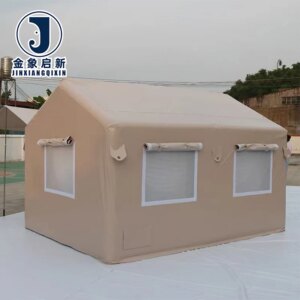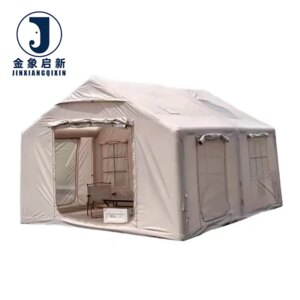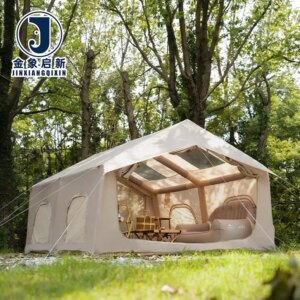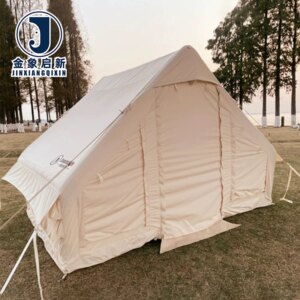
Coating Process Control — every roll of inflatable tent fabric undergoes in-process GSM and adhesion checks across three dedicated production lines, keeping batch weight aligned with the quoted specification from first metre to last.
Technical Specifications
| Parameter | Value |
|---|---|
| Product Type | Inflatable Tent Fabric |
| Core Material | UV Water-resistant PVC Fabric |
| Fabric Thickness Range | 0.3 mm to 0.8 mm |
| Key Performance | Waterproof, UV-resistant, Tear-resistant |
| Tear Strength | Exceeds 300 N warp and weft (test basis not stated — confirm standard required) |
| UV Protection Retention | 90 % after 500 h accelerated weathering (test basis not stated — request report) |
| Airtightness | Tested to maintain pressure for 72 h |
| Wind Load Resistance | Up to 12 m/s |
| Product Form | Inflatable structure, single-layer design |
| Colour | Khaki (custom Pantone matches available) |
| Customisation | OEM & ODM — sample development, pattern printing, logo application |
| Standards | ISO 9001, ISO 14001, ISO 45001, CE |
Application Suitability
| Application | Exposure & Requirement |
|---|---|
| Outdoor event management | Repeated inflation cycles, crowd contact abrasion, full-day UV exposure |
| Mobile exhibition spaces | Frequent transport, rapid deployment, branding print clarity |
| Construction site temporary shelters | Dust, debris impact, wind-driven rain, extended outdoor standing |
| Industrial site accommodations | Constant inflation pressure, temperature swings, chemical-laden air |
| Commercial outdoor marketing activations | High-visibility colour consistency, seasonal redeployment, UV load |
Why Coating Weight and Adhesion Matter More Than Stated GSM for Inflatable Tent Fabric
An inflatable structure fails first where the coating separates from the base fabric — not where the yarn breaks.
When sourcing inflatable tent fabric, buyers often anchor on a single GSM figure. Yet the air-holding performance of a single-layer inflatable membrane depends as much on coating adhesion and uniformity as on base fabric mass. A lighter PVC layer with strong knife-coat penetration into the weave will hold a weld seam longer than a heavier coating sitting on the surface [NEED_CITE: tensile and tear test methods for coated fabrics per ISO 1421]. In my experience, most early-season failures on commercial inflatable tents trace back to delamination at flex points — precisely where inflation pressure pushes the fabric through repeated stress cycles.
Base Fabric, Coating, and the Air-Holding Equation
The relationship between denier, weave density, and coating weight defines how well an inflatable tent fabric resists both burst pressure and slow air loss. Tighter weaves give the PVC coating more surface area to grip, improving peel strength at heat-weld seams. For single-layer inflatable structures, this adhesion is the primary barrier against pressure drop across multi-day deployments.
UV-Stabilised Additives in the Coating Layer
UV stabilisers are compounded into the PVC during the coating stage, not applied as a surface spray. This means their distribution — and therefore the fabric’s long-term colour and strength retention — depends entirely on mixing discipline at the extrusion head. Inflatable tent fabric manufacturers who control their own coating lines can verify additive loading roll by roll, rather than relying on pre-coated stock from a third party [NEED_CITE: accelerated weathering protocols for PVC-coated textiles].
Heat-Weld Behaviour Under Cyclic Inflation
Every inflation and deflation cycle flexes the welded seams. A knife-coated PVC fabric with consistent coating thickness welds predictably: the same temperature and dwell time produce the same peel strength across the entire roll. Variations in coating weight — even within a single roll — force fabricators to adjust welding parameters mid-panel, raising the risk of a weak joint that leaks before the membrane itself shows wear.
Specification Drivers Behind Real-World Performance
Thickness range from 0.3 mm to 0.8 mm covers everything from lightweight exhibition domes to heavy-duty construction shelters. Thinner grades reduce packed weight and speed inflation; thicker grades add puncture resistance against ground debris and tool contact. Tear strength exceeding 300 N in both directions provides a margin against propagation once a small cut occurs — important when the entire structure depends on continuous air pressure. The 72-hour airtightness test signals that the coating and seam construction together limit leakage to a rate compatible with standard blower units. Single-layer design trims material mass versus multi-layer alternatives, cutting both shipping cost and inflation energy demand [NEED_CITE: single-layer versus multi-layer membrane comparison for inflatable shelters]. Wind load resistance up to 12 m/s covers typical open-site conditions; higher gust environments may require ballast or guy-line reinforcement beyond the fabric specification.
The Cost of Overlooking Weld-Seam Compatibility
I have seen coated fabric that met every stated tensile figure on the data sheet yet failed at the seam within the first inflation test. The cause was a coating formulation that softened at a different rate than the base fabric during heat welding, creating a brittle boundary layer. For inflatable tent fabric, weld-seam strength must be validated under the same temperature and pressure parameters the fabricator will use in production — a data point that a generic spec sheet rarely provides [NEED_CITE: weld peel strength testing for PVC-coated inflatable membranes].
Why Procurement Teams Source This Fabric Here
Process control over coating weight and adhesion is maintained across all three production lines, so bulk orders stay within the quoted thickness tolerance from first roll to last. A 10-technician R&D team develops custom Pantone matches and sample panels, letting buyers confirm colour and weld behaviour before committing to a full production run. Every batch ships with a pre-shipment inspection record that documents actual GSM, coating thickness, and airtightness readings — not just a pass stamp. Pattern printing and logo application are handled in-house, keeping registration accuracy aligned with the panel cutting layout. The QA/QC protocol inspects every roll before packing, reducing the chance that a fabric defect reaches the fabricator’s welding table.
Documentation & Verification
- Material specification sheet listing coating composition, thickness range, and UV treatment data per batch
- Tear and UV test reports traceable to the production roll number referenced on the packing list
- Pre-shipment inspection record showing measured GSM, coating weight, and 72-hour pressure-hold result
- ISO 9001, ISO 14001, ISO 45001, and CE certificates included with every consignment
- Certificate of origin and customs documentation prepared for destination-market clearance
Fabrication, Handling & Storage
- Heat-weld at the temperature range validated on your sample panel; coating thickness from 0.3 mm to 0.8 mm each require different dwell times.
- Store rolls upright on a flat pallet to avoid edge compression marks that distort coating adhesion at the weld zone.
- Cut panels with a fresh blade to prevent frayed yarn ends that reduce weld-seam peel strength on single-layer inflatable structures.
- Clean the PVC surface with a mild, non-solvent detergent to preserve UV-stabiliser loading in the coating layer.
- Repair minor punctures with a PVC patch welded at the same temperature used for primary seams to maintain airtightness continuity.
Before You Request a Quote
Share the deployment environment — expected wind speeds, average UV index, and whether the structure will remain inflated continuously or cycle daily. Specify the target market so the correct fire-classification and anti-static requirements can be confirmed against available grades. Provide panel dimensions and annual roll volume; this determines whether stock widths fit your cutting layout or a custom width run is more economical.
Frequently Asked Questions
Q: What GSM and coating weight should inflatable tent fabric carry?
A: The appropriate GSM depends on the structure’s size, inflation pressure, and expected wind load. Thicker coatings improve puncture resistance but add packed weight. Request a material specification sheet that breaks out base fabric weight and coating weight separately so you can match the combination to your design parameters rather than relying on a single total-GSM figure.
Q: How is UV resistance tested and documented per roll?
A: UV retention is measured through accelerated weathering exposure, with results reported as percentage strength and colour retention after a defined period. Because test protocols vary by market, request the specific test report for your production batch and verify that the method aligns with the standards your destination country requires for outdoor textile products.
Q: What welding method and temperature work best with this PVC?
A: Hot-air and hot-wedge welding both work with this coating formulation. The exact temperature window depends on the coating thickness selected from the 0.3 mm to 0.8 mm range. Run a test weld on a sample swatch first and record peel strength; use those parameters as the baseline for full-panel production.
Q: Can fabric thickness and colour be customised per roll order?
A: Yes. Thickness is adjustable across the 0.3 mm to 0.8 mm range, and Pantone colour matching is available. Custom colours require a sample approval step before mass production begins. Provide your target Pantone reference and required roll width so the coating line can be set up for a single, consistent batch.
Q: Which certifications and test reports ship with the fabric?
A: Each consignment includes ISO 9001, ISO 14001, ISO 45001, and CE certificates along with a pre-shipment inspection record. UV and tear-resistance test reports are provided per batch. If your market requires a specific fire-classification grade, confirm the requirement at inquiry stage so the correct additive package is selected and documented.