Process Control Expertise — Nearly 30 years of PVC coating discipline applied to inflatable tent fabric, ensuring batch-to-batch waterproof and tensile consistency that outdoor gear manufacturers rely on for repeatable production runs.
Technical Specifications
| Parameter | Value |
|---|---|
| Product Type | Inflatable Fabric |
| Core Material | PVC tarpaulin |
| Coating Material | PVC |
| Construction | Single layer PVC tarpaulin |
| Waterproof Rating | ≥2000mm water column (batch verified) |
| Tear Strength | ≥300N (standard not stated in source) |
| UV Treatment | 500 hours exposure (test basis not stated in source) |
| Flame Retardant | Available in flame retardant grades — confirm the grade required for your market |
| Anti-Static | Available in anti-static grades — confirm surface resistance or standard required |
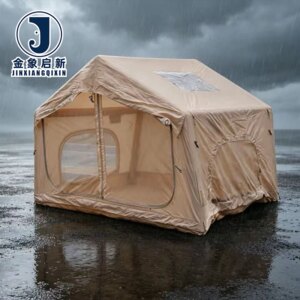
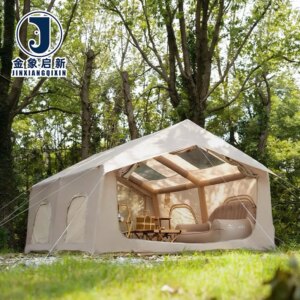
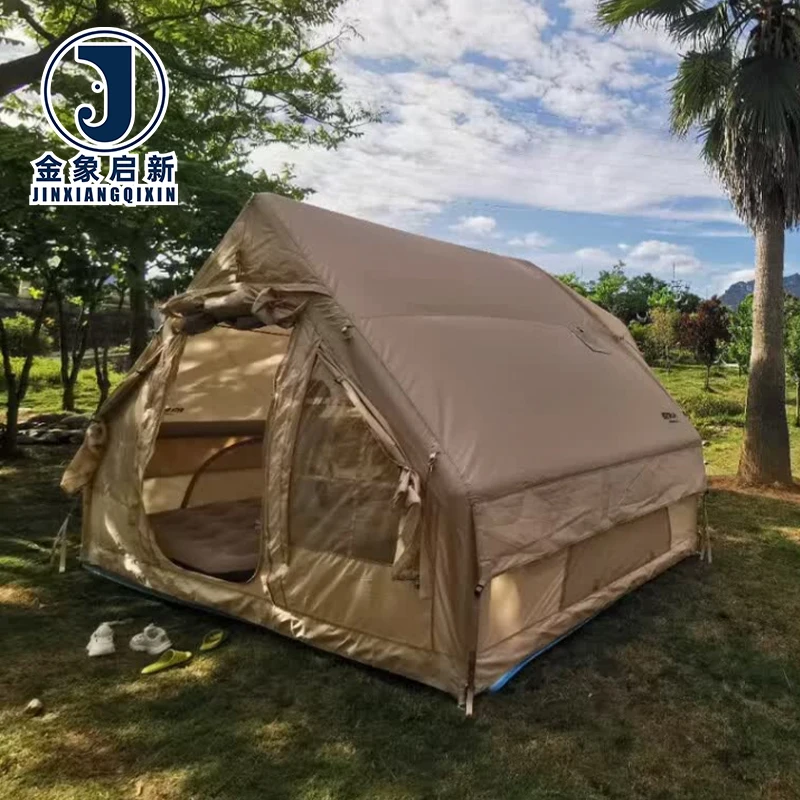
| Capacity (End Product) | 8–10 person inflatable camping tent |
| Season Rating (End Product) | 4 season |
| Customization | OEM & ODM — sample customization, pattern printing, material selection, product design |
| Prototype Lead Time | 7–10 business days |
| Production Lead Time | 15–20 days for standard orders |
| Certifications | ISO9001, ISO14001, ISO45001, CE |
Application Suitability
| Application | Exposure & Requirement |
|---|---|
| Commercial inflatable camping tent manufacturing | Repeated inflation cycles, internal air-beam stress, prolonged outdoor UV and rain exposure |
| Family-sized 4-season shelter assembly | Sub-zero flexibility, snow load on air beams, condensation and ground moisture contact |
| Outdoor gear brand product lines | Batch colour consistency across production runs, pattern print adhesion, retail packaging presentation |
| Wholesale camping equipment distribution | Roll-to-roll uniformity for contract cutters, container-load volume planning, regulatory documentation per shipment |
Why Coating Weight Consistency Matters More Than Stated GSM for Inflatable Tent Fabric
A quoted GSM figure means little if the coating distribution varies from roll to roll — inflatable tent manufacturers need verified weight per batch, not a catalogue number.
Inflatable tent fabric carries structural loads through its air beams. When coating thickness drifts between batches, the fabric’s waterproof barrier and tear behaviour shift unpredictably. Manufacturers then face warranty claims on tents that leaked or tore under conditions the earlier batch survived. An inflatable tent fabric manufacturer must demonstrate that every roll leaving the line matches the specification the design was validated against. [NEED_CITE: tensile and tear test methods for coated fabrics per ISO 1421]
Coating Adhesion and Air-Beam Structural Integrity
The single-layer PVC tarpaulin construction used here is chosen for its balance of inflation pressure resistance and manageable weight during factory assembly. The coating must bond to the base fabric with enough adhesion strength to survive repeated inflation and deflation without delamination at the beam folds. Every roll of inflatable tent fabric produced on these lines passes through a controlled coating process that maintains adhesion within a defined window, reducing the scrap rate manufacturers experience when welding beam seams.
Waterproof Verification Beyond the Datasheet
A waterproof rating of ≥2000mm water column is confirmed through batch testing rather than assumed from the material grade. For commercial tent manufacturers producing 4-season shelters, this means each production run is sampled and tested before dispatch. The test records travel with the shipment documentation, giving the manufacturer traceable evidence that the fabric meets the waterproof specification the end-product label claims. [NEED_CITE: hydrostatic head testing standards for coated textiles]
How Base Fabric Weave Interacts with Tear Propagation
The tear strength of ≥300N reflects both the base fabric denier and the coating’s contribution to holding yarns in place under load. In inflatable air beams, tear initiation typically occurs at welded junctions where stress concentrates. A tighter weave combined with adequate coating penetration prevents small punctures from propagating into full beam failures. Understanding this interaction helps manufacturers set weld temperatures and dwell times that preserve — rather than degrade — the fabric’s tear resistance at the seam.
The Hidden Cost of Ignoring Batch Documentation
When a fabric order arrives without batch-specific test data, the manufacturer has no way to confirm that the waterproof, tear, and UV performance matches the sample the tent design was built around. Colour variation between rolls in the same shipment becomes visible only after panels are welded side by side on the production floor. Welded seams may fail prematurely if the coating formulation drifted, because the heat-seal parameters were set for the original batch. [NEED_CITE: coating formulation drift and heat-seal failure correlation in PVC tarpaulins] These failures surface in the field as warranty claims that are expensive to trace back to a specific roll.
Why Manufacturers Source Inflatable Tent Fabric Here
Deep coating process control built over nearly three decades of PVC tarpaulin production ensures that waterproof and adhesion properties remain stable across container-load quantities. Three full production lines with 36 sets of professional equipment deliver the volume and scheduling reliability that commercial tent manufacturers require for seasonal production peaks. A dedicated 10-technician R&D team handles material selection, pattern printing development, and custom sample builds within 7–10 business days. Every roll undergoes 100% pre-shipment inspection covering waterproof integrity and visual consistency, documented before dispatch. Prototype samples are developed rapidly so manufacturers can validate weld parameters and inflation behaviour before committing to bulk.
Documentation & Verification
- Batch-specific test report stating waterproof rating, tear strength, and UV exposure results for the shipped lot
- ISO9001, ISO14001, ISO45001, and CE certificate copies included with every inflatable tent fabric order
- Material Safety Data Sheets for PVC tarpaulin coating supplied on request for regulatory submissions
- Pre-shipment inspection record with documented airtightness and structural integrity checks per roll
- Roll packing list with individual roll weights and dimensions for container loading verification
- Certificate of origin and customs documentation supporting export to North American and European markets
Fabrication, Handling & Storage
- Set heat-seal temperature and dwell time for single-layer PVC construction to avoid coating degradation at beam welds
- Store rolls upright on pallets to prevent flat-spot creasing that affects downstream cutting accuracy
- Allow cold-stored rolls to reach ambient temperature before unrolling to avoid surface cracking of the PVC coating
- Use PVC-compatible solvent cleaners on the coated surface to maintain waterproof integrity without dissolving the top finish
- Plan cutting layouts to maximise yield from available roll widths and minimise off-cuts at beam junction panels
- Repair minor punctures with PVC-compatible adhesive patches matched to the coating weight of this fabric grade
What We Need to Quote Your Inflatable Tent Fabric Order
To provide an accurate specification and lead time, share the target tent capacity, inflation pressure range, and the seasonal exposure conditions the end product will face. Confirm the fire safety or anti-static regulations your destination market requires so we can match the correct treatment grade. Specify roll width, colour references or pattern print artwork, and your annual volume so we can plan production slots accordingly.
Frequently Asked Questions
Q: How is batch-to-batch waterproof consistency verified before shipment?
A: Every production batch is sampled and tested against the ≥2000mm water column benchmark. The test results are recorded on a batch-specific inspection report that ships with your order, giving you traceable documentation for each roll. This lets you confirm that the waterproof performance matches the value your tent design was validated against before it reaches the cutting table.
Q: What flame retardant grades are available and how do they align with target market fire safety regulations?
A: Inflatable tent fabric is available in multiple flame retardant grades. The specific grade depends on the fire safety standard enforced in your destination market. Share your regulatory requirement during inquiry and we will recommend the matching treatment, supply the corresponding test report, and confirm the grade on the material specification sheet before production begins.
Q: What is the UV test basis and how does it translate to expected outdoor product lifespan?
A: UV stability is assessed at 500 hours of exposure. The test basis is documented and can be shared with your quality team for review. Translating accelerated exposure hours into real-world service life depends on installation geography and seasonal sun intensity, so we recommend field validation in your target climate using sample panels from the production batch.
Q: What customization options are available for pattern printing, dimensions, and material thickness?
A: OEM and ODM customization covers custom pattern printing, roll width selection, material specification, and product-level design input. The R&D team develops samples within 7–10 business days for your approval. Share your artwork files, dimensional requirements, and any treatment preferences so we can prepare a prototype that matches your production specifications.
Q: What documentation is provided to support regulatory compliance in North American and European markets?
A: Each shipment includes ISO9001, ISO14001, ISO45001, and CE certificate copies, a batch-specific test report, material safety data sheets on request, a certificate of origin, and a detailed roll packing list. These documents support market access submissions and customs clearance in both regions. Additional documentation can be arranged based on your specific regulatory framework.