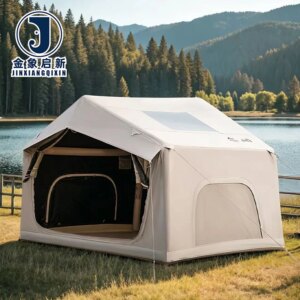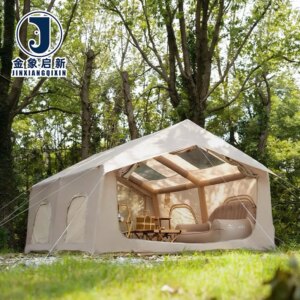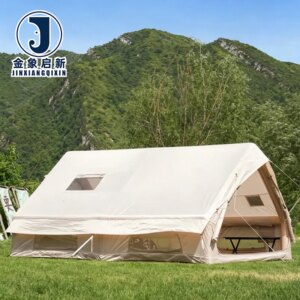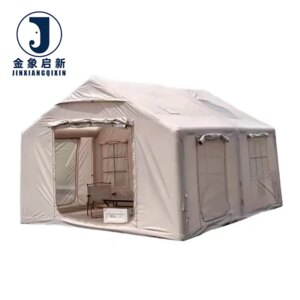

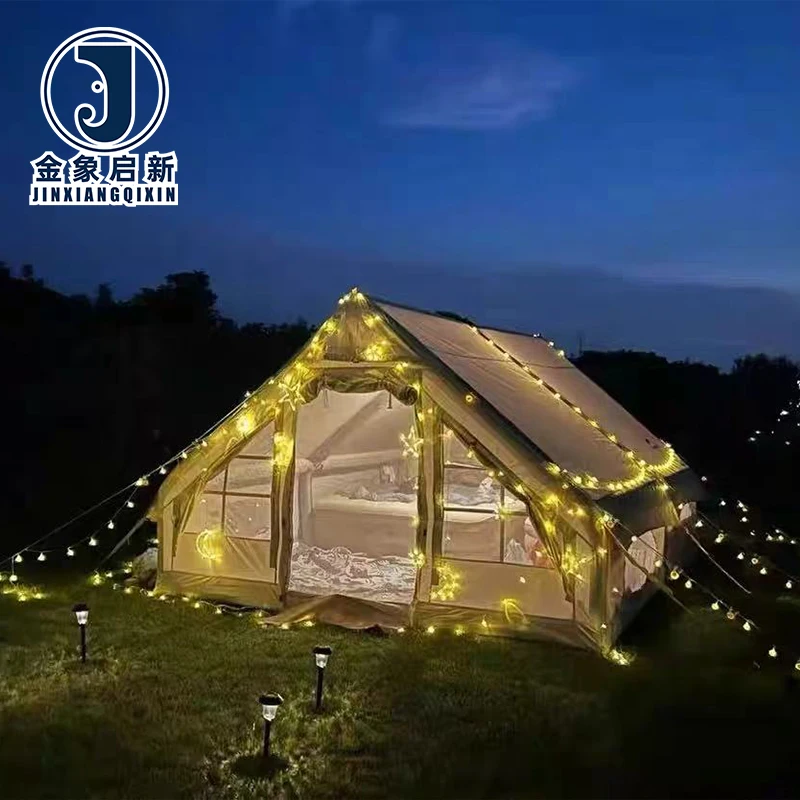
Coating Expertise — Nearly three decades of PVC coating process control ensures every roll of inflatable tent fabric meets the specified GSM, base fabric, and treatment requirements before it leaves the production line.
Technical Specifications
| Parameter | Value |
|---|---|
| Product Type | Inflatable tent |
| Core Material | PVC Tarpaulin |
| Key Performance | Waterproof, UV-resistant (test basis not stated in source), Tear-resistant |
| Capacity | 4-6 Person |
| Feature | Quick Automatic Opening |
| Layer | Single layer |
| Customization Service | OEM & ODM (sample customization, pattern printing) |
| Production Facility Area | 9,180 square meters |
| Production Lines | 3 full production lines |
| Processing Equipment | 36 sets of professional equipment |
| R&D Team Scale | 10 technicians |
| Quality Control | Strict full-process quality inspection with dedicated QA&QC staff |
| Standards | ISO9001, ISO14001, ISO45001, CE |
Application Suitability
| Application | Exposure & Requirement |
|---|---|
| Commercial outdoor gear manufacturing | Consistent roll-to-roll color and GSM for automated cutting lines and branded product lines |
| Temporary workspace for outdoor events management | Rapid inflation cycles, UV exposure during multi-day installations, frequent packing and transport |
| Storage shelter for construction site equipment | Puncture risk from shifting loads, dust ingress, wind-driven rain on exposed sites |
| Mobile facility for disaster relief operations | Quick automatic opening under professional supervision, waterproof integrity in unpredictable weather |
| Temporary on-site structures for engineering firms | Long-duration inflation, thermal fluctuation, abrasion from repeated setup and teardown |
Why Stated UV Resistance Without Test Data Leaves Your Inflatable Tent Vulnerable
Verified UV treatment documentation separates functional inflatable tent fabric from material that degrades unpredictably in the field.
When commercial buyers specify UV-resistant PVC tarpaulin for inflatable structures, they often receive a certificate of conformity with no underlying test basis. The fabric passes visual inspection on arrival, but after months of sun exposure on event sites or disaster relief deployments, the coating begins to chalk, embrittle, and lose tensile integrity. This failure mode is not random — it traces directly to whether the anti-UV additive package was actually compounded into the coating at the stated concentration. [NEED_CITE: UV degradation test protocols for coated technical textiles per ISO 4892] Without batch-level test data showing the specific irradiance exposure and retention of mechanical properties, a buyer cannot distinguish between a formulation designed for prolonged outdoor service and one that merely carries a marketing label. For an Inflatable Tent Fabric PVC coated manufacturer, providing documented UV resistance per recognized test methods is the baseline for commercial credibility.
Coating Composition and Its Role in Inflatable Structure Performance
The PVC coating formulation directly determines how an inflatable tent performs under sustained internal pressure and external environmental stress. The base fabric — typically a woven polyester scrim — provides the structural skeleton, but the coating delivers the airtight barrier, waterproof protection, and surface durability that the inflatable application demands. When sourcing from an Inflatable Tent Fabric PVC coated manufacturer, the critical variable is coating adhesion: if the PVC does not bond fully to the base yarns, inflation cycles will delaminate the layers at stress concentration points, causing air leaks that compromise structural stability.
Knife Coating versus Alternative Methods for Airtight Inflatable Chambers
Knife-over-roll coating produces a uniform PVC layer with controlled thickness, which is essential for maintaining consistent air retention across the entire inflatable chamber. This method forces the coating compound into the interstices of the woven base fabric, creating mechanical interlock that resists peeling under repeated inflation and deflation. For commercial inflatable tent production, the coating weight must be matched to the base fabric denier and weave density — too light and the fabric will not hold pressure reliably; too heavy and the roll becomes unnecessarily costly to ship and harder to fold for transport. [NEED_CITE: coating adhesion test methods for PVC tarpaulin per ISO 2411]
Decoding the Specification Sheet: What Each Parameter Actually Means
GSM (grams per square meter) measures total areal weight — base fabric plus coating combined — and serves as a proxy for overall material substance, but it does not directly translate to strength in isolation. A high-GSM fabric with a loosely woven base and thick coating may weigh more yet tear more easily than a lighter fabric with a denser, higher-denier scrim. For inflatable tent applications, the tensile and tear strength values (measured per ISO 1421 where specified) are more predictive of field performance than GSM alone. The single-layer construction noted in the specification means the coating must perform all protective functions on both sides without a secondary liner, making coating adhesion and uniformity even more critical. Waterproof performance in PVC tarpaulin is inherent to the continuous coating film, provided the coating is free of pinholes and the welded seams are executed correctly — a seam failure will compromise waterproof integrity regardless of the fabric’s inherent resistance. The quick automatic opening feature relies on the fabric’s flexibility and fold recovery, which are influenced by the plasticizer system in the PVC formulation; an overly rigid coating will resist inflation and create stress at fold lines.
The Hidden Cost of Ignoring Batch-to-Batch Color Consistency
When a commercial outdoor gear manufacturer orders multiple rolls of PVC tarpaulin for a production run of inflatable tents, even subtle color variation between rolls becomes glaringly obvious once the finished products are displayed side by side in a showroom or at a trade event. This is not a cosmetic nuisance — retailers will reject an entire shipment if the color does not match across units, and the cost of return logistics, re-cutting, and production downtime dwarfs the savings of buying from a supplier without rigorous color control. The same logic applies to GSM: if one roll in a batch weighs less than specified, the tents cut from that roll will be lighter, less durable, and more prone to field failure, creating warranty claims that damage the brand. [NEED_CITE: batch consistency standards for coated fabric rolls in commercial textile procurement] For inflatable tent fabric, where structural performance and visual presentation are both non-negotiable, verifying every roll against the purchase specification before it ships is not optional — it is the minimum standard for commercial supply.
Why Sourcing Inflatable Tent Fabric Here Reduces Your Verification Burden
Coating weight and adhesion are controlled at every stage across three full production lines, meaning the GSM on your specification sheet is the GSM that arrives on your cutting table. The 10-person R&D team handles material selection and sample development directly, so when you request a custom thickness or color adjustment for your inflatable product line, the sample you approve is produced on the same equipment as your bulk order. Every roll undergoes 100% pre-shipment inspection with documented QA/QC checks, eliminating the surprise of discovering a substandard roll mid-production. OEM and ODM customization — including pattern printing and sample development — is managed in-house, keeping lead times predictable and communication direct. The 36 sets of professional processing equipment support scalable batch output with roll-to-roll consistency, which matters when your inflatable tent line requires identical material across dozens of rolls per order.
Documentation & Verification
- Material specification sheet stating GSM, base fabric denier, and coating composition for every roll shipped
- Batch test reports covering tensile strength, waterproof rating, and UV resistance measurements provided upon request
- Pre-shipment inspection record with QA/QC sign-off at each production stage
- Pattern printing specifications and material composition certificates for OEM/ODM custom orders
- ISO9001, ISO14001, ISO45001, and CE certificates supporting commercial and regulatory compliance
Fabrication, Handling & Storage
- Hot-air welding temperature must match the PVC coating formulation to prevent seam failure at inflation stress points
- Store rolls vertically in a climate-controlled environment to prevent permanent creasing in the single-layer PVC tarpaulin
- Verify coating adhesion at fold lines before automated cutting to avoid delamination during quick automatic opening cycles
- Use PVC-compatible cleaners only — solvent-based agents will degrade the coating surface and compromise waterproof integrity
- Allow rolls to acclimate to ambient temperature before unrolling in cold conditions to prevent coating cracking
What to Include in Your Inquiry for Inflatable Tent Fabric
To receive an accurate specification recommendation and sample, provide your target deployment environment (prolonged sun exposure, wind load, temperature range), the inflation pressure your design operates at, and whether you require flame-retardant grades for specific market compliance. Confirm your annual volume and preferred roll widths to determine batch scheduling and color consistency parameters. Specify whether you need raw rolls for your own cutting line or finished custom sizes with pattern printing, as this affects lead time and sample development scope.
Frequently Asked Questions
Q: How is GSM verified on arrival and what documentation supports the quoted weight?
A: Every roll ships with a pre-shipment inspection record documenting the measured GSM against the specification sheet. We conduct weight verification per roll before dispatch, and batch test reports are available to confirm that the coated fabric meets the stated areal weight. This ensures the inflatable tent material you receive matches the structural properties you designed for, eliminating the risk of underweight rolls compromising inflation performance.
Q: What UV-resistance test basis is provided for prolonged outdoor inflatable tent deployment?
A: We provide batch-level test data documenting UV exposure results for the specific PVC formulation used in your order. Because test basis can vary by target market and application, we recommend confirming the irradiance protocol and exposure duration relevant to your deployment region during the specification phase. Available in UV-resistant formulations — confirm the test standard required for your market so we can match the appropriate additive package.
Q: How do you control batch-to-batch color consistency across multiple rolls for inflatable tent production?
A: Color matching is managed through controlled pigment compounding and verified against approved reference samples before each production run. The 36 sets of processing equipment and dedicated QA/QC staff ensure consistent coating application across all rolls in a single order. For large-volume OEM programs, we maintain color standard records so repeat orders match the original approval, preventing visible variation when finished inflatable tents are displayed side by side.
Q: What OEM/ODM customization options are available for inflatable tent fabric?
A: Full customization covers material thickness adjustment, color matching, pattern printing, and custom roll widths to suit your cutting line or finished product dimensions. The 10-person R&D team develops samples within days, and approved samples are produced on the same 3 full production lines as bulk orders, ensuring the material you test is the material you receive. Custom specifications are documented with full traceability from sample approval to final dispatch.
Q: What certifications and quality inspection reports ship with each batch for commercial compliance?
A: Each shipment includes ISO9001, ISO14001, ISO45001, and CE certificates, along with a material specification sheet and pre-shipment inspection record. Batch test reports covering mechanical properties and treatment verification are provided upon request. This documentation package supports quality assurance audits, regulatory submissions, and retailer compliance requirements for commercial inflatable tent products across international markets.