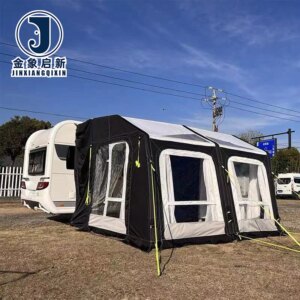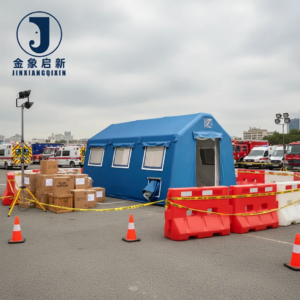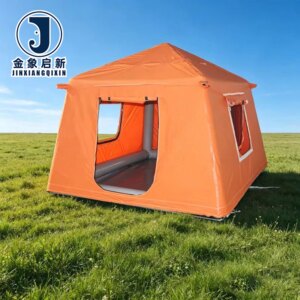
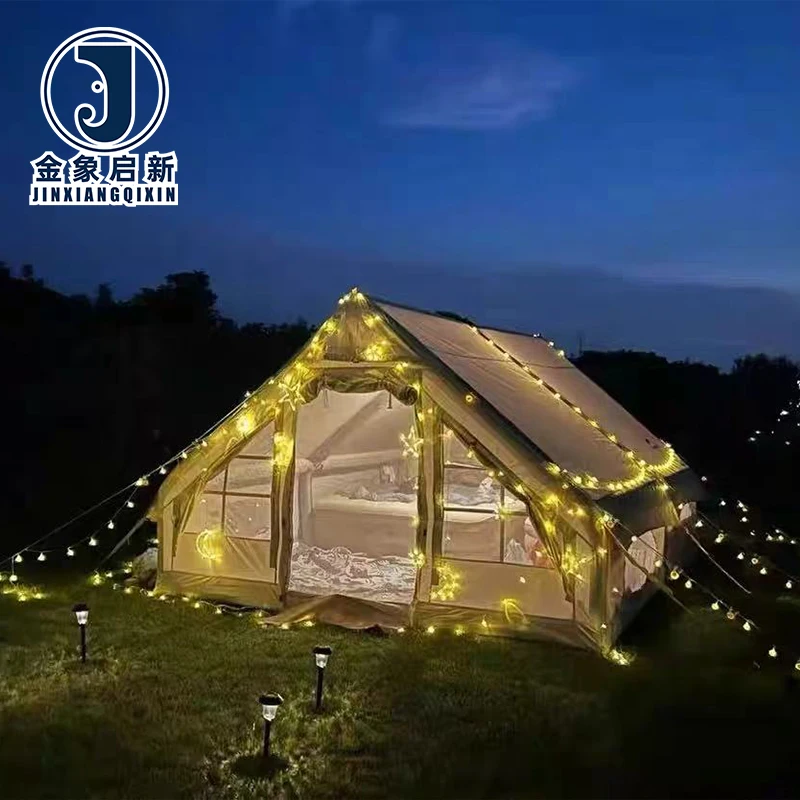
Coating Process Control — Adhesion and air-holding integrity verified at every stage, giving inflatable structure manufacturers confidence that the PVC tarpaulin performs consistently from first roll to last.
Technical Specifications
| Parameter | Value |
|---|---|
| Product Type | Inflatable Tent |
| Core Material | PVC Tarpaulin |
| Layer | Single layer |
| Waterproof | Yes (test basis not stated in source) |
| UV-resistant | Yes (test basis not stated in source) |
| Tear-resistant | Yes (test basis not stated in source) |
| Production Facility Area | 9,180 m² |
| Production Lines | 3 full production lines |
| Processing Equipment | 36 sets of professional processing equipment |
| R&D Team Scale | 10 technicians |
| Customization Service | OEM & ODM (sample customization, pattern printing) |
| Standards | ISO9001, ISO14001, ISO45001, CE |
Application Suitability
| Application | Exposure & Requirement |
|---|---|
| Temporary workspace for outdoor events management | Repeated inflation cycles, UV exposure, rapid assembly and teardown abrasion |
| Storage shelter for construction site equipment | Constant wind loading, dust ingress prevention, structural air retention |
| Mobile facility for disaster relief operations | Extreme weather variability, urgent deployment, repeated relocation stress |
| Commercial outdoor gear manufacturing | Batch-to-batch consistency, weld compatibility, custom print adhesion |
| Temporary on-site engineering structures | Prolonged static inflation, solar radiation, thermal expansion and contraction |
Why Coating Adhesion Matters More Than Stated GSM for Inflatable Tent PVC Tarpaulin
The air-holding performance of an inflatable structure depends on coating-to-base-fabric adhesion far more than on weight alone.
Inflatable tent manufacturers frequently specify GSM as the primary quality gate, yet field failures most often originate at the coating interface or along welded seams rather than in the base fabric itself. When the PVC coating separates under cyclic inflation pressure, the resulting delamination creates pinhole leaks that are nearly impossible to locate and repair on site [NEED_CITE: coating adhesion test methods per ISO 2411]. A heavy-grade roll that delaminates at the weld line will fail faster than a lighter roll with superior bonding. This makes verified adhesion data and weld peel-strength records more operationally relevant than a single weight figure.
Coating Formulation and Base Fabric Selection for Air Retention
The PVC tarpaulin used in Inflatable Camping Tent 4-6 Person Quick Automatic Opening Emergency Waterproof Family Outdoor Shelter is built on a base fabric whose denier and weave density are matched to the coating weight applied. For inflatable structures, the coating must fill the interstices completely to prevent micro-leakage at the yarn crossings while remaining flexible enough to endure repeated folding. The single-layer construction places the full burden of air retention on this one interface, making coating uniformity critical across the entire roll width.
Weld Integrity Under Cyclic Inflation Stress
Every inflation and deflation cycle subjects the welded seams to flexing loads that concentrate at the junction between rigid seam and flexible panel. Inflatable Tent PVC Tarpaulin aftermarket supplier specifications should address not only the peel strength of the weld but also the fatigue behaviour of the coating at the heat-affected zone. Thermal welding parameters — temperature, dwell time and pressure — must be calibrated to the specific PVC formulation, because an over-heated seam embrittles the coating and creates the exact failure point the buyer hoped the weld would eliminate [NEED_CITE: tensile and tear test methods for coated fabrics per ISO 1421].
Reading the Specification Sheet Beyond Weight
Coating weight, base fabric denier, and weave density interact to determine the usable life of inflatable tent fabric. A higher GSM achieved through thick coating on a loose-weave base will crack at fold lines faster than a balanced construction. The single-layer design means there is no backup ply to share the structural load, so the tensile and tear properties of the coated composite must be evaluated together rather than in isolation. Buyers sourcing for commercial outdoor gear manufacturing should request test reports that specify both warp and weft tear values alongside the coating adhesion figure, because real-world loads on an inflated structure are multidirectional and rarely align with a single yarn direction.
The Hidden Cost of Unverified Batch Consistency
Roll-to-roll variation in coating weight or plasticiser content shows up first at the weld line. A batch that welds cleanly on sample may refuse to bond at the same temperature setting on a subsequent delivery, forcing the fabricator to recalibrate equipment mid-run. Colour drift between rolls becomes visible once panels from different rolls are joined on a large inflatable structure, leading to costly panel replacement or order rejection. These downstream costs routinely exceed the savings from selecting a lower-priced roll with looser production tolerances [NEED_CITE: colour fastness and batch consistency standards for coated textiles].
Why Material Buyers Source This Inflatable Fabric Here
Three full production lines and 36 sets of processing equipment support batch volumes large enough to keep a single dye lot across an entire project, reducing the weld recalibration risk described above. A 10-technician R&D team develops custom samples within days, allowing buyers to validate coating behaviour against their own welding equipment before committing to full-roll orders. Dedicated QA/QC at every production stage means coating weight and adhesion are checked inline rather than only at final inspection. OEM and ODM services extend to pattern printing and material specification refinement, so brand owners can integrate visual identity without compromising the coating’s structural role. Pre-shipment inspection records document the actual measured values for each roll dispatched.
Documentation & Verification
- Material specification sheet stating base fabric denier, coating method, and verified GSM per roll
- UV and flame-retardant grade test reports included where applicable to the ordered specification
- Pre-shipment inspection record confirming coating adhesion and colour reference for every roll
- ISO9001, ISO14001, ISO45001, and CE certificates supporting global supply chain compliance
- Certificate of origin and customs documentation for cross-border shipment
- Roll packing list correlating each roll to its production batch for traceability
Fabrication, Handling & Storage
- Heat-weld single-layer PVC tarpaulin at temperatures calibrated to the specific coating formulation to avoid embrittlement at seams
- Reinforce tie-down and anchor points with additional fabric patches bonded before final inflation testing
- Store rolls upright on cores to prevent flat-spot creasing that compromises coating adhesion along fold lines
- Avoid deploying the inflatable structure in sustained contact with sharp aggregate surfaces that may puncture the single-layer PVC
- Clean with mild detergent only; solvents can dissolve plasticiser and alter the coating’s flexibility
- Repair minor punctures with compatible PVC adhesive patches applied to a clean, dry surface under ambient temperature
Specifying Your Inflatable Tent Fabric Order
To receive an accurate material recommendation, share the intended deployment environment, including expected UV exposure duration and operating temperature range. Specify the inflation pressure your structure maintains and the welding method you use, so the coating formulation can be matched accordingly. Indicate required roll width, colour references, and whether pattern printing or custom sizing is needed. Confirm whether sample approval is required before full production begins.
Frequently Asked Questions
Q: How is coating adhesion and weld integrity verified for inflatable structure fabric?
A: Each production batch undergoes inline coating adhesion checks, and pre-shipment inspection records document measured peel-strength values. Buyers can request weld test samples produced from their ordered rolls to validate compatibility with their specific thermal welding equipment before cutting into production stock.
Q: What UV resistance test basis supports prolonged outdoor exposure claims?
A: UV-resistant treatment is applied to the PVC formulation; however, the specific test basis is not stated in the source documentation. Buyers targeting markets with mandatory UV degradation standards should specify the required test method at inquiry stage so the appropriate grade and supporting report can be supplied.
Q: How is batch-to-batch colour and specification consistency controlled across roll production?
A: Rolls are produced within single dye lots where possible, with colour reference and coating weight checked at each production stage. Pre-shipment inspection records document per-roll values, and the three-line production capacity allows full project volumes to be fulfilled from matched batches, reducing inter-roll variation.
Q: What OEM/ODM customization options are available for inflatable tent fabric?
A: Customization covers sample development, pattern printing, custom width and length, and material specification refinement. The 10-technician R&D team works directly with buyers to adjust coating formulation, colour, and surface finish, providing physical samples for approval before mass production begins.
Q: Which certifications and documentation support commercial procurement?
A: Production is certified to ISO9001, ISO14001, and ISO45001 with CE marking. Each shipment includes a material specification sheet, test reports where applicable, pre-shipment inspection records, certificate of origin, and a roll-level packing list for full batch traceability across the supply chain.