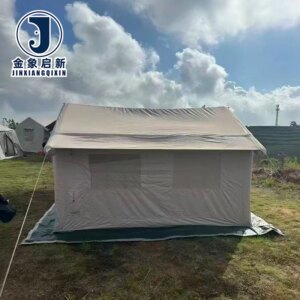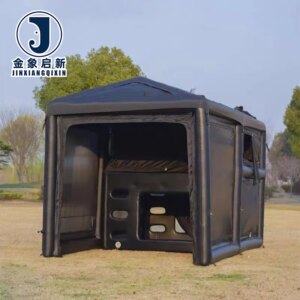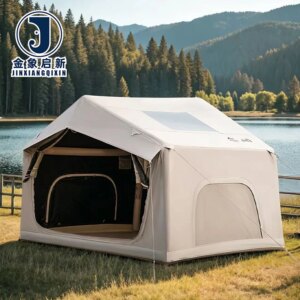
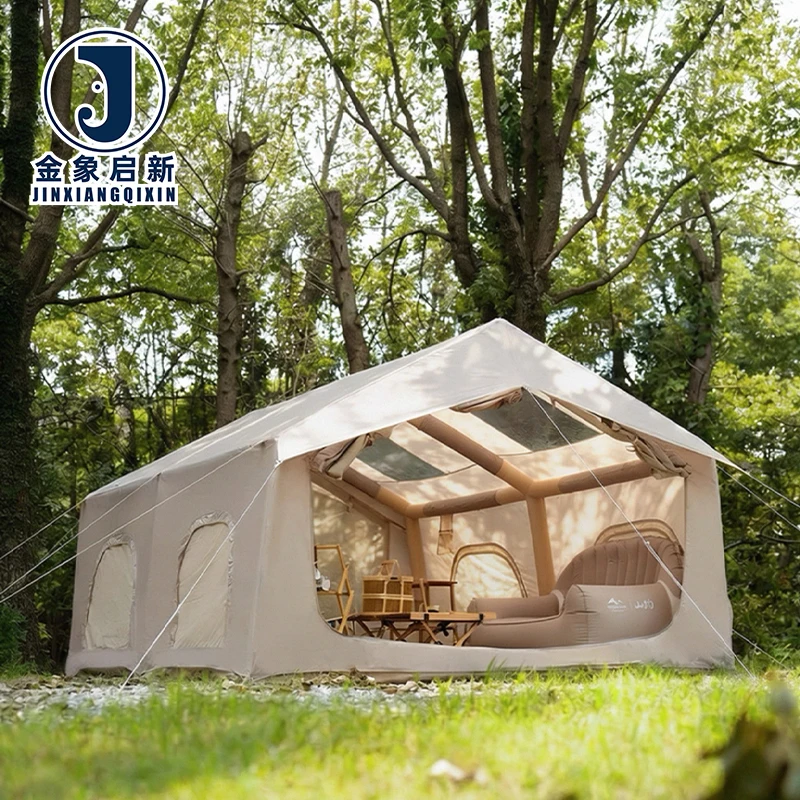
Coating Process Control — Our 36 sets of professional processing equipment maintain consistent PVC coating weight and adhesion across every batch of inflatable tent fabric, ensuring the material specification you approve is the material you receive.
Technical Specifications
| Parameter | Value |
|---|---|
| Product Type | Inflatable Tent |
| Core Material | PVC Tarpaulin |
| Key Features | Waterproof, UV-resistant, Tear-resistant, Fire-retardant, Anti-static |
| Opening Mechanism | Quick automatic opening (inflatable structure) |
| Capacity | 2-3 Person |
| Season Rating | Four-season |
| Customization Service | OEM & ODM (sample customization, pattern printing) |
| Production Facility Area | 9180 square meters |
| Production Lines | 3 full production lines |
| Processing Equipment | 36 sets of professional processing equipment |
| R&D Team Scale | 10 technicians |
| Quality Control System | Strict full-process quality inspection with dedicated QA & QC staff |
Note: Fire-retardant and anti-static grades are available — confirm the specific standard required for your market before ordering.
Application Suitability
| Application | Exposure & Requirement |
|---|---|
| Emergency disaster relief operations | Rapid deployment, varied weather, full waterproofing, structural inflation integrity |
| Emergency response centers | Continuous occupancy, fire safety compliance, high-frequency setup and teardown |
| Temporary construction site shelters | Abrasive environments, dust, UV exposure, wind load on inflatable beams |
| Outdoor event logistics | Public safety standards, visual consistency, four-season temperature fluctuation |
| Temporary workspace creation | Interior climate control retention, floor anchoring stress, repeated inflation cycles |
| Emergency supplies storage | Moisture barrier performance, UV degradation resistance over extended standing |
| Equipment protection | Puncture and tear resistance from contact with machinery and tools |
What Happens When Flame Retardant Comes Without a Grade
A "fire-retardant" claim on a quotation means nothing to a compliance auditor unless a test report tied to a recognized standard accompanies the shipment.
Inflatable tent fabric used for emergency shelters and public gathering structures faces scrutiny from fire marshals and site safety officers. We have seen procurement teams accept PVC Inflatable Tent aftermarket supplier deliveries only to discover at inspection time that no test documentation exists, or that the certificate references a different material batch entirely [NEED_CITE: fire safety compliance documentation for temporary structures]. The consequence is project delay, rejected shipment, and a scramble to source replacement fabric that meets the local fire code. This is why every order we produce for inflatable tent applications ships with test reports matched to the production batch — provided the required grade is specified at the inquiry stage.
Base Fabric and Coating Weight Define Field Performance
The structural integrity of an inflatable tent under wind load and repeated inflation cycles depends on the relationship between base fabric denier, weave density, and PVC coating weight. A heavier coating does not automatically mean a stronger fabric if the underlying yarn count is low. When sourcing Inflatable Tent Fabric PVC coated manufacturer custom options, buyers should evaluate the full material construction rather than relying on a single GSM figure to predict how the inflatable beams will perform under sustained internal pressure.
Fire-Retardant and Anti-Static Options for Regulated Environments
Inflatable shelters deployed at mining sites, aviation facilities, or public emergency centers often require documented flame retardant and anti-static performance. Available fire-retardant grades and anti-static treatments can be applied during the coating stage to meet specific regulatory frameworks. The 10-technician R&D team works with buyers to confirm which standard applies to the destination market and develops a sample with the correct treatment formulation before bulk production begins [NEED_CITE: flame retardant classification systems for coated technical textiles].
Understanding GSM in the Context of Inflatable Beam Stress
GSM measures total fabric weight per square meter but does not isolate coating weight from base fabric weight. For inflatable tent applications, the tensile and tear demands concentrate at the beam joints and flex points where the structure inflates and deflates repeatedly. A PVC tarpaulin with a balanced construction — adequate base fabric denier supporting a properly adhered coating — will outperform a heavier fabric with poor adhesion between layers. Coating method, whether knife coated or laminated, directly affects peel strength and the fabric’s ability to hold a heat-welded seam under cyclic pressure loading. Surface finish, available in glossy or matte options, influences cleanability and the adhesion of any pattern printing applied for branding or identification.
The Cost of Overlooking Batch-to-Batch Consistency
Colour variation between rolls in the same inflatable tent order becomes immediately visible once multiple units are deployed side by side at a disaster relief site or outdoor event. Inconsistent coating weight across a production run can also cause some units to pass fire inspection while adjacent units from the same batch fail. These are not theoretical risks — they represent real field failures that trigger rejection, replacement cost, and damaged credibility with the end user [NEED_CITE: batch consistency failures in coated technical fabrics]. We address this through dedicated QA/QC at every production stage with 100% inspection before shipment.
Why Procurement Teams Source This Fabric Here
Deep process control over coating weight and adhesion developed across near 30 years focused on PVC coated fabric means the material leaving our facility matches the approved sample. Three full production lines and 36 sets of professional equipment support bulk inflatable tent fabric orders with reliable on-time delivery, even when custom widths or pattern printing are specified. The 10-technician R&D team handles material selection and sample development within days, reducing the lead time between inquiry and production approval. Every roll undergoes 100% pre-shipment inspection, so buyers receive a pre-shipment inspection record that documents the actual condition of the goods before they leave the factory floor.
Documentation & Verification
- Material specification sheet stating GSM, base fabric, and coating details per order
- Test reports for flame-retardant and anti-static grades matched to production batch number
- ISO9001, ISO14001, ISO45001, and CE certificates included with shipment documentation
- Pre-shipment inspection record with 100% inspection before dispatch
- Certificate of origin and customs support documentation for international inflatable tent fabric orders
Fabrication, Handling & Storage
- Heat-weld seams at recommended temperature settings matched to the PVC coating formulation for inflatable beam joints
- Store rolls horizontally on padded supports to prevent permanent creasing in the PVC tarpaulin coating
- Allow fabric to acclimatize before unrolling in cold conditions to avoid coating micro-cracking
- Use compatible PVC adhesive for field repairs on inflatable tent beam punctures and abrasion damage
- Plan cutting layout to minimize waste and reduce the number of welded seams in high-stress structural zones
Request a Specification-Matched Quotation
Provide your target inflatable tent dimensions, annual volume estimate, and the specific fire-retardant or anti-static standard required in your destination market. Include any pattern printing or colour matching requirements so the R&D team can prepare a sample that reflects the exact material construction you will receive in bulk.
Frequently Asked Questions
Q: What fire-retardant grades are available for inflatable tent fabric, and which standards do they meet?
A: Fire-retardant treatments are applied during coating to meet various international standards. The specific grade depends on your destination market’s fire code — whether building material classification or temporary structure regulation. Specify the required standard at inquiry stage, and the R&D team will formulate a sample with documented test results tied to that grade for your approval before production.
Q: What test basis supports the UV-resistant claim for extended outdoor deployment?
A: UV-resistant treatment is incorporated into the PVC coating formulation to address degradation from continuous sunlight exposure. The test basis and exposure rating depend on the specific additive package selected for your order. Request the UV test report matched to your batch to verify the performance level against your expected field deployment conditions and regional solar intensity.
Q: Are anti-static inflatable tent fabrics available with documented surface resistance?
A: Anti-static treatment can be applied for inflatable tents deployed in mining, aviation, or other hazardous environments where static discharge is a compliance concern. The surface resistance specification must be confirmed against your site safety requirements before production. We supply test documentation with the shipment showing the measured resistance values for the treated batch.
Q: How are pattern printing and color matching handled before mass production?
A: The R&D team develops a printed sample based on your artwork and colour references before any bulk order proceeds. Colour consistency across rolls within the same order is controlled through dedicated QA/QC at every production stage. Approve the physical sample to lock the colour standard, then all subsequent production is matched against that approved reference.
Q: What information is needed to get a quotation for custom-sized inflatable tent orders?
A: Provide the intended application, inflatable tent dimensions, required treatment standards, estimated quantity, and any pattern printing needs. This allows us to recommend the correct material construction, confirm lead time, and prepare a sample that accurately represents the bulk delivery. Custom width and length orders are supported across all three production lines.