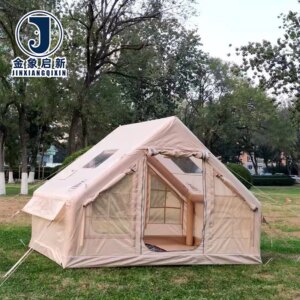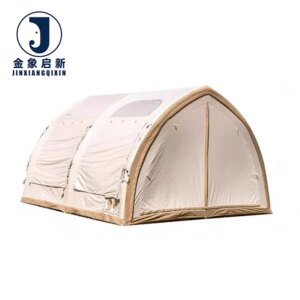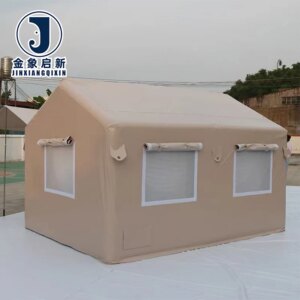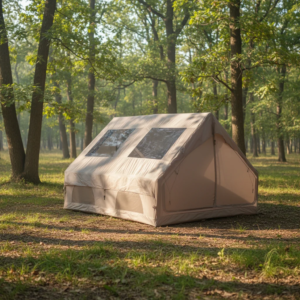
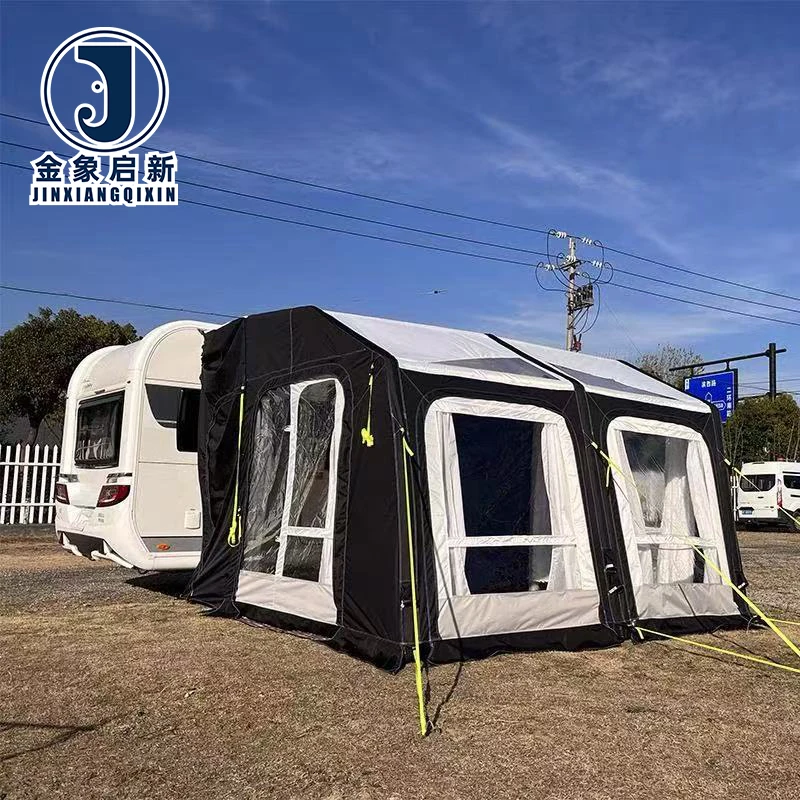
Material Consistency Control — Every roll of PVC inflatable tent fabric is checked against its stated coating weight and base fabric denier before leaving the production line, ensuring batch-to-batch uniformity for airtight inflatable tube construction.
Technical Specifications
| Parameter | Value |
|---|---|
| Product Type | PVC Inflatable Tent |
| Core Material | PVC Tarpaulin |
| Product Forms | Extended Type, Single Layer Construction |
| Waterproof Performance | Fully waterproof coated construction |
| UV Resistance | UV-resistant treatment (test basis not stated) |
| Tear Resistance | Tear-resistant construction |
| Coating Method | Knife coated |
| Customization | OEM & ODM, sample customization, pattern printing |
| Quality Control | Full-process inspection with dedicated QA & QC staff |
| Certifications | ISO9001, ISO14001, ISO45001, CE |
| Production Lines | 3 full production lines |
| Processing Equipment | 36 sets of professional equipment |
| R&D Team | 10 technicians |
| Sample Lead Time | 7–10 business days |
Application Suitability
| Application | Exposure & Requirement |
|---|---|
| Emergency response centers | Rapid inflation cycles, repeated deployment and packing, field abrasion |
| Disaster recovery temporary storage | Sustained UV exposure, wind-driven rain, ground contact moisture |
| Mobile command posts for engineering projects | Long-duration inflation pressure, thermal expansion in direct sunlight |
| Construction site auxiliary workspaces | Dust infiltration, mechanical contact with tools and materials, UV degradation |
| Remote industrial installations | Extended weather exposure, limited repair access, material self-weight under load |
| Logistics hub temporary shelters | Forklift proximity, frequent relocation, variable ground conditions |
Why Coating Weight Verification Matters More Than the Quoted GSM for Inflatable Structures
The air-holding capacity of an inflatable tube depends on coating adhesion and weight uniformity, not the base fabric GSM printed on the invoice.
When sourcing PVC inflatable tent fabric, buyers often receive a GSM figure and assume it governs the entire performance profile. In practice, the coating layer is what makes the tube airtight and what the heat welder actually fuses. If coating weight drifts below specification, the weld zone becomes the weakest link — and under inflation pressure, that is exactly where the failure starts. I have seen coated rolls where the base fabric survived intact but the heat-welded seam peeled open at the flex point because the coating layer was inconsistent [NEED_CITE: tensile and tear test methods for coated fabrics per ISO 1421]. For inflatable shelters deployed in disaster zones, a seam failure is not a warranty claim — it is a structure that no longer holds air.
Coating Adhesion and Its Role in Airtight Tube Construction
The performance of PVC inflatable tent fabric in a sealed tube depends primarily on how well the coating bonds to the base fabric and how evenly that coating is distributed across the roll width. Knife coating applies a measured layer of PVC compound directly onto the woven substrate, and the precision of that application determines whether micro-porosity develops in the coating film. For inflatable structures that must hold internal pressure continuously, even a small variation in coating thickness creates a preferential path for air migration through the material envelope.
Waterproof Integrity Across the Shelter Envelope
Waterproof performance in an inflatable shelter is a system-level property that starts at the material level. The PVC coating must form a continuous barrier with no pinholes or thin spots, particularly along the selvedge edges where coating tension can vary during the knife-over process. When rolls are heat-welded into tube sections, the weld seam must replicate the same waterproof integrity as the parent fabric. Our QA process includes visual and weight-based inspection of the coating surface before any roll is cleared for dispatch.
How GSM, Base Fabric Denier, and Coating Weight Interact in Inflatable Applications
In PVC inflatable tent fabric, the stated GSM is a composite figure that includes both the woven base fabric and the applied PVC coating. A higher base fabric denier contributes to tear propagation resistance — critical when an inflated tube is bent during packing or struck by debris on site. The coating weight governs airtightness and weld-ability. Two rolls with identical total GSM can behave very differently under inflation pressure if one achieves that weight through heavier base yarns while the other relies on thicker coating. Technical buyers should request a breakdown of base fabric weight versus coating weight rather than relying on total GSM alone [NEED_CITE: relationship between base fabric denier and coating weight in determining tensile performance of PVC tarpaulin]. The knife coating process used here allows controlled adjustment of each component independently, so the specification can be matched to the structural demands of a specific inflatable design.
The Hidden Cost of Specifying Inflatable Fabric Without Coating Breakdown
When a procurement specification lists only total GSM without separating base fabric and coating contributions, the manufacturer can meet the number in multiple ways — and not all of them support reliable inflatable tube performance. A fabric that achieves its GSM primarily through a heavy coating layer may have adequate airtightness but reduced flexibility, making it prone to cracking at fold lines during repeated packing cycles. Conversely, a lighter coating on a heavier base may tear well but leak air through the thinner coating film. For disaster relief shelters that deploy and repack dozens of times, this mismatch shows up as field failures that trace back to a specification gap, not a material defect [NEED_CITE: DIN 4102 fire classification for building materials and coating weight standards]. Batch-to-batch colour variation is a secondary but visible issue: when rolls from the same production run show shade differences, the installed shelter presents an inconsistent appearance that undermines professional credibility even though structural performance may be unaffected.
Why Procurement Teams Source Inflatable Fabric Here
Deep process control over coating weight and adhesion comes from operating three full production lines with dedicated knife-coating capability, allowing each PVC inflatable tent fabric order to be produced with independently verified coating parameters. A 10-technician R&D team develops custom specifications by adjusting base fabric denier, coating compound formulation, and surface finish to match the structural requirements of specific inflatable designs. Every roll undergoes coating weight verification at multiple production stages rather than a single end-of-line check, catching drift before it becomes a batch problem. Full-process quality inspection with dedicated QA and QC staff means the material that ships matches the specification agreed at sampling — not a production average. Sample development within days allows buyers to validate weld parameters and inflation behaviour on actual production material before committing to a full order. ISO9001, ISO14001, ISO45001, and CE certification frameworks govern the production environment, and documentation accompanies every shipment.
Documentation & Verification
- Material specification sheet stating GSM, base fabric denier, and PVC coating weight per roll
- UV-resistant treatment data with test basis available on request for each fabric grade
- ISO9001, ISO14001, ISO45001, and CE certificates covering production compliance
- Pre-shipment inspection record with coating weight measurement against stated specification
- Roll packing list with individual roll identification for full batch traceability
- Certificate of origin and customs documentation for international inflatable fabric shipments
Fabrication, Handling & Storage
- Heat welding temperature must match the PVC coating compound used on this specific knife-coated inflatable fabric grade
- Store rolls vertically on pallets to prevent compression marks on the PVC coating surface
- Allow cold-stored rolls to reach ambient temperature before unrolling to avoid coating cracking
- Use compatible PVC adhesive for field repairs on single-layer inflatable tube construction
- Cut patterns should account for weld seam allowance on extended-type inflatable panel layouts
- Avoid dragging rolls on unprotected ground to prevent base fabric abrasion before fabrication
What We Need to Specify Your Inflatable Fabric Correctly
To recommend the right PVC inflatable tent fabric for your application, share the structural design requirements including tube diameter, expected inflation pressure, and deployment cycle frequency. If your target market mandates specific fire classification or UV exposure standards, include the exact regulation so we can confirm whether available grades meet the requirement or whether a custom compound is needed. Specify the roll widths and lengths that match your fabrication equipment, and indicate whether you need sample rolls for weld parameter validation before placing a production order.
Frequently Asked Questions
Q: How is the GSM of the inflatable tent fabric verified on arrival?
A: Each roll ships with a pre-shipment inspection record that documents the measured coating weight and total GSM. Buyers can verify on arrival by cutting a measured sample and weighing it. We recommend checking both total GSM and requesting a coating-to-base-fabric weight breakdown, since total GSM alone does not confirm that the coating layer meets the airtightness requirement for inflatable tube applications.
Q: What UV test standard supports the anti-UV claim on this fabric?
A: UV-resistant treatment is applied during the coating process, but the specific test basis and exposure duration should be confirmed for your target market. We recommend requesting the test data sheet for your specific fabric grade and cross-referencing it against local regulatory requirements before finalising the specification for outdoor inflatable shelters.
Q: How does the PVC coating behave at welded seams under inflation pressure?
A: Knife-coated PVC on this inflatable tent fabric produces a homogeneous weld zone when heat-welded at the correct temperature for the specific coating compound. The weld strength depends on coating weight uniformity at the seam area. We supply sample rolls so fabricators can validate their welding parameters and test peel strength before committing to a full production run.
Q: What documentation is supplied with each batch for material traceability?
A: Every shipment includes a material specification sheet, pre-shipment inspection record, roll packing list with individual roll IDs, ISO and CE certificates, and a certificate of origin. This documentation set allows traceability from the received roll back to the production batch and the coating weight measurements recorded during manufacturing.
Q: Can the base fabric denier and coating weight be customized for specific inflatable designs?
A: Yes. Our 10-technician R&D team adjusts base fabric denier and PVC coating weight independently through the knife-coating process. This allows the specification to be tuned for the structural demands of your inflatable design — higher denier for tear resistance at fold points, or adjusted coating weight for optimal airtightness and weld-ability.