Coating Weight Transparency — Every roll of PVC Inflatable Tent Fabric ships with a verified GSM and base fabric specification sheet, so technical buyers confirm coating construction before the material reaches the cutting table.
Technical Specifications
| Parameter | Value |
|---|---|
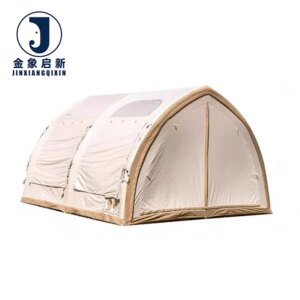
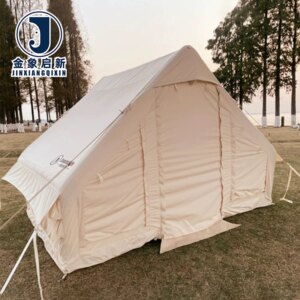
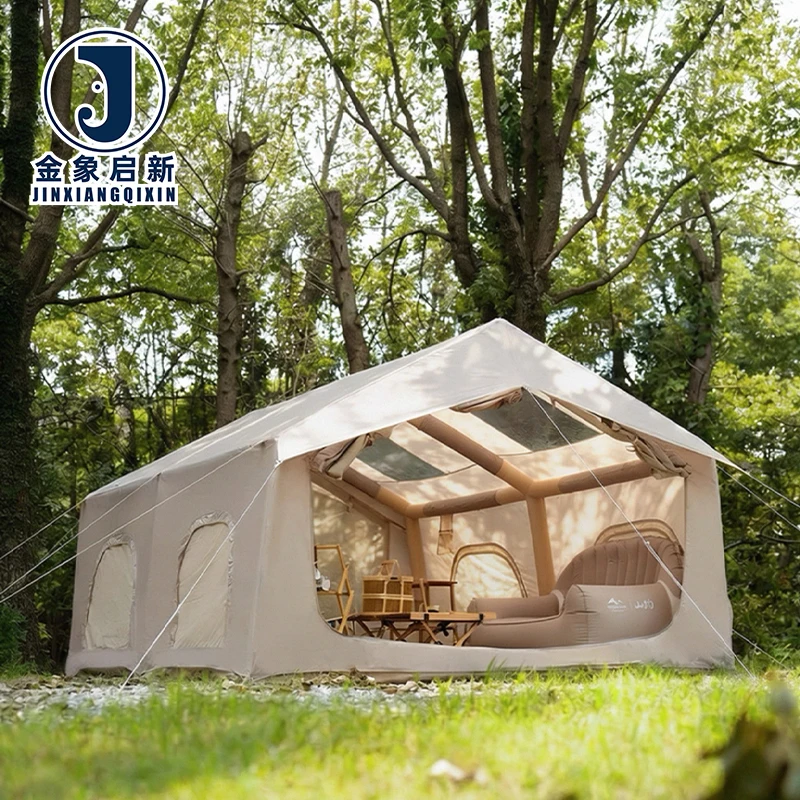
| Product Type | Inflatable Tent |
| Core Material | PVC Tarpaulin |
| Product Form | Inflatable structure with quick automatic opening |
| Capacity | 2-3 Person |
| Waterproof Performance | Fully waterproof coated construction |
| UV Resistance | Available in UV-resistant grades — confirm the grade required for your market (test basis not stated) |
| Fire-Retardant Performance | Available in flame retardant grades — confirm the grade required for your market (grade not stated) |
| Anti-Static Performance | Available in anti-static grades — confirm the standard required for your market (standard not stated) |
| Customization Service | OEM & ODM, sample customization, pattern printing |
| Production Lines | 3 full production lines |
| Processing Equipment | 36 sets of professional processing equipment |
| R&D Team | 10 technicians |
| Quality Control | Strict full-process quality inspection with dedicated QA & QC staff |
| Certifications | ISO 9001, ISO 14001, ISO 45001, CE |
Application Suitability
| Application | Exposure & Requirement |
|---|---|
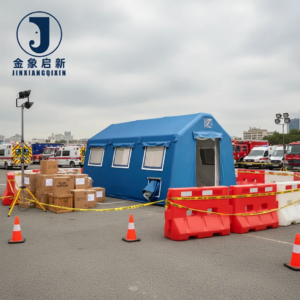
| Emergency disaster relief shelters | Rapid deployment, repeated inflation and deflation cycles, full weather exposure |
| Temporary construction site shelters | Dust, debris impact, wind load on air-supported panels, UV exposure |
| Emergency response centers | Continuous inflation over multi-day operations, interior climate control retention |
| Outdoor event logistics structures | Public occupancy fire compliance requirements, frequent assembly and teardown |
| Four-season outdoor exposure | Temperature variation causing material contraction and expansion at seams |
Why "Flame Retardant" Without a Grade Is a Compliance Risk for Inflatable Shelters
A flame-retardant claim on PVC inflatable tent fabric means nothing at a site inspection unless it references a test standard your jurisdiction accepts.
I have watched fabricators ship inflatable emergency shelters to mining sites only to have the safety officer reject the entire batch because the material certificate said "flame retardant" without citing a recognised classification. The shelter sat deflated on the tarmac while the project waited for replacement material. PVC inflatable tent fabric destined for aviation, tunnelling or disaster-relief environments must carry a grade that maps to the local fire code — whether that is DIN 4102 B1 in European construction contexts, NFPA 701 for temporary structures in North America, or an anti-static surface resistance reading for explosive-atmosphere zones. [NEED_CITE: DIN 4102 fire classification for building materials]
Base Fabric Construction and Coating Adhesion for Air-Holding Panels
The structural integrity of an inflatable membrane depends on how the PVC coating bonds to the base fabric under sustained internal pressure. When the air beam flexes at a joint or an anchor point, the coating must resist delamination rather than crack or peel away from the yarn. PVC inflatable tent fabric built on a knife-coated process typically achieves higher peel strength between coating and substrate compared to laminated alternatives, because the PVC paste penetrates the weave rather than sitting on the surface as a film layer.
Seam Behaviour Under Inflation Stress and Repeated Flex Cycles
Every welded seam on an inflatable structure is a point where the material must perform as well as the body of the fabric itself. During inflation, the internal pressure pushes outward uniformly, but at corners and beam junctions the stress concentrates along the weld line. If coating adhesion is weak, the seam splits before the panel fabric reaches its tensile limit. PVC inflatable tent fabric with consistent coating weight across the roll width allows fabricators to set heat-welding parameters once and maintain them through an entire production run, reducing the reject rate on structural seams. [NEED_CITE: tensile and tear test methods for coated fabrics per ISO 1421]
How GSM, Base Fabric Denier and Coating Method Interact
GSM alone tells you the total mass per square metre, but it does not reveal how that mass is distributed between the base fabric and the coating layers. A high GSM achieved through heavy coating on a low-denier base fabric will feel stiff but may tear easily once a nick propagates through the weave. Conversely, a tightly woven high-denier base with moderate coating weight delivers better tear propagation resistance — critical when an inflatable panel is punctured by debris on a disaster site. Knife coating allows the manufacturer to control coating weight independently on each side, tuning the balance between exterior weather resistance and interior weldability. The relationship between base fabric density and coating formulation ultimately determines whether PVC inflatable tent fabric holds air reliably through hundreds of inflation cycles or begins to leak at micro-cracks along fold lines.
The Hidden Cost of Specifying Material Without Verifying the Coating Construction
Fabricators who order PVC coated tarpaulin for inflatable structures based solely on a GSM figure and a colour swatch often discover problems only after the first production batch is welded and inflated. Coating weight that varies across the roll width causes some seams to weld cleanly while adjacent sections delaminate at the same temperature setting. UV treatment that is blended into the coating rather than applied as a surface layer may perform differently under accelerated weathering tests. Batch-to-batch colour drift becomes visible when panels from different rolls are assembled into the same shelter. [NEED_CITE: coating weight consistency and its effect on heat-weld parameter stability]
Why Technical Buyers Source This Material Here
Coating formulation and weight are controlled in-house across three full production lines, giving consistent PVC inflatable tent fabric from the first roll to the last in a container load. The 10-person R&D team develops material samples matched to specific inflation pressure and seam strength requirements before you commit to a production order. Dedicated QA and QC staff inspect every roll against the stated specification before dispatch, catching coating weight deviation or colour drift before it reaches your cutting table. Full test documentation accompanies each shipment, with traceable batch records that satisfy compliance audits for fire-retardant and anti-static grades.
Documentation & Verification
- Material specification sheet stating GSM, base fabric denier and coating weight per roll
- UV and flame-retardant test reports traceable to production batch where applicable
- Pre-shipment inspection record with 100% QA/QC coverage before dispatch
- ISO 9001, ISO 14001, ISO 45001 and CE certificates included with shipment
- Roll packing list with individual roll weights and dimensions for receiving verification
Fabrication, Handling & Storage
- Set heat-weld temperature based on coating weight verified from the roll spec sheet, not a generic PVC setting
- Allow welded seams on inflatable panels to cool under flat pressure before folding to preserve bond integrity
- Store rolls upright on end caps to prevent flat-spot deformation of the coating surface
- Avoid dragging roll edges across concrete floors to protect the coating layer from abrasion damage
- Use mild detergent for field cleaning; solvent-based cleaners may soften the PVC coating and compromise seam adhesion
What We Need to Prepare Your Material Recommendation
Provide the inflation pressure your structure operates at and the cycle frequency expected in service. Specify the fire-retardant classification or anti-static surface resistance standard required by the end-use jurisdiction. Confirm whether you need roll stock in standard widths or custom slit widths to match your panel cutting layout, and state your annual volume so we can plan batch consistency across your production schedule.
Frequently Asked Questions
Q: How is GSM verified and what base fabric denier supports inflatable structure loads?
A: Each roll is weighed and measured against the stated GSM before shipment, with the base fabric denier and weave density documented on the material specification sheet. The relationship between base fabric construction and coating weight determines tear propagation resistance under inflation stress — we recommend requesting the full spec sheet rather than relying on GSM alone to judge structural suitability.
Q: Which fire-retardant grade applies to my target market for inflatable shelters?
A: Fire-retardant requirements vary by jurisdiction and application. European construction sites typically reference DIN 4102 classifications, while North American temporary structures may require NFPA 701 compliance. Confirm the specific standard with your local authority before ordering, and request the corresponding test report with your PVC inflatable tent fabric shipment.
Q: What test basis supports the UV-resistance claim on this material?
A: UV-resistant grades are available with treatment integrated into the coating formulation. The applicable test method and exposure data depend on the grade selected. Request the UV test report matched to your product variant and compare the results against the outdoor exposure duration expected in your application environment.
Q: How does coating adhesion perform under inflation and flex stress at welded seams?
A: Knife-coated PVC construction allows the coating to penetrate the base fabric weave, creating mechanical interlocking that supports peel strength at welded joints. We supply coating weight and adhesion data so fabricators can validate heat-weld parameters on sample pieces before running full production on inflatable structural panels.
Q: What surface resistance data is available for anti-static compliance?
A: Anti-static grades are available for environments where static discharge poses a risk, such as mining ventilation or explosive-atmosphere zones. Surface resistance values and the applicable test standard are documented on the material specification sheet — confirm the required threshold with your site safety specification before placing your order.