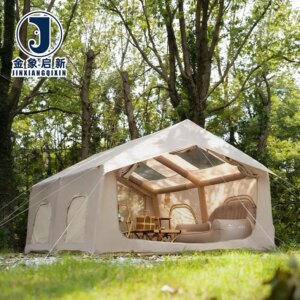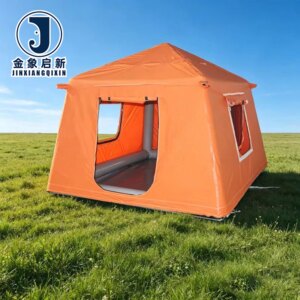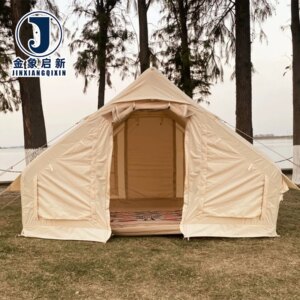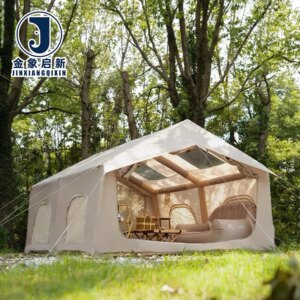
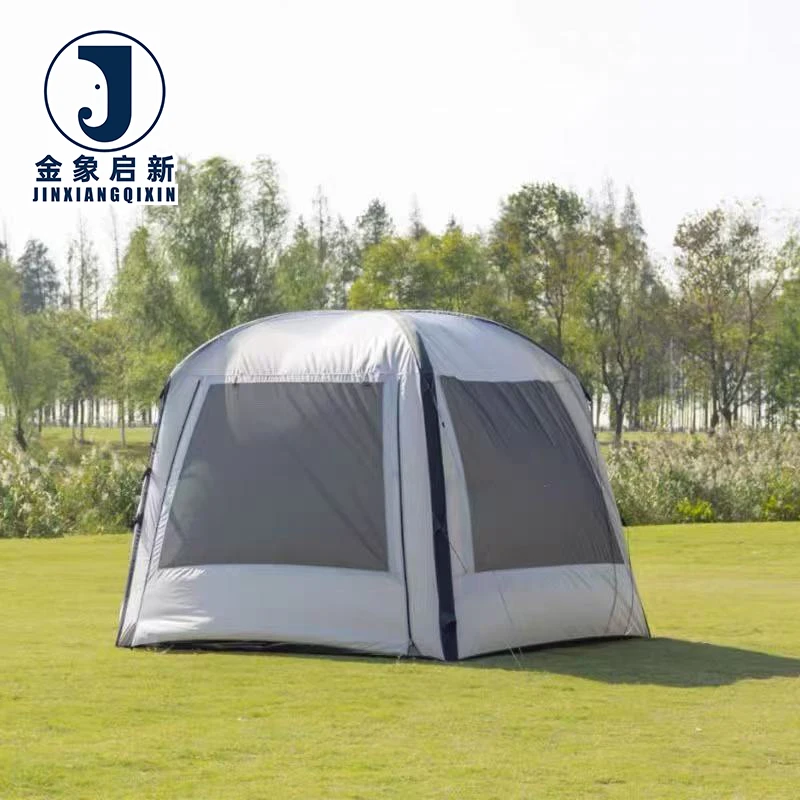
Proven coating expertise — Nearly 30 years of PVC coating process control underpins every roll of inflatable tent fabric we produce, ensuring reliable seam adhesion and consistent inflation performance for your commercial and emergency shelter designs.
Technical Specifications
| Parameter | Value |
|---|---|
| Product Type | Inflatable Tent |
| Core Material | PVC tarpaulin |
| Product Form | Automatic Inflatable |
| Capacity | 3-5 Person |
| Waterproof | Fully coated waterproof construction |
| UV Resistance | Available in UV-resistant grades — confirm the grade required for your market |
| Fire Retardancy | Available in flame retardant grades — confirm the grade required for your market |
| Tear Resistance | Tear-resistant PVC coated structure |
| Anti-Static | Available in anti-static grades — confirm surface resistance requirements for your application |
| Customization | OEM & ODM (sample customization, pattern printing) |
| R&D Support | 10 technicians |
| Production Lines | 3 full production lines |
| Processing Equipment | 36 sets of professional processing equipment |
| Quality System | Full-process inspection with dedicated QA & QC |
| Standards | ISO 9001, ISO 14001, ISO 45001, CE |
Application Suitability
| Application | Exposure & Requirement |
|---|---|
| Construction site field offices | Constant outdoor weather exposure, wind loading, repeated inflation cycles |
| Emergency response staging areas | Rapid deployment, harsh terrain contact, all-weather protection |
| Outdoor event management | UV exposure, crowd proximity, frequent setup and teardown |
| Logistics operations temporary shelter | Forklift and equipment abrasion, dust ingress prevention, wind uplift |
| Equipment storage | Long-term moisture barrier, puncture risk from stored items |
Why Inflatable Tent Structures Fail at the Weld Before the Fabric Does
The most common failure point in an inflatable shelter is not the PVC membrane itself — it is the welded seam where internal pressure concentrates during inflation and structural flex.
Seam failure almost always traces back to inconsistent coating adhesion across the roll. When the coating weight varies even within a single batch, the heat-seal temperature that works in one section produces a cold weld in the next. I have seen coated rolls where the weld line peeled apart under inflation pressure while the surrounding fabric remained intact. This is a coating process problem, not a fabrication error. [NEED_CITE: weld strength testing methods for PVC coated fabrics]
For manufacturers producing inflatable tents at scale, this means your welding operators spend time reworking seams, your rejection rate climbs, and your end customer receives a product that fails in the field at the exact point the structure flexes most. The PVC inflatable tent fabric you source determines whether the seam holds or the tent deflates unexpectedly.
Coating Weight and Adhesion Control
The performance of any PVC inflatable tent fabric depends on how evenly the coating is applied to the base fabric. Our production lines maintain consistent coating weight across the full roll width, which directly affects how predictably the material responds to heat welding. Uniform coating thickness means your fabricators can set welding parameters once and maintain them throughout the production run without constant adjustment.
Fire Safety and Market Compliance
Inflatable tents used for commercial events, construction sites, or emergency staging must meet local fire safety regulations. We offer PVC inflatable tent material in flame retardant grades — confirm the specific classification your target market requires before ordering. Different regions mandate different test standards, and we provide test documentation matched to the grade specified. Anti-static treatment is also available where the operating environment demands controlled surface resistance.
Performance Under Repeated Inflation Cycles
An inflatable shelter expands and contracts with every setup, creating cyclic stress at seam junctions and structural curves. The PVC coated fabric must maintain dimensional stability through these repeated cycles without delamination or coating crack. Our base fabric selection and coating formulation account for this flex fatigue. The tear-resistant construction ensures that minor punctures or abrasions do not propagate into structural failures during use. [NEED_CITE: cyclic loading effects on coated fabric seam integrity]
Reading the Specification Sheet Correctly
GSM alone does not tell you how the fabric will perform in an inflatable structure. A lighter-weight fabric with a dense base weave can outperform a heavier material with a loose weave and thick coating fill. The coating method — whether knife-coated, laminated, or calendered — determines peel strength between the PVC layer and the polyester base, which directly governs weld quality and long-term delamination resistance. Surface finish, whether glossy or matte, affects cleaning ease, UV reflection, and the adhesion of printed branding. When comparing inflatable tent fabric options, request the full specification sheet showing base fabric denier, weave density, and coating weight separately rather than relying on total GSM.
The Cost of Underspecifying Your Inflatable Tent Fabric
Choosing PVC coated fabric based on price per kilogram without verifying coating adhesion or batch consistency creates downstream costs that outweigh any initial savings. Rolls with uneven coating weight produce inconsistent welds, forcing fabricators to increase rejection rates or accept seam weaknesses. Colour variation between rolls in the same order becomes visible once multiple tent units are deployed side by side at an event or site. When the flame retardant grade does not match the procurement specification, the entire shipment can fail site inspection, causing project delays and reordering costs. [NEED_CITE: coating weight variation impact on production yield]
Why Source Inflatable Tent Fabric Here
Our 10-person R&D team handles material selection, custom sizing, and sample development for inflatable structures, reducing the gap between your design intent and the fabric you receive. Every roll undergoes coating weight verification and adhesion testing before it leaves our facility. We run 3 full production lines with 36 sets of processing equipment, supporting volume orders with consistent lead times. Pre-production samples are developed within days for custom requirements, allowing you to validate weld parameters and colour match before committing to bulk production. Full QA and QC inspection at each production stage catches coating inconsistencies early, not at shipment.
Documentation & Verification
- Material specification sheet stating base fabric denier, coating type, and total weight per roll
- Test reports for UV-resistant and flame retardant grades as applicable to your order
- Pre-shipment inspection record with batch-specific coating weight verification
- ISO 9001, ISO 14001, ISO 45001, and CE certificates included with dispatch
- Roll packing list with individual roll identification for traceability
Fabrication, Handling & Storage
- Heat-weld seams using manufacturer-recommended temperature ranges matched to the PVC coating thickness of your specific roll batch
- Allow welded inflatable panels to cool fully under tension before folding to prevent seam creep
- Store rolls vertically in a dry environment to prevent permanent crease marks in the PVC coating layer
- Avoid dragging cut panels across abrasive surfaces during tent assembly to protect the coated surface
- Use compatible PVC repair adhesive for field patching, matching the coating formulation of the base material
Before You Enquire
To match the correct PVC inflatable tent fabric to your production requirements, share your target market fire safety classification, the inflation pressure range of your tent design, and whether you need fabric supplied by the roll or as cut-to-spec components. Confirm your colour and printing requirements, along with estimated annual volume, so we can plan batch consistency across your orders.
Frequently Asked Questions
Q: How can I verify coating adhesion and seam strength before bulk production?
A: We develop pre-production samples from the same coating batch planned for your order. You can run weld tests on these samples using your own fabrication equipment to confirm seam peel strength and inflation pressure tolerance before we begin mass production.
Q: Which flame retardant grade should I specify for inflatable tents?
A: The required grade depends on your target market and end-use environment. Confirm the applicable fire safety standard for your region, and we will supply material with the matching flame retardant treatment and supporting test documentation.
Q: What test basis supports the UV resistance claim?
A: UV-resistant grades are available with test documentation. Specify the UV treatment level required for your expected outdoor exposure duration and geographic region, and we will provide the corresponding test report with your shipment.
Q: Can I order custom colours and pattern printing for inflatable tent panels?
A: Yes. Our R&D team supports OEM and ODM customization including sample development, pattern printing, and colour matching. We produce pre-production samples for your approval before bulk runs to ensure colour consistency across all rolls in your order.
Q: How do you maintain colour and thickness consistency across large orders?
A: Each production batch undergoes full-process quality inspection with dedicated QA and QC staff. Coating weight is verified per roll, and colour is checked against approved references before dispatch to ensure uniformity across your entire shipment.