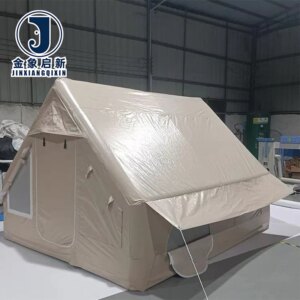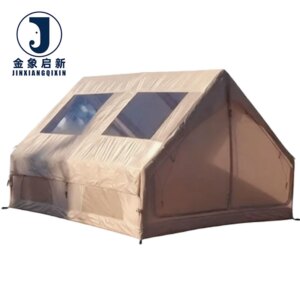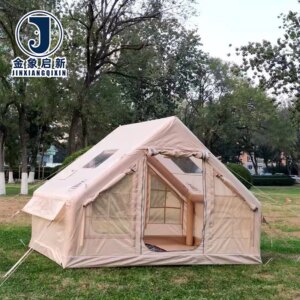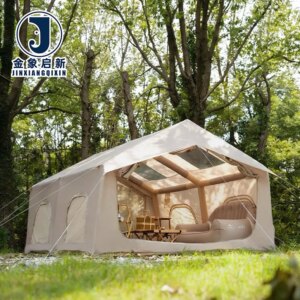
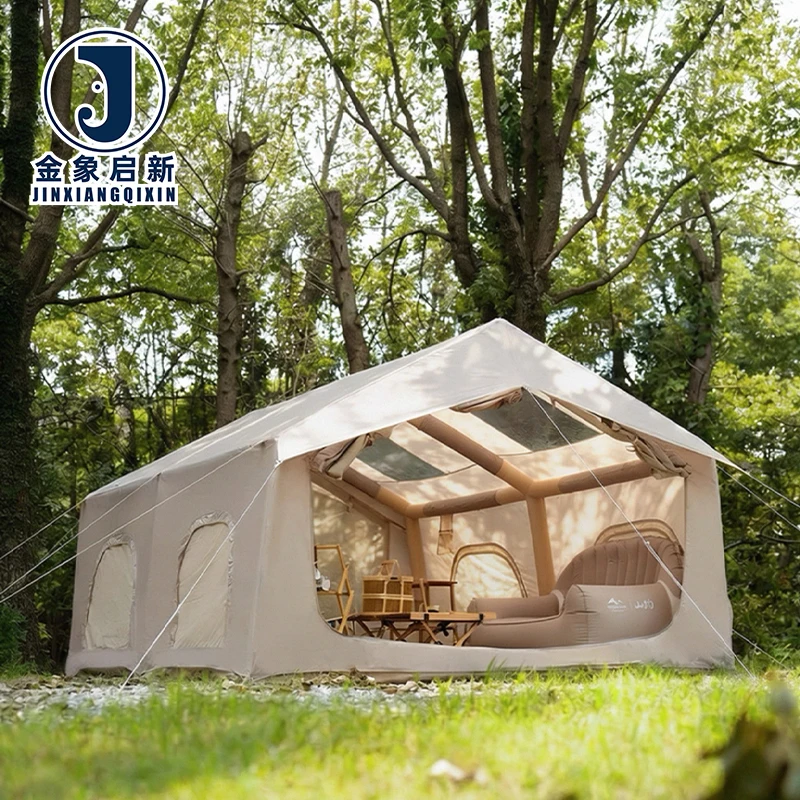
Specialist Fabric Engineering — our 10-person R&D team develops PVC inflatable tent fabric samples within days, validating coating weight, adhesion, and weld compatibility before any roll leaves the facility.
Technical Specifications
| Parameter | Value |
|---|---|
| Product Type | Inflatable Tent |
| Core Material | PVC Tarpaulin |
| Product Forms | Inflatable structure with quick automatic opening |
| Capacity | 2-3 person |
| Waterproof | Yes (performance stated, rating not given) |
| UV-resistant | Available in UV-resistant grades — confirm the grade required for your market |
| Tear-resistant | Yes (test standard not stated in source) |
| Fire-retardant | Available in flame retardant grades — confirm the grade required for your market |
| Anti-static | Available in anti-static grades — confirm surface resistance or standard for your application |
| Customization Service | OEM & ODM with sample customization and pattern printing |
| Quality Control | Full-process inspection with dedicated QA/QC staff |
| Standards | ISO 9001, ISO 14001, ISO 45001, CE |
Application Suitability
| Application | Exposure & Requirement |
|---|---|
| Disaster relief inflatable shelters | Rapid deployment, prolonged outdoor UV and rain exposure, fire safety compliance in temporary camps |
| Emergency response command centers | Continuous inflation pressure, frequent assembly and teardown, equipment protection from moisture |
| Temporary construction site shelters | Abrasive dust and debris, wind loading on inflated membrane, chemical splash resistance |
| Outdoor event logistics structures | High public visibility requiring colour consistency, sun exposure, fire-retardant compliance for assembly permits |
| Emergency supply storage enclosures | Sustained waterproof barrier, ground moisture ingress prevention, long-term membrane tension |
| Temporary workspace creation | Interior climate control retention, puncture resistance from tools and materials, ventilation duct compatibility |
Why Inflatable Tent Fabric Fails at the Weld Before the Membrane Does
The seam is the weakest link in any inflatable structure, and coating formulation controls whether the weld holds.
When PVC inflatable tent fabric is joined by hot-air or high-frequency welding, the coating layer must melt uniformly and bond to the opposing surface at a molecular level. If the plasticiser content, coating weight, or surface finish varies across a roll, the weld line creates a stress concentration exactly where the inflated structure flexes most — at the tube radius and joint intersections [NEED_CITE: tensile and tear test methods for coated fabrics per ISO 1421]. In the field, this means the membrane body remains intact while the seam peels apart under sustained inflation pressure, compromising the entire shelter. Manufacturers of emergency and disaster-relief inflatable tents frequently trace field failures back to inconsistent coating adhesion rather than base fabric deficiency. The specification sheet must therefore document not only GSM but also the coating method and plasticiser system to ensure predictable weld behaviour across every batch.
Coating Method and Its Effect on Inflatable Membrane Performance
The PVC inflatable tent fabric supplied here is produced using a knife-coating process, where liquid PVC compound is drawn across the base fabric under controlled blade pressure. This method produces a uniform coating thickness and forces the PVC into the weave structure, improving adhesion between the base yarn and the surface layer. For inflatable structures that rely on consistent air retention, this coating-to-yarn bond directly affects how well the membrane resists micro-porosity under sustained internal pressure. The knife-coating process also allows tight control over the total GSM contribution from the coating itself, which is critical when fabricators calculate weld energy settings for high-frequency or hot-air joining.
Fire-Retardant and Anti-Static Treatment for Regulated Environments
Inflatable tents deployed in aviation hangars, mining sites, or disaster-relief camps often require membrane material that meets specific fire classification and surface resistivity thresholds. Our PVC inflatable tent fabric is available in flame retardant and anti-static grades; however, the applicable test standard — whether DIN 4102 B1, NFPA 701, M2, or another national code — must be confirmed at the enquiry stage [NEED_CITE: DIN 4102 fire classification for building materials]. Anti-static treatment is similarly project-specific: mining and aviation applications demand defined surface resistance values that differ from general-purpose outdoor use. Requesting the relevant test report with each quotation ensures that the material supplied matches the regulatory framework your end client or site authority requires.
How Base Fabric Density and Coating Weight Interact
The performance of inflatable tent fabric depends on the interplay between the woven base layer and the PVC coating. Base fabric denier and thread count determine tensile and tear strength, while coating weight adds puncture resistance, waterproofing, and weld capability. A higher GSM reading alone does not guarantee a stronger membrane — if the coating is thick but the base weave is open, the fabric may resist abrasion well yet tear easily under load. Conversely, a dense base fabric with insufficient coating may show strong tensile figures but fail at the weld line because there is not enough surface PVC to form a continuous bond. Specifying both parameters independently, and reviewing the material specification sheet before committing to volume, prevents mismatches that only appear during fabrication or deployment.
The Hidden Cost of Specifying on Colour Swatches Alone
Colour consistency across rolls is a frequent source of rejection in inflatable tent fabrication. When multiple rolls are cut and welded into a single large membrane structure, even slight shade variation becomes visible along the seam lines — especially under natural daylight on site. This issue compounds when orders are placed across separate batches without referencing a fixed colour standard. Fabricators working on event structures or multi-unit disaster-relief shelters often discover the mismatch only after cutting, when the cost of replacement material and lost production time far exceeds the original savings on fabric sourcing [NEED_CITE: colour measurement standards for coated textile batches]. Confirming a Pantone or RAL reference with each order and requesting a pre-production sample from the same batch mitigates this risk entirely.
Why Procurement Teams Source Inflatable Membrane Fabric Here
Material specification sheets are issued for every roll, documenting GSM, base fabric construction, coating method, and colour reference so that fabricators can verify performance before cutting.
Fire-retardant and anti-static test reports are supplied when applicable to the specified grade, eliminating uncertainty about regulatory compliance at the construction or event permit stage.
A dedicated 10-person R&D team handles pattern printing, custom sizing, and sample development, allowing inflatable structure manufacturers to validate material behaviour on their own welding equipment before committing to full production runs.
Full-process quality inspection is conducted at every production stage, with 100% pre-shipment inspection ensuring that coating adhesion, colour consistency, and dimensional accuracy meet the agreed specification.
Three full production lines and 36 sets of professional processing equipment support bulk capacity with reliable lead times, even when custom widths or non-standard colours are required for large inflatable tent projects.
Documentation & Verification
- Material specification sheet stating GSM, base fabric denier, coating method, and colour reference for each inflatable fabric roll
- UV and fire-retardant test reports matched to the grade specified for your inflatable structure project
- ISO 9001, ISO 14001, ISO 45001, and CE certificates provided with shipment documentation
- Pre-shipment inspection record covering coating adhesion, colour consistency, and dimensional accuracy
- Roll packing list and certificate of origin included for customs clearance of inflatable membrane shipments
Fabrication, Handling & Storage
- Hot-air weld temperature and speed must be calibrated to the specific PVC coating weight of this inflatable tent fabric before production runs
- High-frequency welding compatibility should be verified on sample pieces to confirm consistent bond strength across seam intersections
- Store rolls horizontally on a flat surface to prevent permanent creasing in the PVC coating layer
- Avoid compressing stacked rolls during transport to maintain uniform coating thickness and surface finish
- Clean inflated membrane surfaces with mild pH-neutral detergent to preserve UV-resistant and fire-retardant treatment integrity
- Field repairs should use compatible PVC adhesive patches matched to the coating formulation of the inflatable tent fabric
What to Include in Your Material Enquiry
When specifying PVC inflatable tent fabric for a project, provide the intended application and deployment environment so that the correct coating formulation can be recommended. Confirm the fire-retardant classification and anti-static standard required by your local authority or site operator, as these vary between markets and sectors. Indicate the roll width, annual volume, and whether pattern printing or custom colour matching is needed for brand consistency across multiple inflatable structures. If finished cut panels rather than full rolls are required, share the panel dimensions and weld seam specifications so that fabrication feasibility can be assessed at the sample stage.
Frequently Asked Questions
Q: What fire-retardant grade is available for inflatable tent fabric and how is it tested?
A: Our PVC inflatable tent fabric is available in flame retardant grades, with the specific standard — such as DIN 4102 B1, NFPA 701, or M2 — confirmed at the enquiry stage based on your market requirements. Test reports from accredited laboratories are supplied with the relevant grade to support building permit applications, event licensing, or mining site safety audits.
Q: What anti-static surface resistance is provided for inflatable membrane used in aviation or mining?
A: Anti-static treatment is available for PVC inflatable tent fabric where the end-use environment demands controlled surface resistivity. The required standard or resistance value must be specified at the quotation stage, as aviation hangar and underground mining regulations differ. Test documentation is issued with the applicable batch to confirm compliance with your project specification.
Q: How is UV resistance validated for long-term outdoor inflatable structures?
A: UV-resistant treatment is offered in grades suited to extended outdoor exposure, with the test method and duration confirmed per project. For inflatable tents deployed in high-irradiance environments, requesting the UV test report with your sample order allows you to verify that the coating formulation meets the expected service conditions before committing to bulk production.
Q: How is batch-to-batch colour and GSM consistency controlled across rolls?
A: Each production batch is manufactured against a fixed colour reference and documented GSM target, with 100% pre-shipment inspection verifying compliance. A material specification sheet accompanies every roll, and fabricators ordering for large inflatable membrane structures can request pre-production samples from the exact batch to confirm shade and coating consistency before cutting begins.