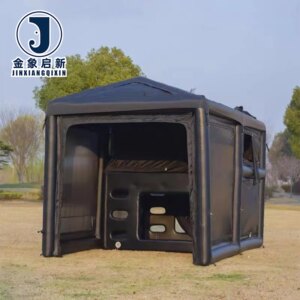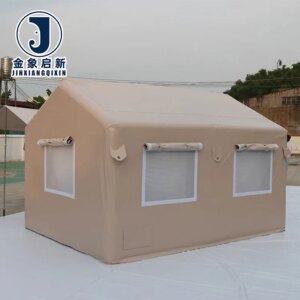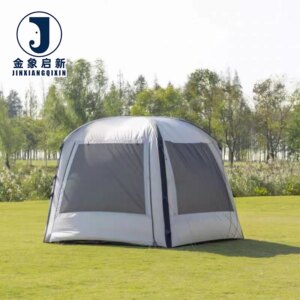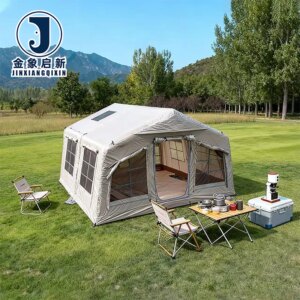
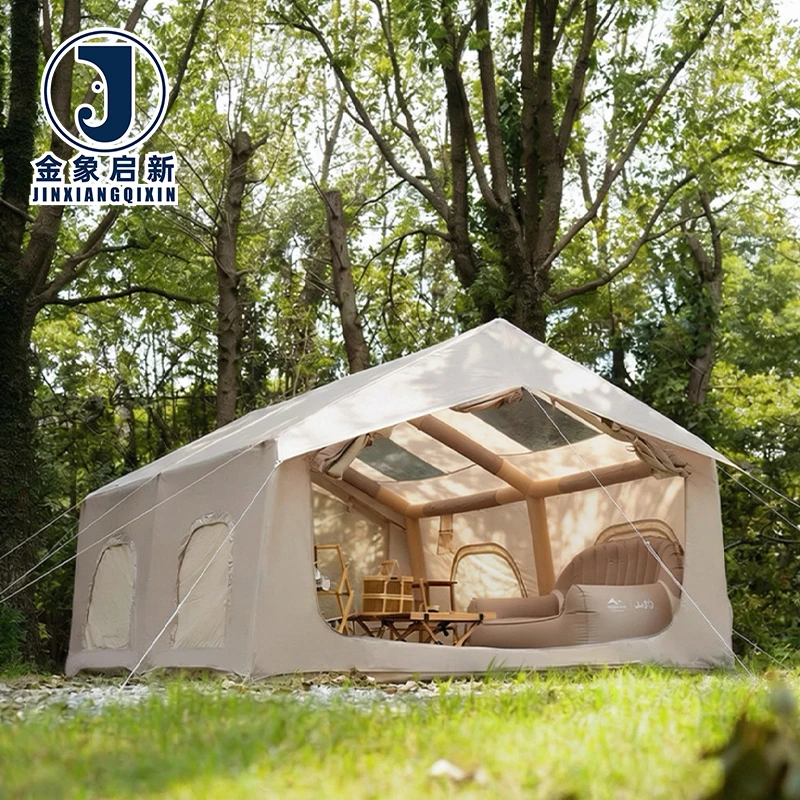
Coating Weight Control — Every roll of PVC inflatable tent fabric is verified against the quoted GSM before dispatch, supported by in-process QA across all three production lines.
Technical Specifications
| Parameter | Value |
|---|---|
| Product Type | Inflatable Fabric |
| Core Material | PVC Tarpaulin |
| Waterproof | Yes |
| UV-resistant | Available (test basis not stated in source) |
| Tear-resistant | Yes |
| Fire-retardant | Available in flame retardant grades — confirm the grade required for your market |
| Anti-static | Available in anti-static grades — confirm the standard required for your market |
| Product Forms | Inflatable structure with quick automatic opening |
| Capacity | 2-3 Person |
| Customization | OEM & ODM, sample customization, pattern printing |
| Standards | ISO9001, ISO14001, ISO45001, CE |
Application Suitability
| Application | Exposure & Requirement |
|---|---|
| Emergency and disaster relief inflatable shelters | Rapid deployment, repeated inflation/deflation cycles, verified fire-retardant and anti-static compliance |
| Temporary construction site inflatable enclosures | Weather exposure, mechanical handling, abrasion from ground contact and equipment movement |
| Inflatable membrane and event structures | UV exposure over extended periods, colour consistency across rolls, structural airtightness under wind load |
| Outdoor event logistics and equipment protection | Waterproof barrier, tear resistance during rigging and transport, batch-to-batch coating consistency |
Why Fire-Retardant Inflatable Tent Fabric Without a Grade Is a Compliance Risk
A flame retardant claim without a documented grade and test report leaves your inflatable structure exposed to site rejection and regulatory failure.
When you specify PVC inflatable tent fabric for a disaster relief tent or an event structure, the fire safety officer on site will ask for a test report that references a recognised standard — not a marketing statement. Many buyers have discovered after delivery that the fabric supplied carries no documented grade, forcing last-minute substitutions or failing site inspection [NEED_CITE: fire classification standards for temporary structures and inflatable membranes]. The consequence is not a paperwork delay; it is a structure that cannot be occupied. Always request the specific fire-retardant test report against the standard your market mandates before the order enters production.
Coating Adhesion and Inflation Cycle Fatigue
The PVC tarpaulin used in inflatable tent structures must withstand repeated pressurisation and depressurisation. Each cycle places stress on the bond between the coating and the base fabric. The knife-coated PVC inflatable tent material we supply is processed with controlled adhesion parameters so that the coating does not delaminate at the flex points where the inflatable beam bends during setup and takedown. This is critical for structures that are deployed and struck multiple times over their service life.
Airtight Chamber Integrity Under Pressure Differential
Inflatable tent chambers maintain their rigidity through internal air pressure. The PVC coating weight and its uniformity across the fabric surface determine whether micro-porosity develops under sustained pressure. Our inflatable tent fabric production includes dedicated QA/QC checks at every coating stage to ensure the PVC layer forms a continuous barrier. Seams joined by hot-air welding must hold the same pressure as the coated fabric itself, and weld behaviour is directly tied to the coating formulation and surface finish [NEED_CITE: tensile and peel strength test methods for coated fabrics per ISO 1421].
Understanding the Specification Chain: Base Fabric, Coating, and Treatment
The performance of PVC inflatable tent fabric is not defined by a single number. The base fabric denier and weave density establish the tensile and tear foundation — a tighter weave distributes load across more yarns, slowing tear propagation when the inflatable beam is punctured or abraded. The PVC coating method and weight add the airtight barrier, waterproof seal, and the chemical anchor for any surface treatment. GSM alone tells you the total mass per square metre, but it cannot distinguish between a fabric that achieves its weight through a heavy, low-density base and one built on a denser, lighter-weave fabric with a proportionate coating. For inflatable structures, the ratio matters: a heavier coating on a lighter base may resist abrasion well but flex-crack faster in cold deployment. UV-resistant and flame-retardant treatments are applied during or after coating, and their effectiveness depends on the coating chemistry being compatible with the additive. Requesting a material specification sheet that breaks out base fabric denier, weave count, and coating weight separately — rather than a single GSM figure — gives you the data to evaluate whether the fabric matches your inflation pressure and deployment conditions.
What Happens When Weld Integrity Is Overlooked in Specification
The most common failure point on an inflatable tent is not the fabric face — it is the welded seam where two panels join under internal pressure. When the PVC coating weight or formulation varies between rolls, the hot-air welding temperature that worked on the first panel may under-weld or over-burn the second. This produces seams that peel open during inflation or crack when the structure flexes in wind. Buyers who specify only GSM without verifying coating consistency across the batch often find the weld line fails before the fabric does [NEED_CITE: welded seam peel strength testing for PVC coated fabrics]. The entire structure then requires patching or panel replacement on site, at the worst possible moment.
Why Procurement Verification Matters Here
Our production runs are built around process control, not post-production sorting. Each roll of inflatable tent fabric passes through dedicated QA/QC at every stage, from base fabric inspection through coating application to final winding. A 10-person R&D team handles material selection and sample development, so you can evaluate coating behaviour on your own welding equipment before committing to bulk. We operate three full production lines with 36 sets of professional equipment, supporting both roll stock supply for fabricators and finished inflatable tent structures. Samples are developed within days for custom requirements including colour matching and pattern printing.
Documentation & Verification
- Material specification sheet stating GSM, base fabric denier and weave, coating method and weight
- Test reports for UV and flame-retardant grades supplied with the batch where applicable
- Pre-shipment inspection record with per-roll weight verification against stated GSM
- ISO9001, ISO14001, ISO45001 and CE certificates for compliance documentation
- Certificate of origin and customs support documentation for export shipments
Fabrication, Handling & Storage
- Hot-air welding temperature must be calibrated to the specific PVC coating weight — run test welds on each new roll before joining structural panels
- Store rolls horizontally on pallets in a shaded area to prevent compression marks on the PVC coating surface
- Allow cold-stored rolls to reach ambient temperature before unrolling to avoid coating micro-cracking during handling
- Use mild detergent and soft cloth for cleaning — avoid solvents that can dissolve the PVC surface layer
- Cut panels with a minimum seam allowance matched to the fabric thickness to ensure full weld contact area
- For on-site repair, use compatible PVC patches bonded with heat welding rather than adhesive-only methods
What to Include in Your Specification Request
To match the correct inflatable tent fabric to your application, share the inflation pressure your chambers will operate under, the deployment frequency, and the environmental exposure range. If your market mandates a specific fire-retardant grade or anti-static standard, include the regulation reference so we can supply the corresponding test report. Confirm whether you need fabric by the roll for your own fabrication or finished cut panels with welded seams. Let us know if colour consistency across rolls or pattern printing is required for your structure.
Frequently Asked Questions
Q: How is the GSM of the inflatable tent fabric verified on arrival?
A: Every roll undergoes weight verification during our pre-shipment inspection, measured against the stated GSM on the material specification sheet. You receive the inspection record with your shipment documentation, so you can cross-check the values on receipt without relying solely on the quotation figure.
Q: What fire-retardant grade does the fabric carry and does it meet my market regulation?
A: We supply inflatable tent fabric in flame retardant grades, but the specific grade depends on your target market’s regulation. Confirm the standard required for your project during inquiry so we can supply the matching test report with your order — a generic claim without a documented grade will not pass site inspection.
Q: What is the test basis for the anti-static claim?
A: Anti-static treatment is available for inflatable tent fabric used in environments where static discharge is a hazard, such as mining or aviation applications. The surface resistance value and test standard must be confirmed against your project specification before order confirmation to ensure documented compliance.
Q: Can the fabric be supplied by the roll with batch-consistent colour and coating weight?
A: Yes. Our production lines are set up for roll stock supply with dedicated QA/QC at every coating stage. Colour and coating weight are monitored across the batch to ensure roll-to-roll consistency, which is critical when multiple rolls are welded together into a single inflatable structure.
Q: How does PVC coating adhesion hold up under repeated inflation and deflation cycles?
A: The knife-coated PVC on our inflatable tent fabric is processed for adhesion strength that resists delamination through repeated flex cycles. The coating-to-base-fabric bond is verified during production, ensuring the inflatable beam maintains airtight integrity across multiple deployments and strikes.