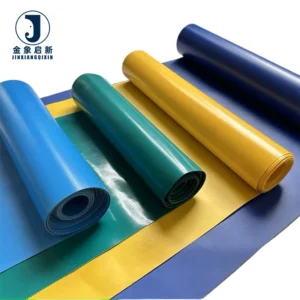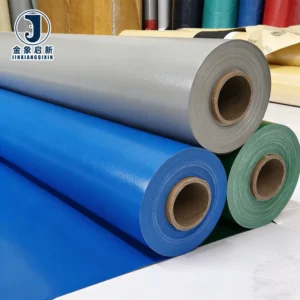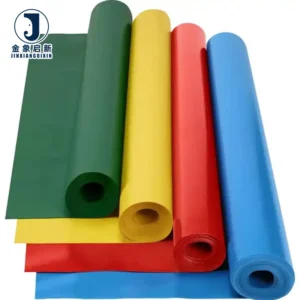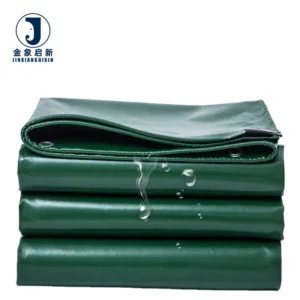
Coated Fabric Process Control — Every roll of warp knitted PVC coated tarpaulin undergoes in-process coating weight checks to ensure the GSM and adhesion values match the material specification sheet before dispatch.
Technical Specifications
| Parameter | Value |
|---|---|
| Product Type | PVC Coated Tarpaulin |
| Coating Material | PVC |
| Base Fabric Construction | Warp Knitted |
| Weave Style | Plain |
| Waterproof | Yes — fully coated construction |
| Anti-Static | Available — confirm the grade required for your market |
| Tear Resistance | Claimed durable (test basis not stated) |
| Color | Customizable colors available |
| Flame Retardant | Available in flame retardant grades — confirm the grade required for your market |
| UV Treatment | Available in UV treated grades — confirm the grade required for your market |
| Weight (GSM) | Confirm required grade at inquiry |
| Standards | ISO and CE certified production (company level) |
Application Suitability
| Application | Exposure & Requirement |
|---|---|
| Poultry and broiler farm side-wall covers | Continuous moisture, ammonia vapour, dust accumulation, and routine wash-down |
| Pig and sheep shelter enclosures | Wind load stress, animal contact abrasion, and seasonal temperature fluctuation |
| Agricultural tent and temporary livestock housing | Field assembly tension, UV exposure, and repeated erection and teardown cycles |
| Farm structure roof covers | Standing water runoff, hail impact, and long-term solar degradation |
Why Material Test Reports Matter More Than the Label on the Roll
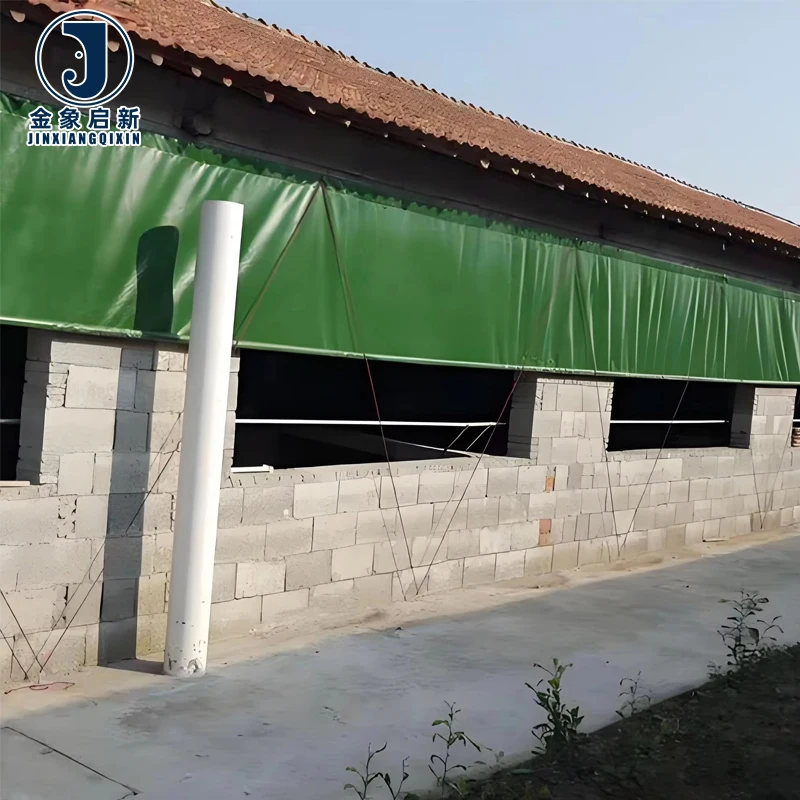
When a PVC Coated Tarpaulin for Poultry Farm arrives at your site, the label may claim anti-static or waterproof performance — but without a test report tied to that specific batch, you have no way to verify what the fabric will actually do in a high-dust, high-moisture broiler house environment.
Specify the test standard on the purchase order, not just the property name.
Too many agricultural cover fabrics are quoted with generic claims like "waterproof" or "anti-static" that collapse under the first audit or compliance check. A coating formulation that passes a bench test at controlled humidity may behave differently when exposed to ammonia-laden air and daily pressure washing. The gap between a marketing claim and a verifiable test result is where cover failures originate [NEED_CITE: tensile and tear test methods for coated fabrics per ISO 1421]. Procurement teams that do not require documentation before production often discover the mismatch only after installation.
How Warp Knitted Construction Controls Tear Propagation
The warp knitted base fabric used in this PVC coated tarpaulin creates interlocking loop structures that distribute stress across multiple yarn paths rather than concentrating it at a single point. When a puncture or cut occurs in a livestock enclosure — whether from equipment contact or wind-driven debris — the knitted structure resists the tear from running in a straight line across the panel. This is particularly relevant for poultry farm side curtains where a small tear, if uncontrolled, can compromise the entire climate envelope within hours during a storm event.
Coating Adhesion and Its Role in Farm Cover Durability
The PVC coating is applied to the warp knitted base with controlled weight parameters across the production line. Adhesion between the coating layer and the base fabric determines whether the material delaminates under the flexing and tension cycles that farm covers endure daily. Poor adhesion shows up first at folded edges and welded seams — exactly where poultry house curtains experience the most mechanical stress during automated roll-up and roll-down operations. Every batch is produced with process controls designed to maintain consistent coating-to-substrate bonding [NEED_CITE: coating adhesion test methods for PVC coated textiles].
Reading the Specification Sheet Beyond GSM
GSM alone tells you the total weight per square metre but reveals nothing about how that weight is distributed between the base fabric and the coating. A heavy coating on a light base fabric may meet the GSM target while offering limited tensile contribution from the yarn structure itself. The denier of the base yarns, the stitch density of the warp knit, and the coating formulation together determine how the material performs under load. This PVC Coated Tarpaulin for Poultry Farm applications is specified with base fabric denier, construction type, and coating weight documented on the material specification sheet so that buyers can evaluate the full material composition rather than relying on a single aggregate number. Requesting these details before ordering is the most effective way to compare materials from different sources on a like-for-like basis.
The Hidden Cost of Specifying on Price Per Kilogram Alone
When procurement decisions focus exclusively on cost per kilogram, suppliers have an incentive to shift weight into the coating layer — which is cheaper per kilogram than the polyester base yarn — while reducing base fabric density. The result is a roll that meets the quoted GSM but tears more easily under wind load and delaminates faster at welded seams. For farm covers that must span entire livestock structures, a batch that arrives lighter on base fabric density than expected means the entire installation may need premature replacement. Colour variation between rolls in the same shipment compounds the problem when adjacent panels on a poultry house show visibly different shades once installed side by side [NEED_CITE: batch colour consistency standards in coated fabric production]. These failures are not visible during a quick warehouse inspection but become apparent only after the material is tensioned and exposed to sunlight.
Why Buyers Source This Fabric Here
Three full production lines with 36 sets of professional equipment support bulk roll orders with consistent output quality, meaning your poultry farm cover specification does not drift between the first and last roll in a container. A 10-person R&D team handles material selection and sample development, so custom width and colour requirements are resolved at the sampling stage rather than discovered as problems during production. Dedicated QA/QC inspection at every production stage with 100% pre-shipment checking ensures that the roll packing list matches what actually arrives on your dock. Custom samples are developed within days, allowing you to verify hand feel, colour, and coating adhesion before committing to a full production run.
Documentation & Verification
- Material specification sheet stating base fabric denier, coating weight, and GSM for each roll
- Test reports for anti-static or flame retardant grades where specified on the purchase order
- Pre-shipment inspection record documenting roll-by-roll weight and visual verification
- Roll packing list with colour reference codes for batch consistency cross-checking on arrival
- ISO and CE certificates with production batch traceability for compliance audits
Fabrication, Handling & Storage
- Weld temperature and dwell time must be matched to the PVC coating weight to avoid seam delamination at flex points
- Store rolls horizontally on racking to prevent flat spots that create permanent creases in the warp knitted base
- Unroll in ambient temperature conditions to allow the PVC coating to relax before cutting panels to size
- Use compatible PVC adhesive for field repairs on coated surfaces to maintain waterproof continuity at patch edges
- Plan panel cutting layout to minimise off-cuts and reduce the number of welded seams in high-stress zones
- Avoid dragging rolls on unprotected ground to prevent abrasion damage to the outer coating layer
What to Include in Your Inquiry
Provide the specific livestock application and the environmental exposure conditions your covers will face, including wash-down frequency and chemical contact. Specify the required roll width, target colour reference, and whether you need full rolls or pre-cut panels. If your market requires fire classification or anti-static certification, state the standard that applies so the correct grade is selected at the quotation stage.
Frequently Asked Questions
Q: How is GSM verified on arrival and what does the pre-shipment inspection record show?
A: Each roll is weighed and measured during the 100% pre-shipment inspection. The inspection record documents the actual GSM, base fabric denier, and coating weight against the values stated on the material specification sheet. This record ships with the documentation package so you can cross-check the figures on your receiving dock before the rolls enter your fabrication workflow.
Q: What test basis supports the anti-static claim for poultry farm environments?
A: Anti-static treatment is available in specific grades suited to dust-heavy environments like broiler houses. The applicable test standard and measured surface resistance values are documented on the test report that ships with your order. Request the test report at the quotation stage to confirm the grade matches the compliance requirements of your market before production begins.
Q: How is colour consistency controlled across multiple rolls in a single order?
A: Colour consistency is managed through controlled coating line parameters and pigment dosing across the entire production batch. Each roll carries a colour reference code on the packing list. When multiple rolls are installed side by side on a single poultry structure, the batch-level process controls are designed to minimise visible shade variation between adjacent panels.
Q: What base fabric denier and weave options are available for farm cover applications?
A: The standard construction for this product is a warp knitted plain weave base fabric. Specific denier options are selected based on the tensile and tear requirements of your application. Provide the wind load conditions and structural span dimensions at the inquiry stage so the appropriate base fabric grade is matched to your farm cover design.
Q: What documentation ships with the rolls — spec sheet, test report, certificate of origin?
A: Every shipment includes a material specification sheet, roll packing list with colour references, pre-shipment inspection record, and certificate of origin. Test reports for any specified treatments such as anti-static or flame retardant grades are included where applicable. ISO and CE certificates are available for compliance documentation and customs clearance requirements.