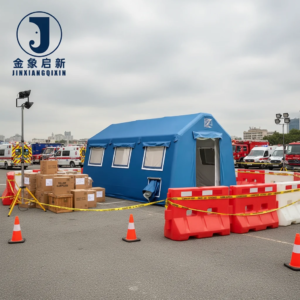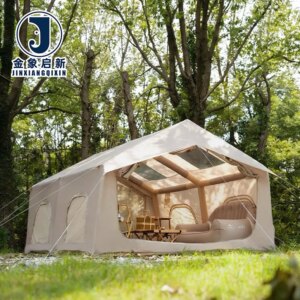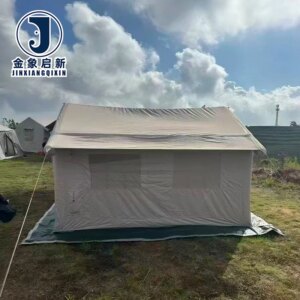
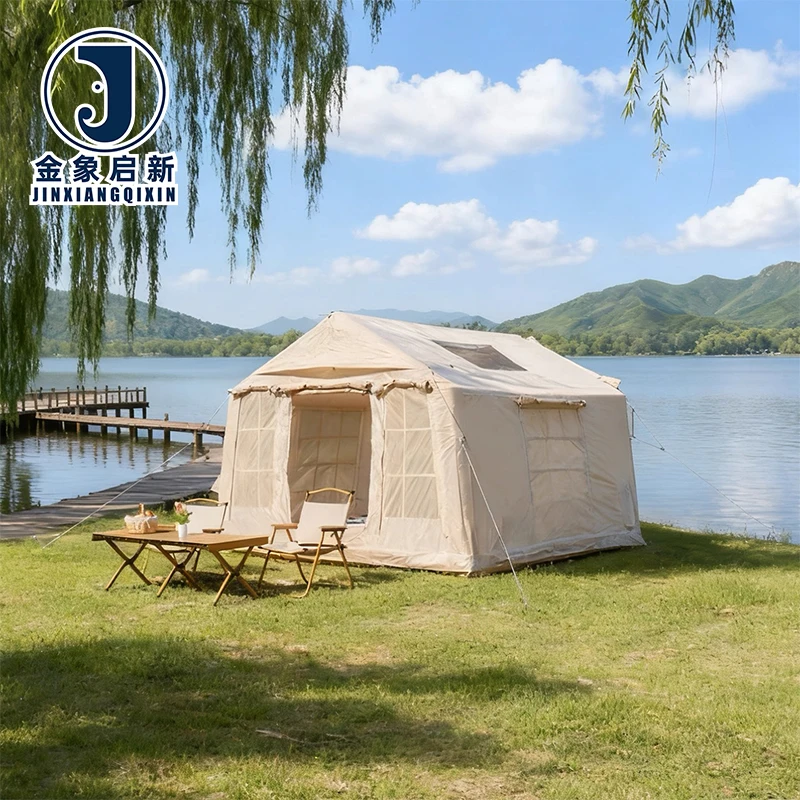
Coating Weight Control — Nearly 30 years of PVC formulation experience applied to inflatable tent fabric, with documented GSM verification on every roll before dispatch.
Technical Specifications
| Parameter | Value |
|---|---|
| Product Type | Inflatable Tent Fabric |
| Core Material | Waterproof PVC Coated Fabric |
| Water Resistance | Fully waterproof coated construction |
| UV Resistance | UV-resistant formulation (test basis not stated in source) |
| Fire Retardancy | Fire-retardant grades available — confirm the grade required for your market |
| Anti-static Property | Anti-static options available (standard not stated in source) |
| Key Features | Tear-resistant, waterproof, customizable GSM and width |
| Customization | OEM & ODM, sample development, pattern printing, material selection |
| Production Facility | 9,180 m² with 3 full production lines |
| Processing Equipment | 36 sets of professional equipment |
| R&D Support | 10 technicians |
| Certifications | ISO 9001, ISO 14001, ISO 45001, CE |
Application Suitability
| Application | Exposure & Requirement |
|---|---|
| Commercial glamping sites | Prolonged sun exposure, seasonal inflation cycles, guest comfort expectations |
| Temporary event accommodations | Rapid deployment, repeated packing and unpacking, variable weather |
| Construction site welfare facilities | Dust and debris contact, heavy use, fire safety compliance on site |
| Outdoor exhibition spaces | High visibility requirements, UV exposure over event duration, branding surfaces |
| Equipment storage shelters | Water ingress prevention, wind load on membrane, long-term UV exposure |
Why Material Data Sheets Matter More Than Quoted GSM for Inflatable Tent Fabric
A quoted GSM tells you weight per square metre; it does not tell you how that weight is distributed between base fabric and coating, or what tensile and tear values result.
Technical buyers sourcing Inflatable Tent Fabric + coating technology / material properties often discover that two rolls at the same GSM behave completely differently under cyclic inflation stress. The base fabric denier and weave density determine how the load transfers through the yarn structure, while the coating method and weight govern adhesion at weld lines and valve attachment points. Without a complete material specification sheet, you are comparing products on a single number that hides the variables actually responsible for field performance. [NEED_CITE: tensile and tear test methods for coated fabrics per ISO 1421]
Base Fabric Construction and Its Role in Structural Integrity
The base fabric is the load-bearing skeleton of any Inflatable Tent Fabric + coating technology / material properties specification. Denier and weave density determine how stress distributes across the membrane when the structure inflates and flexes under wind load. A tighter weave with higher-denier yarns resists tear propagation more effectively at seam junctions, which is critical where air beams connect to the main body.
Coating Adhesion at Weld Lines and Valve Points
PVC coating must bond to the base fabric with sufficient peel strength to survive repeated inflation and deflation cycles. At valve attachment points and air-beam junctions, the material experiences concentrated cyclic stress. If the coating adhesion is inadequate, delamination begins at these high-flex zones long before the base fabric itself reaches its tensile limit. [NEED_CITE: peel strength test methods for PVC coated fabrics]
Reading GSM, Denier and Coating Weight Together
GSM alone is an incomplete indicator. A fabric with a heavy coating but a light base fabric may show high GSM yet tear easily along the yarn structure. Conversely, a dense base fabric with a thinner coating may have lower GSM but substantially higher tear resistance. For inflatable structures, the relationship between base fabric denier, weave density, and PVC coating weight must be evaluated as a system. Coating method — whether knife-coated, laminated, or calendered — also affects weld behaviour and long-term adhesion under thermal cycling.
What Happens When Material Specs Are Not Verified Before Production
When a batch of PVC coated fabric arrives lighter than the quotation stated, the consequences compound through the entire production run. Air beams designed around a specific stiffness may flex beyond their intended radius, stressing weld lines prematurely. Fire-retardant treatment claimed without a supporting test report can result in failed site inspections, particularly in jurisdictions requiring documented compliance for temporary structures. Colour variation between rolls becomes visible once panels are welded side by side on a large inflatable shell. [NEED_CITE: common field failures in inflatable membrane structures]
Procurement Advantages for Inflatable Tent Fabric Buyers
Deep process control over coating weight and adhesion comes from nearly three decades focused exclusively on coated fabric production. Three full production lines and 36 sets of processing equipment support bulk roll orders with consistent output. A 10-technician R&D team handles custom formulation, colour matching, and sample development within days rather than weeks. Dedicated QA/QC at every production stage includes 100% inspection before shipment, with GSM verification per roll against the stated specification.
Documentation & Verification
- Material specification sheet stating GSM, base fabric construction, and PVC coating type for each roll
- Independent test reports for UV resistance and flame-retardant grades where applicable to your market
- Pre-shipment inspection record confirming weight verification per roll before dispatch
- ISO and CE certificates with batch traceability for export compliance
- Certificate of origin and full customs documentation for international shipments
Fabrication, Handling & Storage
- Set hot-air weld temperature based on coating thickness to avoid burning through thin PVC layers
- Reinforce valve attachment zones with additional PVC patches to distribute cyclic inflation stress
- Store rolls upright on pallets to prevent flat-spot deformation of the coated surface
- Allow cold-transported rolls to reach ambient temperature before unrolling to prevent coating micro-cracking
- Use PVC-compatible cleaners only; solvent-based products can degrade the coating surface finish
- Plan panel cutting layout to minimize weld seams across high-stress air-beam junctions
What We Need to Quote Your Inflatable Tent Fabric Order
Provide your target application and the environmental exposure conditions the structure will face, including expected UV intensity and wind load. Specify any fire-retardant grade or anti-static standard required by your local building or event safety codes. Confirm the roll width, colour reference, and whether you need raw rolls or pre-cut panels with welded seams.
Frequently Asked Questions
Q: Can I get a test report verifying the UV and flame-retardant claims?
A: Yes. We supply independent test reports for UV-resistant and fire-retardant formulations where applicable. Because fire safety codes vary by market, confirm the specific grade your jurisdiction requires — such as B1, M2, or NFPA 701 — so we match the correct formulation and provide the corresponding documentation with your shipment.
Q: What GSM and coating weight options are available for inflatable tent beams?
A: We produce PVC coated fabric across a range of GSM grades suitable for inflatable structures. The appropriate weight depends on your beam diameter, expected wind load, and inflation pressure. Our R&D team can recommend a base fabric denier and coating weight combination after reviewing your structural design requirements.
Q: How do you ensure colour consistency across multiple rolls in one order?
A: Every production run undergoes in-process colour checks against the approved reference sample. Our QA/QC protocol includes visual inspection of rolls side by side before packing. For large orders spanning multiple batches, we maintain formulation records to ensure the same pigment ratio and coating thickness across the entire order.
Q: Do you supply fabric only, or complete inflatable tent units?
A: We manufacture and supply PVC coated fabric by the roll, as well as custom-cut panels with welded seams. For complete inflatable tent units, we offer OEM and ODM services including product design, pattern printing, and full assembly. Share your design drawings or application requirements to determine the most suitable supply format.