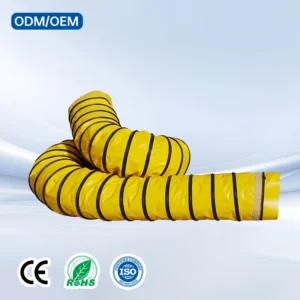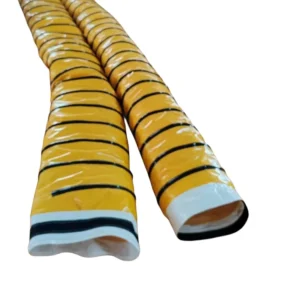
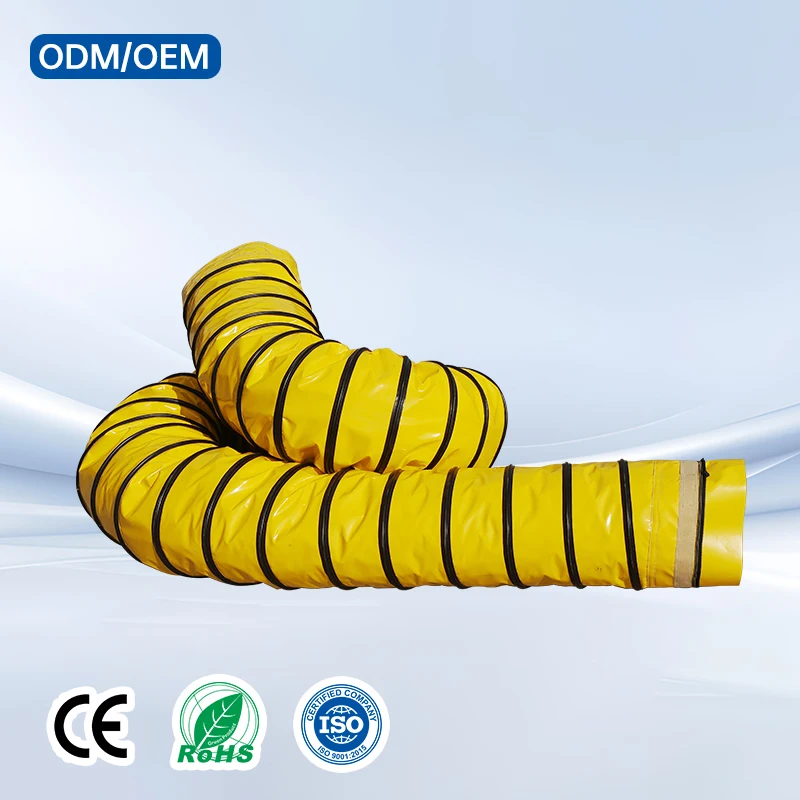
Three production lines with full in-process QA — Every aviation air duct undergoes stage-by-stage inspection with 100% pre-shipment verification before leaving our Jinan facility.
Technical Specifications
| Parameter | Value |
|---|---|
| Product Type | Aviation Air Duct |
| Coating Material | PVC + fabric-reinforced layer / aluminum foil insulation |
| Insulation Layer | Built-in aluminum foil bubble film |
| Temperature Range | -30°C to 150°C |
| Outer Layer Coloring | Yellow-black alternating protective pattern |
| Connection System | Zipper and Velcro link |
| Mildew Resistance | Yes |
| Water Resistance | Yes |
| Flame Retardant Grade | Available in flame retardant grades — confirm the grade required for your airport authority |
| Anti-Static | Available in anti-static grades — confirm the standard required for your site compliance |
| Logo Customization | Supported, MOQ 100 units |
| Pattern Customization | Supported, MOQ 100 units |
| Standards | ISO, CE |
Application Suitability
| Application | Exposure & Requirement |
|---|---|
| PCA unit to aircraft cabin air transmission | Continuous thermal cycling between conditioned air and apron ambient temperature, flexing during deployment and retraction |
| Airport apron ground support equipment connection | High-visibility safety coloring required, abrasion from ground contact, UV exposure during outdoor staging |
| Aircraft cabin door air conditioning interface | Precise diameter matching to aircraft flange, airtight connection under positive pressure, rapid connect-disconnect between flights |
| Aviation maintenance hangar temporary air supply | Extended continuous operation, duct routing around hangar structures, repeated handling by ground crews |
| Military and charter flight ground operations | Rugged field deployment, portable air conditioning system compatibility, storage under variable conditions |
Why Generic Industrial Duct Fails on the Airport Apron
Aviation PCA Hose Air Duct fire retardant certified requirements are not optional suggestions — airport authorities enforce fire safety and anti-static compliance as a condition for ground equipment operation. Ventilation duct supplied without the fire-retardant or anti-static certification the site requires causes delays, rejected inspections, and grounded flights. Confirm the exact fire-retardant grade and anti-static standard your airport authority mandates before placing any order.
I have seen ground support operators purchase standard industrial ducting at lower cost, only to have it rejected during the airport safety audit weeks later. The duct looked right on the outside, but the material specification sheet lacked the fire classification the authority required. The entire batch sat in storage while replacements were sourced on emergency timelines [NEED_CITE: airport apron ground equipment fire safety classification requirements].
This is where documentation matters as much as the product itself. A duct that performs well physically but arrives without the correct certification paperwork is functionally useless on a regulated airfield.
Multi-Layer Construction for Thermal Control
The Aviation PCA Hose Air Duct fire retardant certified design uses a PVC-coated fabric-reinforced outer structure with a built-in aluminum foil bubble film insulation layer. This combination manages the thermal transfer between pre-conditioned air flowing inside and the apron environment outside. Without proper insulation, conditioned air loses temperature before reaching the aircraft cabin, forcing the PCA unit to work harder and consume more energy. The aluminum foil bubble film layer acts as a thermal barrier that maintains air temperature across the duct length during transmission.
Rapid Deployment Under Turnaround Pressure
Aircraft turnaround windows are measured in minutes, not hours. The zipper and Velcro connection system on this Aviation Air Duct aftermarket supplier product allows ground crews to deploy, connect, and retract the duct without tools or complex fastening procedures. Each segment links to the next through the integrated closure system, enabling crews to configure the duct run length to match the aircraft parking position. After departure, the duct disconnects and collapses for compact storage on the ground support vehicle.
Temperature Range Across Operating Conditions
The verified -30°C to 150°C operating range covers the full spectrum of pre-conditioned air delivery. Cold air transmission in summer and warm air delivery in winter both fall within this envelope. This range is critical because the duct material must remain flexible at low temperatures without becoming brittle, and must maintain structural integrity when warm air passes through during cold-weather operations [NEED_CITE: PCA unit outlet temperature specifications for commercial aircraft]. Material that stiffens below its rated minimum temperature will crack at the flex points during deployment.
Decoding the Specification Sheet for Aviation Procurement
The PVC-coated fabric-reinforced layer provides the structural backbone of this Aviation Air Duct aftermarket supplier hose. The base fabric carries the mechanical load — tensile forces during pulling, internal pressure from airflow, and external abrasion from ground contact. The PVC coating seals the fabric against moisture ingress and provides the surface for the high-visibility yellow-black coloring that airport safety protocols demand. The aluminum foil bubble film insulation layer is sandwiched within the construction, protected from direct mechanical damage by the outer PVC-coated shell. This multi-layer architecture means the duct performs three distinct functions — structural containment, thermal insulation, and visual safety compliance — through separate material systems rather than relying on a single layer to do everything. The temperature range of -30°C to 150°C reflects the combined performance envelope of all layers working together [NEED_CITE: tensile and tear test methods for coated fabrics per ISO 1421].
The Cost of Specifying the Wrong Duct Grade
When an Aviation PCA Hose Air Duct fire retardant certified order arrives without the fire-retardant grade the airport authority requires, the consequences cascade beyond the material itself. Ground support equipment gets pulled from service pending compliance verification. Flight turnaround schedules slip because alternative PCA connections must be arranged. Procurement teams face pressure to source emergency replacements at premium timelines while the original batch sits unapproved. Similarly, if the anti-static certification does not match the site requirement, the duct may pass visual inspection but fail the compliance audit that follows [NEED_CITE: fire-retardant and anti-static testing standards for aviation ground equipment].
Batch-to-batch colour variation in the yellow-black outer layer creates a different problem. When replacement duct segments are installed alongside existing ones and the colour does not match, it raises questions about whether the replacement is the same specification. Airport safety inspectors notice these inconsistencies during routine checks, and they trigger deeper documentation reviews that slow operations.
Why Procurement Teams Source This Duct Here
Our 10-person R&D team handles material selection and custom sizing for aviation duct requirements, developing samples within days when a specific aircraft interface or connection configuration is needed.
Three full production lines and 36 sets of professional equipment support bulk capacity, meaning repeat orders for airport ground support fleets ship on reliable timelines rather than stretching into uncertain lead times.
Dedicated QA/QC runs at every production stage with 100% inspection before shipment, so each duct in the batch is checked against the specification rather than sampled statistically.
Material specification sheets state the coating composition, insulation layer construction, and temperature test report, giving your engineering team the documentation they need for compliance submissions.
Sample development for custom diameter, length, and connection requirements proceeds through our sales process from inquiry to approval before production begins, reducing the risk of specification mismatches on the finished batch.
Documentation & Verification
- Material specification sheet stating PVC coating composition, base fabric construction, and aluminum foil insulation layer details
- Temperature test report documenting verified performance across the -30°C to 150°C operating range
- Fire-retardant grade and anti-static certification matching the airport authority compliance standard specified on your purchase order
- Pre-shipment inspection record with 100% QA coverage documenting each duct against stated specifications
- ISO and CE certificates with certificate of origin and customs documentation for international dispatch
- Roll packing list with batch identification for traceability across repeat orders
Fabrication, Handling & Storage
- Zipper and Velcro connection points should be inspected for alignment before each deployment to prevent tearing at the closure interface
- Yellow-black outer PVC coating tolerates standard mild cleaning agents; avoid solvent-based cleaners that degrade the coating surface
- Store collapsed duct segments in dry conditions away from direct compression to prevent permanent creasing in the aluminum foil insulation layer
- When routing around hangar structures, avoid sharp edge contact that can cut through the PVC-coated fabric reinforcement layer
- Repair minor outer layer damage with compatible PVC adhesive patches matched to the coating composition stated on the material specification sheet
- Custom diameter and length orders should be confirmed against the aircraft flange interface drawing before production begins
How to Structure Your Duct Inquiry
Provide the aircraft models and PCA unit types in your fleet so we can match duct diameter and connection configuration to your specific ground support equipment interfaces. State the fire-retardant grade and anti-static standard your airport authority requires, along with the documentation format needed for compliance audits. Confirm whether you need standard segments or custom lengths, and specify any logo or pattern branding requirements for fleet identification.
Frequently Asked Questions
Q: What fire-retardant grade and anti-static standard does this PCA duct meet for aviation apron use?
A: This Aviation Air Duct aftermarket supplier product is available in flame retardant and anti-static grades. The specific grade must be confirmed against your airport authority compliance requirements before ordering. We provide the corresponding test report and certification documentation with each shipment to support your compliance audit process.
Q: How is the insulation layer constructed and what temperature range is verified?
A: The duct incorporates a built-in aluminum foil bubble film insulation layer within the PVC-coated fabric-reinforced construction. The temperature range of -30°C to 150°C is verified by testing, covering both cold and warm pre-conditioned air delivery. Request the temperature test report to include in your ground equipment documentation package.
Q: Can you customize length and diameter for specific aircraft models?
A: Yes. Our R&D team develops samples for custom diameter, length, and connection configurations matched to your aircraft cabin door interfaces and PCA unit outlets. Custom logo and pattern branding is supported with a minimum order of 100 units. Submit your aircraft model specifications and we will recommend the duct configuration.
Q: How do you ensure batch-to-batch consistency in coating and colour?
A: Dedicated QA/QC operates at every production stage with 100% inspection before shipment. The yellow-black alternating outer coloring is checked against colour references to maintain consistency across repeat orders. Pre-shipment inspection records document each duct against the stated specification, and we provide batch identification for traceability.
Q: What documentation is provided for customs clearance and airport authority compliance?
A: Each shipment includes the material specification sheet, temperature test report, fire-retardant and anti-static certification where applicable, ISO and CE certificates, certificate of origin, customs documentation, and a roll packing list with batch identification. Specify your documentation requirements during the inquiry stage so everything is prepared before dispatch.