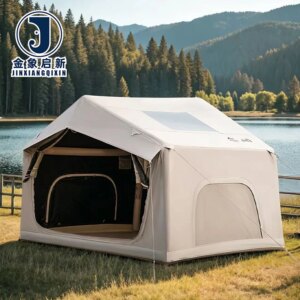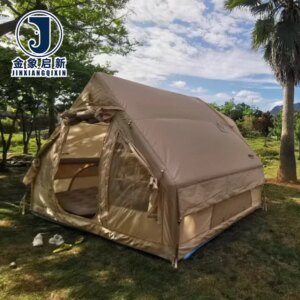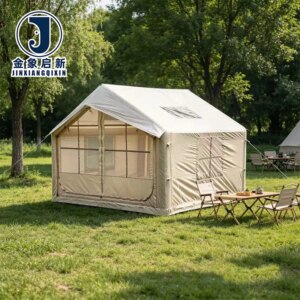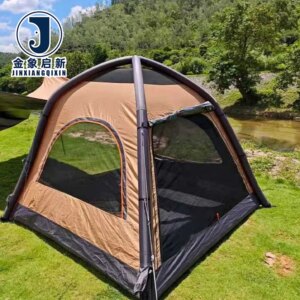
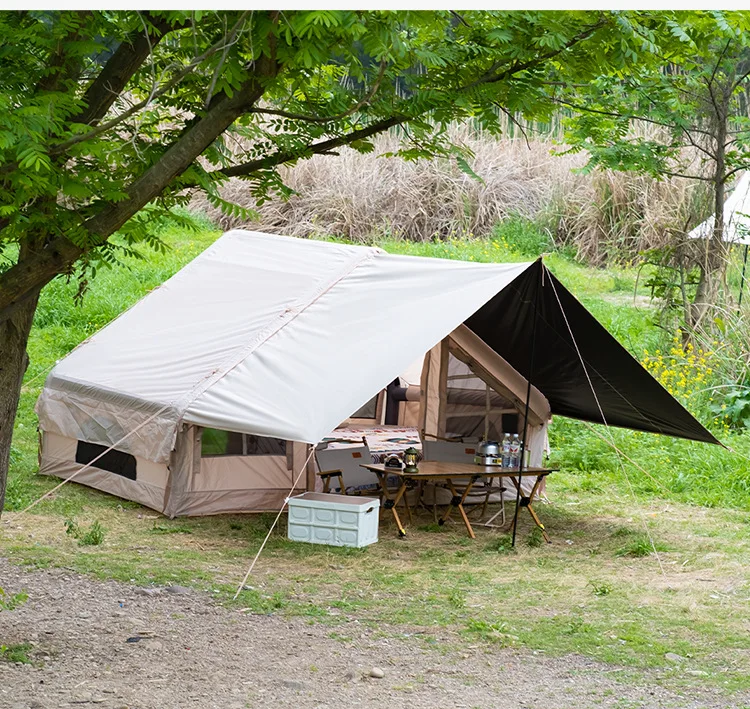
Precision Coating Control — Three full production lines and 36 sets of professional equipment enable tight GSM tolerance on every roll of inflatable tent fabric, with dedicated QA/QC verifying coating weight before dispatch.
Technical Specifications
| Parameter | Value |
|---|---|
| Product Type | PVC Tent |
| Core Material | PVC waterproof fabric |
| Construction | Single-layer PVC |
| Key Performance | Waterproof, UV-resistant (test basis not stated in source), tear-resistant, fire-retardant (grade not stated in source), anti-static (standard not stated in source) |
| Season Rating | Four-Season |
| Capacity | 2-3 Person |
| Deployment | Quick automatic opening mechanism |
| Customization Service | OEM & ODM, sample customization, pattern printing |
| Certifications | ISO9001, ISO14001, ISO45001, CE |
Application Suitability
| Application | Exposure & Requirement |
|---|---|
| Professional outdoor gear manufacturing | Repeated inflation cycles, prolonged UV exposure, moisture ingress, abrasion during packing and deployment |
| Construction site temporary shelters | Wind loading on inflatable frames, rain and dust exposure, rapid deployment demand, fire safety compliance on site |
| Emergency response field structures | Extreme temperature fluctuation, frequent relocation, tear resistance during transport, chemical exposure from decontamination |
| Commercial event and glamping operators | Guest-facing aesthetics, colour consistency across multiple units, seasonal storage and re-deployment cycles |
Why Coating Adhesion Matters More Than Fabric Weight for Inflatable Structures
An inflatable tent fails at the coating-to-yarn bond long before the base fabric reaches its tensile limit.
When buyers evaluate inflatable tent fabric, the instinct is to compare GSM across quotations. Yet in pressurised structures, the internal air column places constant peel stress on the coating layer. If the PVC compound does not penetrate the base weave adequately during coating, micro-delamination begins at the seam allowance—often invisible during pre-shipment inspection. We have examined returned rolls where the coating separated cleanly from the yarn under fingernail pressure, despite the stated GSM reading within tolerance [NEED_CITE: peel strength test methods for coated fabrics per ISO 2411]. A heavier coating applied without proper knife-gap control adds dead weight without improving bond strength, and the extra mass increases packing volume for the finished tent. Specifying PVC inflatable tent aftermarket supplier requirements around adhesion pull-test data, rather than GSM alone, separates materials that survive repeated inflation from those that blister after the first season.
Coating Formulation and Waterproof Integrity in Single-Layer Construction
Single-layer PVC inflatable tent fabric relies on one continuous coating pass to deliver waterproof performance. The PVC compound viscosity and plasticiser ratio must be matched to the base fabric denier so the coating fills interstices without forming a brittle surface film. Jinan Jinxiang controls this formulation in-house across all three production lines, adjusting the compound recipe when the base fabric lot changes. This process control is what allows the material to maintain waterproof integrity through the flex cycles an inflatable camping tent endures during inflation, deflation, and wind-induced movement. The finished PVC inflatable tent aftermarket supplier product ships in rolls ready for pattern cutting and high-frequency welding.
UV and Fire-Retardant Treatments: What the Test Report Actually Covers
UV-resistant and fire-retardant treatments are available for this inflatable tent fabric — confirm the specific grade required for your target market before placing the order. A test report that covers UV exposure duration under a particular standard (e.g., ISO 4892-2) tells you the conditions under which the material was evaluated, not a universal service life. Similarly, fire-retardant classification varies by jurisdiction; a grade accepted in one country’s building code may not satisfy another’s temporary structure regulation [NEED_CITE: fire classification standards for temporary structures by region]. Requesting the test basis from your PVC inflatable tent aftermarket supplier before sample approval ensures the treatment matches the regulatory environment where the finished tent will be deployed.
Decoding the Specification Sheet: Beyond the Surface Numbers
Coating weight and base fabric denier work together to determine how the material behaves under inflation pressure. A higher denier base yarn resists tear propagation, but if the coating weight is insufficient to fill the weave, pinholes become leak paths in the air column. Single-layer PVC construction means every square metre carries the full waterproof burden with no secondary membrane backup—there is no margin for coating thin-spots. The quick automatic opening mechanism in the finished tent places sudden peak stress on the fabric during inflation, demanding tear resistance that correlates to both yarn count and coating penetration depth. UV-resistant treatment, where specified, must be compounded into the PVC layer itself rather than applied as a topical finish; topical treatments abrade during the first packing cycle. Available fire-retardant grades should be confirmed against the end-market’s fire safety standard, as formulations differ between halogenated and phosphorus-based systems, each with distinct implications for weld temperature and seam strength.
The Hidden Cost of Ignoring Roll-to-Roll Consistency
Colour variation between rolls in a single container load becomes visible the moment two tent panels are erected side by side at a trade show or glamping site. The buyer absorbs the full cost: return shipping, replacement production, and the reputational damage when a customer photographs the mismatch. Beyond aesthetics, inconsistent coating weight across rolls causes welding parameters to drift—what sealed perfectly on the sample tears open on the third production roll [NEED_CITE: hot-air weld strength variance across coating weight tolerance]. Inflatable tent manufacturers who skip the pre-production sample approval step and rely solely on the quotation’s stated specification expose themselves to these batch-level surprises. Sourcing from a PVC inflatable tent aftermarket supplier that inspects every roll before dispatch and retains batch traceability records is a direct mitigation against this class of failure.
Why Production Depth Supports Your Inflatable Tent Programme
Jinan Jinxiang operates three full production lines with 36 sets of professional equipment, giving the capacity to hold roll-to-roll coating consistency across the volume an inflatable tent programme demands. The 10-technician R&D team develops custom formulations and pattern printing layouts during the sample stage, so colour and surface texture are locked before mass production begins. Nearly 30 years of focused coated-fabric experience translates into process parameters that have been refined across seasonal production cycles, reducing the trial-and-error burden on your procurement team. Dedicated QA/QC personnel conduct 100% pre-shipment inspection against the approved sample, recording coating weight and visual consistency for every roll. ISO9001, ISO14001, ISO45001, and CE documentation accompanies each shipment, supporting both customs clearance and your own compliance audit trail.
Documentation & Verification
- Material specification sheet stating base fabric denier, coating compound type, and treatment references for your PVC tent order
- UV and fire-retardant test reports — request before order confirmation to match your market requirements
- Pre-shipment inspection record documenting coating weight and colour consistency per roll
- ISO9001, ISO14001, ISO45001, and CE certificates included with every dispatch
- Certificate of origin and customs support documents for import clearance
Fabrication, Handling & Storage
- High-frequency and hot-air welding compatible with single-layer PVC construction; calibrate temperature to coating compound batch
- Store rolls vertically on end-caps to prevent flat-spot creasing on the PVC waterproof fabric surface
- Clean with mild detergent only; solvent-based cleaners may attack plasticiser in the PVC coating layer
- Allow cold-stored rolls to reach ambient temperature before unrolling to avoid coating micro-cracking
- Pattern printing adhesion should be validated on pre-production sample before full-run commitment
What to Include in Your Inflatable Tent Fabric Inquiry
Specify the inflation pressure range and expected deployment cycle frequency so the correct coating formulation can be recommended. State the fire-retardant classification required by your end market’s temporary structure regulation, along with any UV exposure standard your product line claims. Indicate roll width preference, annual volume, and whether pattern printing or custom colour matching is needed for your PVC inflatable tent aftermarket supplier order.
Frequently Asked Questions
Q: How is UV resistance verified and what test basis supports the outdoor durability claim?
A: UV-resistant treatment is available for inflatable tent fabric — the specific test standard and exposure duration must be confirmed for your application. Request the test report before sample approval so the data aligns with your target market’s outdoor product claims. The R&D team adjusts the UV additive package based on the end-use climate zone.
Q: What fire-retardant grade is available and does it meet my market’s fire safety standard?
A: Fire-retardant grades are available but the specific classification must be matched to your jurisdiction’s temporary structure regulation. Provide the required standard in your inquiry and the technical team will confirm formulation compatibility. Test reports are issued per batch, covering the compound used in your production run.
Q: Can the inflatable tent fabric be customised in width, colour, and pattern printing?
A: OEM and ODM customisation covers roll width, colour matching, and pattern printing. A pre-production sample is developed within days for your approval before mass production. The 10-technician R&D team handles layout adjustments and surface finish selection to match your product line’s design requirements.
Q: How do you ensure colour and coating consistency across multiple rolls?
A: Every roll undergoes 100% pre-shipment inspection against the approved sample, with coating weight and visual consistency recorded. Batch traceability records are retained for verification. Production parameters are locked during sample approval and held constant throughout the manufacturing run.
Q: What documentation is provided for customs clearance and compliance audits?
A: Each shipment includes material specification sheet, applicable test reports, ISO and CE certificates, certificate of origin, and pre-shipment inspection records. The documentation package supports both import customs clearance and your internal quality compliance audits.