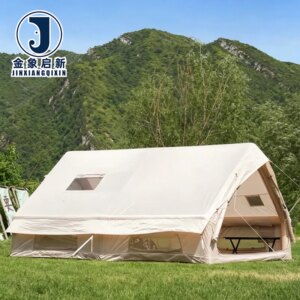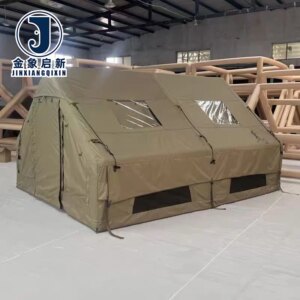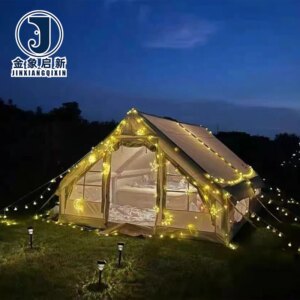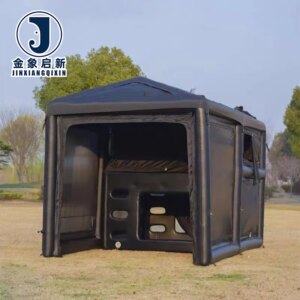
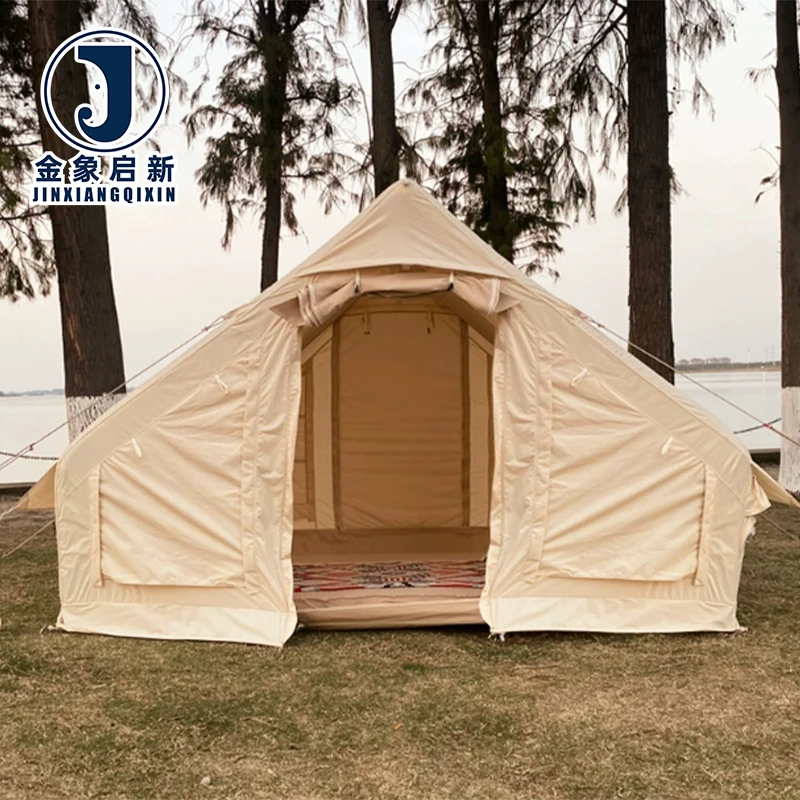
Coating adhesion control — PVC inflatable tent fabric produced across 3 lines with 36 sets of professional equipment, maintaining consistent bond strength through every inflation cycle.
Technical Specifications
| Parameter | Value |
|---|---|
| Product Type | Inflatable Tent |
| Core Material | PVC Tarpaulin |
| Waterproof | available — test basis not stated |
| UV-resistant | available — test basis not stated |
| Tear-resistant | available — test basis not stated |
| Fire-retardant | available in flame retardant grades — confirm the grade required for your market |
| Anti-static | available — test basis not stated |
| Product Form | Inflatable structure with automatic opening mechanism |
| Customization Service | OEM & ODM (sample customization, pattern printing, material selection, product design) |
| Production Lines | 3 full production lines |
| Processing Equipment | 36 sets of professional equipment |
| R&D Team | 10 technicians |
| Quality Control | Full-process inspection with dedicated QA & QC staff |
| Standards | ISO9001, ISO14001, ISO45001, CE |
Application Suitability
| Application | Exposure & Requirement |
|---|---|
| Commercial camping operations | Repeated inflation and deflation cycles, constant UV exposure, guest safety compliance |
| Industrial field accommodations | Extended weather exposure, temperature fluctuation, fire safety certification for temporary structures |
| Specialized outdoor work shelters | Rapid deployment requirement, wind load stress, abrasion from ground contact |
| Outdoor gear manufacturing | Batch-to-batch material consistency, pattern printing durability, structural validation under load |
Why Inflatable Tent Fabric Fails Where You Least Expect It
Seams split long before the PVC inflatable tent fabric itself reaches its breaking point.
Inflatable structures place continuous stress on welded joints every time the tent is pressurised. Standard tarpaulins that perform well in static applications often show premature seam separation under repeated inflation cycles, particularly at the flex zones where the air beams connect to the ground sheet. I have seen coated rolls fail at the weld line during the first season of commercial use, not because the fabric lacked strength but because the coating adhesion was insufficient for heat welding. [NEED_CITE: peel strength and weld integrity testing for coated fabrics per ISO 2411]
Coating Adhesion and Weld Performance
The bond between the PVC coating and the polyester base fabric determines whether a heat-welded seam holds through thousands of inflation cycles. Poor adhesion causes the coating to delaminate at the weld zone, creating a failure path that propagates under internal pressure. Our PVC inflatable tent fabric is produced with controlled coating weight and adhesion parameters refined over decades of coated fabric manufacturing, ensuring that the weld zone remains the strongest section of the structure rather than the weakest.
Fire-Retardant and Anti-Static Treatment Considerations
Temporary structures used in commercial camping and industrial sites increasingly require documented fire safety compliance. Available in flame retardant grades — confirm the grade required for your market before specifying. Anti-static treatment options are also available for applications where dust accumulation or electronic equipment proximity demands it. [NEED_CITE: fire classification standards for temporary membrane structures]
Understanding the Base Fabric and Coating Relationship
The tear resistance of PVC inflatable tent fabric depends on both the base fabric construction and the coating formulation. A heavier coating does not automatically mean higher tear strength if the base fabric denier and weave density are inadequate for the intended load. The polyester base provides the structural skeleton, while the PVC coating seals the weave, adds abrasion resistance, and enables heat welding. When evaluating material options, request the base fabric specification alongside the total coated weight to understand how the two components work together. [NEED_CITE: relationship between base fabric denier and tear propagation resistance per ISO 1421]
The Hidden Cost of Specifying on Weight Alone
Buyers who select inflatable tent fabric based solely on stated GSM often discover that the actual coated weight on arrival falls below the quotation value. This discrepancy matters less for static covers but becomes critical in inflatable structures where the air pressure exerts constant force on every square centimetre of fabric. A coating that is lighter than specified may lack the adhesion strength needed for reliable heat welding, leading to seam failures that compromise the entire structure. [NEED_CITE: coating weight verification methods for PVC tarpaulin]
Why Source This PVC Inflatable Tent Fabric Here
Nearly 30 years of focused coated fabric production means coating formulation and adhesion control are not variables but constants in every roll. Three full production lines and 36 sets of processing equipment support volume orders without sacrificing the consistency that inflatable structure manufacturers require across multiple production batches. A 10-technician R&D team handles material selection, pattern printing specification, and sample development so that your custom requirements are validated before bulk production begins. Dedicated QA and QC staff conduct full-process inspection with 100% pre-shipment checks, ensuring that the PVC inflatable tent fabric you receive matches the specification you approved.
Documentation & Verification
- Material specification sheet stating base fabric denier, coating type, and treatment grades for your inflatable tent application
- Test reports for UV resistance and flame retardant grades where applicable to your market requirements
- ISO and CE certificates accompanying each shipment with pre-shipment inspection records
- Roll-by-roll packing list enabling weight verification against stated GSM before fabrication begins
Fabrication, Handling & Storage
- Heat welding temperature and dwell time should be calibrated to the specific PVC coating formulation before production runs
- Reinforce stress concentration zones at air beam junctions with additional PVC patches bonded to the coated surface
- Store rolls horizontally on pallets in dry conditions to prevent creasing that weakens the coating at fold lines
- Allow cold-stored rolls to reach ambient temperature before unrolling to avoid coating crack damage
- Use only PVC-compatible cleaners that do not degrade the coating surface or compromise pattern printing adhesion
Requesting a Material Recommendation
Tell us the climatic conditions your inflatable structures will face, the fire safety classification your target market requires, and the annual volume you plan to produce. If you need custom widths, colour matching, or pattern printing, provide your design files and target delivery schedule so we can confirm feasibility and develop samples for your structural validation before bulk commitment.
Frequently Asked Questions
Q: What fire-retardant grades are available for inflatable tent fabric?
A: Flame retardant treatment is available in multiple grades depending on your target market’s regulatory requirements. Confirm the specific standard your application demands — such as local building code classifications for temporary structures — and we will provide the corresponding test report with your material specification sheet.
Q: Can you supply samples for weld testing before bulk orders?
A: Sample development is handled by our 10-technician R&D team and typically completed within days for custom requirements. We supply samples sized for heat weld parameter calibration so you can validate seam strength and inflation cycle performance before committing to full production volumes.
Q: How do you verify coating weight and adhesion before shipment?
A: Dedicated QA and QC staff conduct full-process inspection with 100% pre-shipment checks on every roll. Each shipment includes a pre-shipment inspection record and roll packing list that enables you to verify the actual coated weight against the stated GSM upon receipt.
Q: What customisation is possible for colour, printing, and dimensions?
A: OEM and ODM services cover material selection, custom widths, single or double side colour options, and pattern printing for branding. Provide your design specifications and we will develop samples for your approval, confirming batch-to-batch colour consistency across your full order quantity.