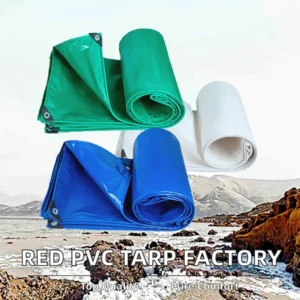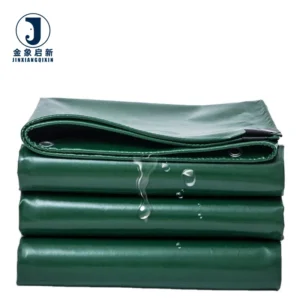
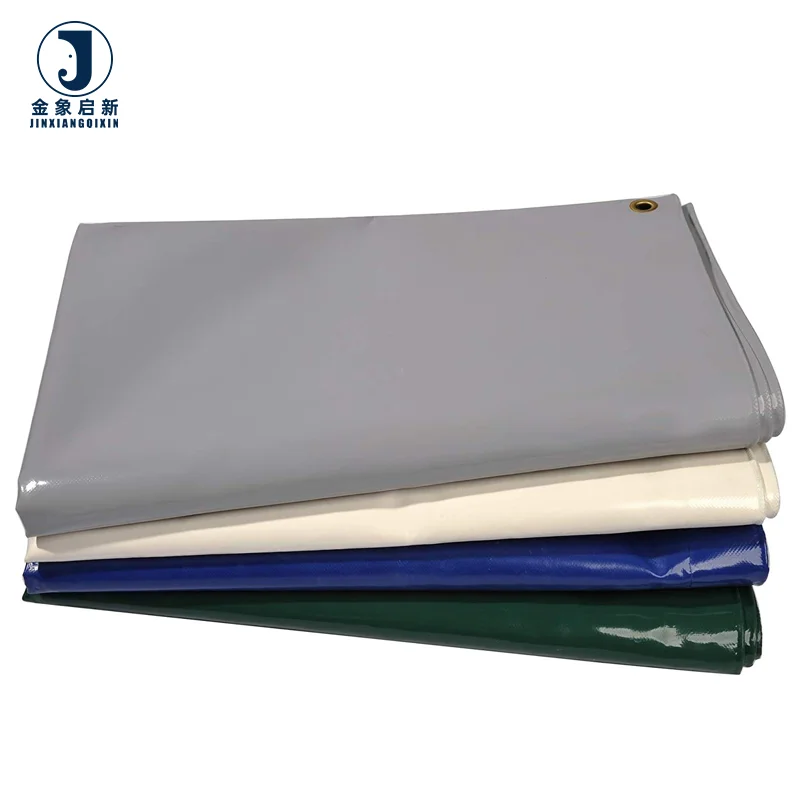
Material Consistency — every roll of PVC coated tarpaulin verified against stated GSM, base fabric denier, and coating weight before it leaves the line.
Technical Specifications
| Parameter | Value |
|---|---|
| Product Type | PVC Coated Tarpaulin |
| Coating Material | PVC double-sided coating on polyester base fabric |
| Yarn Count Options | 500D×840D / 1000D×1000D / 1000D×1300D / 1300D×1300D / 1000D×2000D |
| Mesh Density | 20×20 / 30×15 / 30×19 |
| Weight Range | 350 / 400 / 420 / 500 / 600 / 650 / 750 / 900 g/m² |
| Thickness Range | 0.29 / 0.32 / 0.38 / 0.44 / 0.46 / 0.55 / 0.65 mm |
| Tensile Strength (Warp) | 1650–3900 N (test basis not stated in source) |
| Tensile Strength (Weft) | 1600–3500 N (test basis not stated in source) |
| Flame Retardant | Flame retardant grade available — confirm the grade required for your market |
| UV Treatment | Anti-UV treatment applied (test basis not stated in source) |
| Waterproof | Fully waterproof coated construction |
| Brittle Temperature | ≤ −50 to −60 °C |
| Softening Temperature | ≥ 80 °C |
| Color | Gray |
| Edge Construction | 5 mm rope hem, high-temperature heat-sealed seamless edge wrapping |
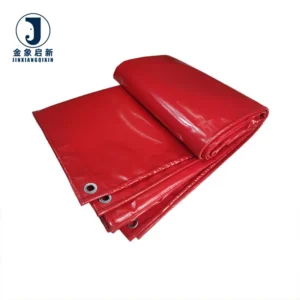
| Eyelets | 3 cm enlarged aluminum alloy buttonhole with reinforced corners |
| Certifications | ISO, CE |
Application Suitability
| Application | Exposure & Requirement |
|---|---|
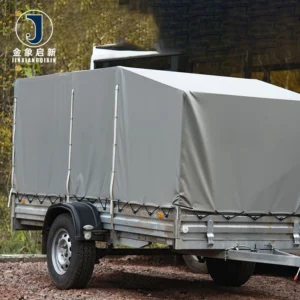
| Truck side curtains and trailer covers | Constant flexing at load points, road abrasion, UV exposure, weather sealing |
| Industrial machine and equipment covers | Dust ingress, outdoor weathering, repeated draping and removal |
| Tent and awning panels | Wind load tension, prolonged sun exposure, rain shedding, flame-retardant compliance for public venues |
| Pergola and canopy rain covers | Permanent outdoor mounting, UV degradation, pooling water load |
| Groundsheets and construction site covers | Puncture from aggregate, soil moisture, foot traffic abrasion |
| Balcony and window rainproof screens | Wind-driven rain, residential aesthetic, lightweight handling |
Why Coating Weight Matters More Than Total GSM for PVC Coated Tarpaulin
Total GSM alone tells you nothing about how the PVC coated tarpaulin will behave under load or after seasons of sun exposure.
Buyers frequently quote a target GSM, receive rolls that match the scale reading, and still experience premature coating delamination or weld-line failure. The reason is that two fabrics can share the same total weight while carrying very different ratios of base fabric to coating. A heavier base yarn with a thinner coat reaches the same GSM as a lighter yarn buried under thick PVC, yet the tensile and peel behaviour diverge sharply. Technical buyers specifying PVC coated tarpaulin base fabric denier, coating weight, and GSM tensile strength relationships need the breakdown, not just the sum. [NEED_CITE: coating-to-substrate weight ratio and peel strength per ISO 2411]
How Base Fabric Denier Governs Structural Capacity
The polyester base fabric carries virtually all the tensile and tear load; the PVC coating contributes weather protection and surface durability. When the yarn count steps up from 500D×840D to 1000D×2000D, the individual filament diameter increases substantially, raising both warp and weft breaking force. Mesh density compounds this effect — a 30×19 weave packs more yarns per unit area than a 20×20 weave, distributing point loads across a wider yarn network. Specifiers comparing grades should read denier and density together, because a high-denier yarn in a sparse weave can underperform a mid-denier yarn in a tight weave under tear propagation.
PVC Coating Weight and Its Effect on Weld Behaviour
Coating thickness directly influences how the fabric responds to hot-air or wedge welding during fabrication. Thicker PVC layers require more heat energy and longer dwell time to reach fusion temperature without scorching the polyester substrate underneath. If the weld temperature is too low, the joint peels before the fabric reaches its rated tensile value. If it is too high, the coating degrades and the seam becomes brittle. Across the 0.29 mm to 0.65 mm thickness range offered here, welding parameters must be adjusted per grade. Fabricators running multiple GSM grades on the same production line benefit from material specification sheets that state coating weight separately from base fabric weight. [NEED_CITE: hot-air welding parameters for PVC coated polyester fabrics]
Reading the Thickness-to-GSM Correlation
Each thickness step in this product family corresponds to a specific GSM band, and the relationship is not perfectly linear because base fabric construction varies between grades. The 0.29 mm option sits at the lighter end, suited to applications where drapability and low roll weight matter more than puncture resistance. At 0.65 mm, the fabric carries enough PVC mass to resist abrasion and withstand repeated flexing at tie-down points. Thickness also affects low-temperature handling — the stated brittle temperature of −50 to −60 °C applies to the PVC compound, but stiffer heavy-grade rolls demand more care during cold-weather unfolding to avoid crease damage.
The Hidden Cost of Specifying on GSM Alone
When a buyer approves a PVC coated tarpaulin based only on a GSM figure, several failure modes go unaddressed. A roll that meets weight but uses a sparse weave will show lower tear resistance than expected, and the first sign is a rip propagating from an eyelet under wind load. Coating adhesion, measured as peel strength between PVC and polyester, is invisible on a scale yet determines whether the fabric survives repeated folding. Colour inconsistency between rolls in the same shipment becomes visible only after installation, when panels sit side by side on a truck curtain or pergola frame. Each of these issues traces back to incomplete specification rather than faulty material. [NEED_CITE: common failure modes in coated fabric field returns]
Why Technical Buyers Source This PVC Coated Fabric Here
Three full production lines and 36 sets of professional equipment run dedicated PVC coating processes, giving consistent coating weight control across large-volume roll orders. The 10-person R&D team develops custom GSM grades, colour matches, and width options with samples produced within days rather than weeks. Every roll passes 100 percent inspection before dispatch, with a pre-shipment record documenting actual measured GSM against the purchase order specification. ISO and CE certification underpins the quality management system, and documentation packages include material specification sheets that break down base fabric denier, coating weight, and mesh density for each roll shipped. Buyers receive the test report relevant to their specified flame-retardant or anti-UV grade rather than a generic certificate.
Documentation & Verification
- Material specification sheet stating GSM, base fabric denier, and PVC coating weight per roll
- Flame-retardant test report matched to the grade specified on the purchase order
- Pre-shipment inspection record with measured GSM and thickness values
- ISO and CE certificates included in the shipping documentation package
- Colour reference standard and batch consistency record for multi-roll orders
- Certificate of origin and customs documentation for export clearance
Fabrication, Handling & Storage
- Heat-seal welding parameters must be adjusted for each thickness grade from 0.29 mm to 0.65 mm to avoid coating scorch or cold joints
- The 3 cm aluminum alloy eyelets with reinforced corners distribute tie-down loads, but grommet spacing should tighten on heavier GSM grades under wind load
- Store rolls upright on pallets to prevent flat-spotting the PVC coating, especially on softer grades in warm warehouse conditions
- Unfold heavy-grade rolls in temperatures above 5 °C to stay within the material’s ductile range and avoid crease whitening
- Clean the PVC surface with mild detergent only; solvent-based cleaners attack the plasticiser in the coating compound
- Off-cut edges should be heat-sealed immediately after cutting to prevent moisture wicking into the polyester base fabric
What We Need to Quote Your PVC Coated Fabric Accurately
Provide the intended application and the environmental exposure conditions — particularly whether flame-retardant compliance is required and which standard your destination market enforces. Confirm the GSM grade or the tensile strength target you need, along with roll width and estimated annual volume so we can map production scheduling. If you require finished cut sizes with specific eyelet spacing or edge reinforcement, share the panel dimensions and a drawing if available.
Frequently Asked Questions
Q: How do I verify the GSM of PVC coated tarpaulin on arrival matches the quoted specification?
A: Each roll ships with a pre-shipment inspection record showing measured GSM and thickness. On receipt, cut a known-area sample from the roll end and weigh it on a calibrated scale. Compare the result against the material specification sheet provided in the documentation package. Any discrepancy beyond normal tolerance should be flagged before fabrication begins.
Q: Which flame-retardant grade should I specify for my market?
A: Fire codes differ by region and application — construction membrane structures, mining ventilation, and public-event tents each have distinct requirements. Confirm the exact standard your project demands, such as DIN 4102, NFPA 701, or a local building code classification, and we will supply the matching test report with your shipment documentation.
Q: How does yarn denier affect real-world performance of PVC coated fabric?
A: Higher denier yarns increase individual filament diameter, raising both tensile breaking force and tear propagation resistance. A 1000D×2000D base fabric handles substantially higher mechanical stress than a 500D×840D construction. For applications involving wind load, tie-down tension, or repeated flexing at seams, specify the denier and mesh density together rather than relying on GSM alone.
Q: What controls batch-to-batch colour consistency across multiple roll orders?
A: Production uses a recorded colour reference standard for each order, with in-process QA checks against that reference throughout the coating run. The pre-shipment documentation includes a batch consistency record. For installations where panels sit side by side, we recommend ordering the full project quantity in a single production run to minimise shade variation.
Q: How should I adjust welding parameters when switching between GSM grades?
A: Thicker PVC coatings require higher heat input and longer dwell time to reach fusion temperature without degrading the polyester base. When moving between grades in the 0.29 mm to 0.65 mm range, run test welds on off-cuts first and perform peel tests to confirm joint strength meets or exceeds the fabric tensile value before committing to production panels.