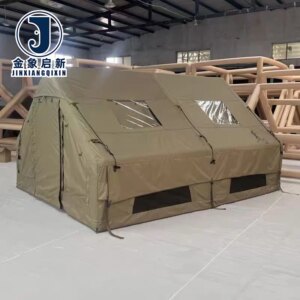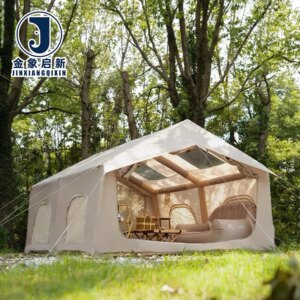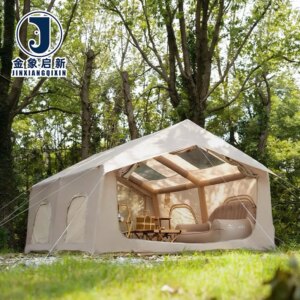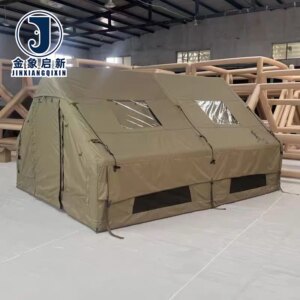
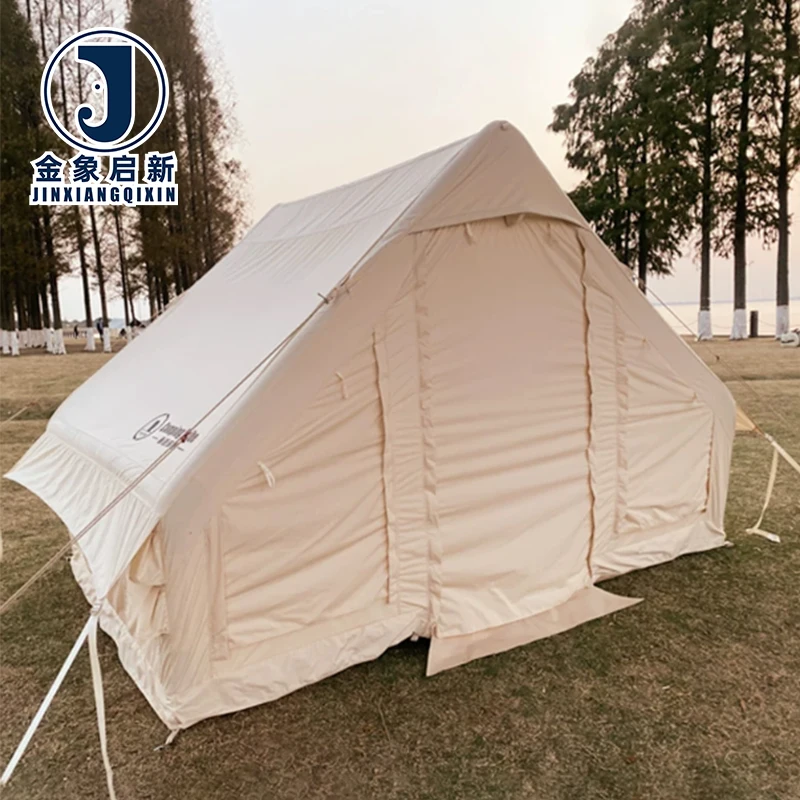
Coated Fabric Mastery — Nearly 30 years of PVC coating process control ensures consistent fabric thickness, adhesion, and surface finish across every roll of inflatable tent fabric produced for commercial deployment.
Technical Specifications
| Parameter | Value |
|---|---|
| Product Type | Inflatable Tent |
| Core Material | UV Water-resistant PVC Fabric |
| Key Performance | Waterproof, UV-resistant, Tear-resistant |
| Product Form | Inflatable structure with single layer design |
| Fabric Thickness Range | 0.3mm to 0.8mm (available options — confirm requirement) |
| UV Protection Retention | 90% after 500 hours accelerated weathering (test basis not stated) |
| Tear Resistance | Exceeds 300N warp and weft (test basis not stated) |
| Wind Load Capacity | Up to 12m/s |
| Airtightness | 72-hour pressure maintenance (test basis not stated) |
| Color Options | Khaki, custom Pantone matches available |
| Customization Service | OEM & ODM (sample customization, pattern printing) |
| Standards | ISO 9001, ISO 14001, ISO 45001, CE |
Application Suitability
| Application | Exposure & Requirement |
|---|---|
| Construction site temporary shelters | Continuous UV exposure, wind loading, dust ingress, 4-season temperature fluctuation |
| Outdoor event management structures | Rapid inflation and deflation cycles, crowd proximity abrasion, branding print adhesion |
| Industrial site accommodations | Remote deployment, sustained air pressure retention, weather sealing over extended periods |
| Mobile exhibition and marketing activations | Frequent transport and packing, surface scuffing, custom color and pattern presentation |
| Outdoor marketing activation spaces | High visibility requirements, UV-stable color retention, repeated setup and teardown |
Why UV Claims on Inflatable Tent Fabric Require More Than a Data Sheet Promise
UV resistance only matters if the test method and exposure duration are documented and verifiable.
When buyers evaluate an Inflatable Tent Fabric manufacturer custom option, the stated UV protection level often lacks a traceable test basis. A claim of 90% retention after accelerated weathering means little without knowing whether the test followed ISO 4892, ASTM G154, or another recognized protocol [NEED_CITE: accelerated weathering test standards for PVC coated fabrics]. Commercial structures deployed across open sites face continuous solar loading that degrades unprotected plasticizer systems within the PVC matrix, causing embrittlement and surface chalking. The difference between a fabric that holds structural integrity through a full season and one that fails mid-deployment often comes down to whether the UV stabilizer package was formulated for the specific thickness and exposure profile of the application.
Coating Formulation and UV Stabilizer Integration
The PVC coating applied to this inflatable tent fabric incorporates stabilized additives designed to slow photodegradation under sustained sun exposure. The single layer design reduces overall material weight while maintaining the coating thickness necessary for effective UV absorption throughout the fabric cross-section. As an Inflatable Tent Fabric manufacturer custom supplier, the formulation approach balances plasticizer retention with surface hardness to prevent premature chalking on structures that remain inflated for extended commercial deployments.
Airtightness and Structural Pressure Management
Inflatable structures depend entirely on sustained internal pressure to maintain their shape and wind resistance. The 72-hour airtightness test protocol indicates that the PVC fabric, combined with welded seam construction, holds pressure under static conditions without continuous compressor support [NEED_CITE: airtightness testing methodology for inflatable membrane structures]. For remote industrial sites where power supply is intermittent, this pressure retention capability reduces reliance on constant reinflation and lowers the risk of structural collapse during power interruptions.
Reading the Specifications Beyond Surface Numbers
The stated tear resistance exceeding 300N in both warp and weft directions reflects the combined contribution of base fabric denier, weave density, and coating adhesion. Tear strength in coated fabrics does not come from the PVC layer alone — it depends on how effectively the coating penetrates and bonds with the yarn structure to resist propagation once a cut initiates [NEED_CITE: tensile and tear test methods for coated fabrics per ISO 1421]. The fabric thickness range from 0.3mm to 0.8mm allows selection based on deployment severity, where thinner options suit temporary event structures and thicker grades address sustained wind loading on construction shelters. Wind load capacity rated to 12m/s reflects the interaction between fabric tensile properties, seam weld strength, and the aerodynamic profile of the inflated form. Single layer construction reduces packed weight and transport volume, which matters significantly for commercial operations that relocate structures between sites frequently. The khaki color option and custom Pantone matching capability address both functional heat absorption considerations and client branding requirements across different commercial applications.
The Hidden Cost of Specifying Inflatable Tent Fabric on Price Alone
Choosing inflatable tent fabric based primarily on unit cost without verifying coating weight, UV stabilizer content, and seam weld parameters leads to predictable field failures. Fabric that arrives lighter than the quoted specification loses pressure faster and tears more easily at stress concentration points around valve fittings and anchor attachments. Inconsistent coating thickness across a roll causes uneven inflation, creating bulges that attract wind loading and accelerate fatigue at the seams [NEED_CITE: common failure modes in inflatable membrane structures]. Color variation between production batches becomes visible when multiple units are deployed side by side at an event or site, forcing replacement or acceptance of a mismatched appearance that undermines the professional presentation the buyer intended.
Production Capability Behind Every Roll
The 9,180 square meter facility houses three full production lines and 36 sets of professional processing equipment, supporting batch volumes required for large commercial orders without sacrificing coating consistency. A 10-technician R&D team handles fabric thickness selection, custom Pantone development, and pattern printing specifications directly tied to each buyer’s deployment requirements. Full-process inspection with dedicated QA and QC staff covers coating weight verification, seam integrity testing, and air pressure validation before any roll or finished unit leaves the production floor. OEM and ODM sample development allows buyers to confirm material behavior, color accuracy, and structural performance before committing to production quantities. ISO 9001, ISO 14001, ISO 45001, and CE certifications provide the compliance framework that procurement teams in regulated industries require for vendor approval.
Documentation & Verification
- Material specification sheet stating PVC fabric composition, coating weight, and thickness range for the selected grade
- UV resistance test documentation with stated weathering duration and protection retention values
- Tear strength test results showing warp and weft values with applicable test method identified
- Pre-shipment inspection records covering air pressure testing, seam weld integrity, and surface quality
- ISO 9001, ISO 14001, ISO 45001, and CE certificate copies for compliance review and customs clearance
Fabrication, Handling & Storage
- Heat welding parameters must match the selected PVC fabric thickness between 0.3mm and 0.8mm to ensure seam strength equals or exceeds the base material tear resistance
- Single layer design reduces roll weight, but stored rolls should remain upright on pallets to prevent flat-spot deformation that affects inflation uniformity
- Custom Pantone color runs require pre-production sample approval to confirm batch-to-batch consistency across multi-unit commercial orders
- Inflatable structures should be fully deflated and dried before packing to prevent mold formation on the PVC coating surface during storage
- Field repairs on welded seams require compatible PVC patch material matched to the original fabric thickness and coating formulation
What to Include in Your Inquiry
Provide the intended deployment environment, including expected wind conditions, duration of continuous inflation, and seasonal temperature range. Specify required fabric thickness, color matching targets, and whether pattern printing or branding is needed on the outer surface. Confirm the quantity of units and whether the order calls for finished structures or raw fabric rolls for your own fabrication line.
Frequently Asked Questions
Q: How is UV resistance verified and what does the accelerated weathering test cover?
A: The fabric is tested to maintain 90% UV protection after 500 hours of accelerated weathering exposure. The specific test standard governing this result should be confirmed at the inquiry stage, as different markets reference different protocols. Request the test report documentation to verify the methodology and conditions used for your compliance review.
Q: What customization options exist for fabric thickness, color, and dimensions?
A: Fabric thickness is available from 0.3mm to 0.8mm depending on deployment severity and wind load requirements. Custom Pantone color matching and pattern printing are supported through the OEM and ODM service. Structural dimensions and valve placement can be adjusted to match specific site footprint and inflation system configurations.
Q: How is batch-to-batch consistency maintained across large commercial orders?
A: Three full production lines and dedicated QA and QC staff conduct full-process inspection covering coating weight, color matching, and seam integrity at each production stage. Pre-shipment inspection records document the results for every roll or finished unit. Sample approval before production locks in the specification baseline that all subsequent batches are measured against.
Q: What documentation accompanies each shipment for customs and compliance?
A: Each shipment includes a material specification sheet, test reports for UV resistance and tear strength, ISO and CE certificate copies, pre-shipment inspection records, and a packing list with roll details. Certificate of origin and customs support documentation are provided based on the destination market requirements.
Q: What is the sample development process for custom specifications?
A: The 10-technician R&D team develops samples based on your specified fabric thickness, color, and structural requirements. Sample turnaround allows buyers to verify material handling, inflation behavior, and visual appearance before authorizing full production. Confirm lead time and sample scope at the inquiry stage to align with your project schedule.