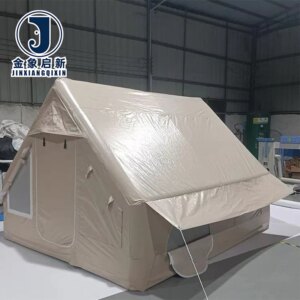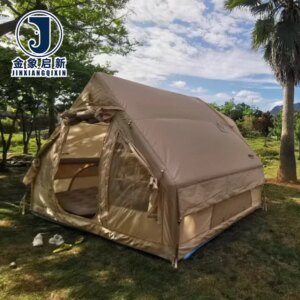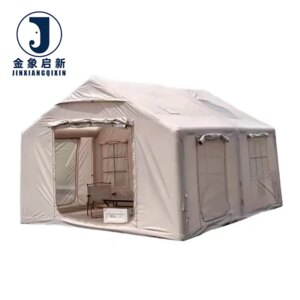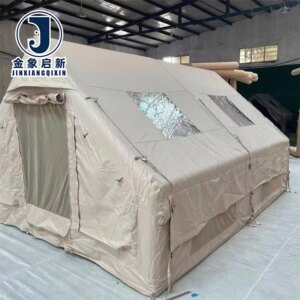
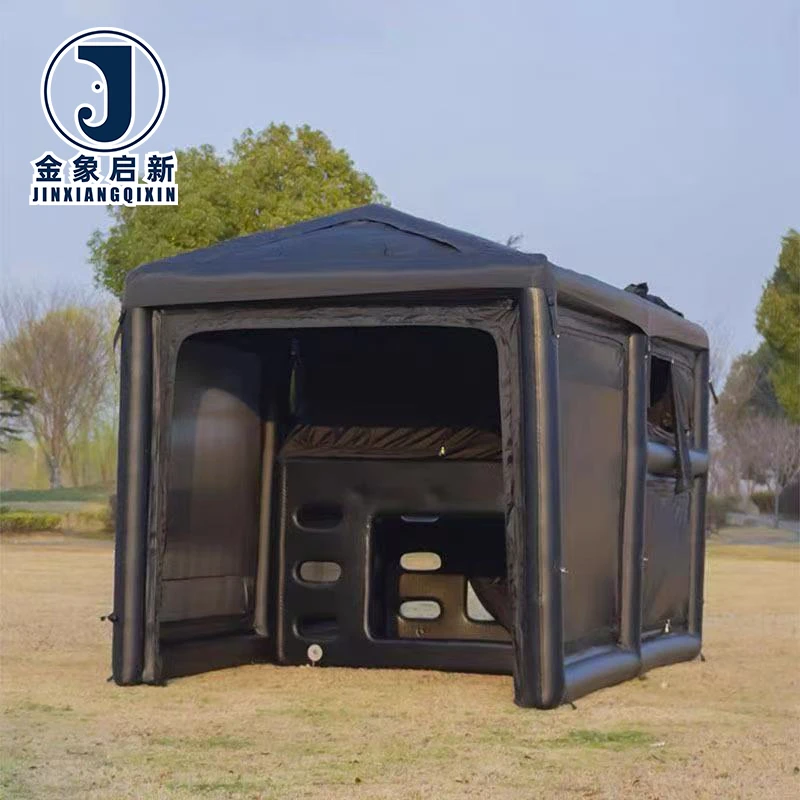
Three decades of coating expertise — every roll of inflatable tent fabric we produce carries the process control developed across 9,180 m² of dedicated production space, with 100% pre-shipment inspection verifying weight and adhesion before it leaves the line.
Technical Specifications
| Parameter | Value |
|---|---|
| Product Type | Inflatable Tent Fabric |
| Core Material | PVC knife-coated tarpaulin |
| Key Performance | Waterproof, UV-resistant, tear-resistant |
| Flame Retardant | Available in flame retardant grades — confirm the grade required for your project¹ |
| Anti-Static | Available on request — confirm compliance requirements for your market¹ |
| Product Forms | Single layer construction, extended type |
| Season Rating | Four-season material stability |
| Customization | OEM & ODM: sample customization, pattern printing, size adjustment, material thickness variation |
| Certifications | ISO 9001, ISO 14001, ISO 45001, CE |
¹ Test basis not stated in source — request applicable test report before specifying.
Application Suitability
| Application | Exposure & Requirement |
|---|---|
| Commercial camping ground inflatable shelters | Year-round UV exposure, repeated inflation-deflation flex cycles, ground moisture contact |
| Outdoor event management rapid-deployment structures | Frequent transport and handling, high-wind loading on inflated panels, short setup windows |
| Industrial site temporary accommodation | Dust and chemical exposure, personnel traffic abrasion, all-weather thermal stability |
| Emergency response logistics enclosures | Rapid inflation requirement, unpredictable terrain puncture risk, immediate waterproof integrity |
| Inflatable membrane structure fabrication | Roll-to-roll colour consistency for multi-panel welding, structural stress at seam junctions |
Why Stated UV Resistance Without Test Data Leaves Your Tent Panels Exposed
Inflatable tent fabric that arrives with a UV claim but no test report forces you to accept the manufacturer’s word — and the sun does not.
We have seen coated fabric specified for four-season inflatable shelters degrade within a single summer season because the UV treatment was listed on the quotation but never validated against a recognised test method. When the coating breaks down under solar exposure, the base fabric absorbs moisture, the weld lines stiffen, and panels that must flex through inflation cycles begin to crack at the stress points. For an Inflatable Tent Fabric manufacturer custom-building material for commercial deployments, providing verifiable test data is not optional — it is the difference between a shelter that holds through its intended service life and one that fails mid-season. [NEED_CITE: UV degradation test methods for PVC coated fabrics]
Coating Adhesion and the Inflation Flex Cycle
Every time an inflatable tent is pressurised, the fabric stretches and relaxes across the panel surface. The PVC knife-coated construction used in our Inflatable Tent Fabric manufacturer custom production process forces the coating compound directly into the base fabric weave, creating a mechanical bond that resists delamination under repeated flex loading. This matters because inflatable structures cycle through pressure changes daily — and any separation between coating and substrate becomes a moisture entry point that accelerates failure.
Waterproof Integrity Across Welded Panel Junctions
Inflatable tents are fabricated from multiple panels welded together, and the waterproof performance of the finished structure depends as much on the seam as on the field of the fabric. Our knife-coated PVC tarpaulin is engineered to accept heat-welding at temperatures that fuse the coating layers without burning through the base fabric, producing joints that maintain waterproof continuity. We recommend requesting weld test samples with every custom order so your fabrication team can dial in the temperature and dwell time that match the specific material thickness. [NEED_CITE: heat welding parameters for PVC coated technical textiles]
Reading the Specification Sheet Beyond Surface Claims
The base fabric denier and weave density determine how the material resists tear propagation once a puncture or cut initiates — a critical consideration for inflatable structures that face ground contact and handling abrasion during deployment. The PVC coating weight applied during knife-coating controls the waterproof barrier thickness and the surface available for heat-weld bonding. Together, these parameters define how the fabric behaves when an inflated panel is pushed against sharp terrain or when tie-down hardware concentrates load at attachment points. Four-season material stability means the PVC compound retains flexibility at lower temperatures without becoming brittle, while resisting softening and tackiness at elevated ambient heat — both boundaries matter when inflatable shelters deploy across varying geographic climates.
The Cost of Overlooking Batch Consistency in Multi-Panel Fabrication
When an inflatable tent requires six or eight panels welded side by side, even a slight colour shift between rolls becomes visible once the structure is inflated and lit by sunlight. We have seen orders where the fabric met all mechanical specifications but colour variation across rolls forced the fabricator to reject entire panels after welding — wasting material, delaying project delivery, and damaging client relationships. Batch-to-batch consistency in coating weight and pigment dispersion is not a cosmetic concern; it is a fabrication requirement that determines whether your production line runs smoothly or stalls at the quality check station. [NEED_CITE: colour measurement standards for coated fabric production batches]
Why Technical Buyers Source This Fabric Here
Deep process control over PVC coating weight and adhesion comes from nearly 30 years of focused coated fabric production, giving you material that behaves predictably during fabrication. Three full production lines and 36 sets of professional equipment mean your roll order for inflatable tent fabric maintains throughput capacity without sacrificing the inspection discipline that catches defects early. A 10-technician R&D team handles your material selection, custom thickness development, and pattern printing requirements — developing samples within days so you can validate before committing to volume. Dedicated QA and QC staff inspect every production stage, with 100% pre-shipment verification ensuring the rolls you receive match the specification sheet you approved.
Documentation & Verification
- Material specification sheet stating base fabric denier, coating method, and performance parameters for inflatable tent engineering validation
- UV-resistance and flame retardant test reports supplied where applicable — matched to your project compliance grade
- Pre-shipment inspection records with batch-specific quality data available for audit
- Roll packing list with weight verification per roll against stated specification
- Certificate of origin and customs documentation for international inflatable tent fabric shipments
- ISO 9001, ISO 14001, ISO 45001, and CE certificates included with every order
Fabrication, Handling & Storage
- Heat-weld temperature and dwell time should be calibrated to the specific PVC knife-coated thickness before panel production begins
- Store rolls horizontally on pallets to prevent permanent creasing that weakens the coating at fold lines
- Cut patterns with allowance for weld seam overlap to maintain structural integrity at inflated panel junctions
- Avoid dragging rolls across unprotected floors to prevent surface abrasion on the PVC coating face
- Clean finished inflatable panels with mild detergent only — solvent-based cleaners can degrade the knife-coated PVC surface
What to Include in Your Fabric Inquiry
To specify the right inflatable tent fabric for your application, provide the deployment environment and expected exposure conditions — including temperature range and UV intensity for your target geography. Confirm the fire classification or anti-static grade your local regulations require so we can match the correct treatment and supply the supporting test documentation. Let us know whether you need rolls at standard width for your own fabrication, or custom width and printed branding produced to your design files.
Frequently Asked Questions
Q: What PVC coating weight and base fabric denier options are available for inflatable tent structures?
A: We offer a range of coating weights and base fabric deniers suited to inflatable tent applications, from lighter grades for portable event shelters to heavier constructions for permanent commercial installations. Our technical team reviews your inflation pressure requirements, panel dimensions, and expected handling frequency to recommend the appropriate specification. Request a material data sheet with specific values for your evaluation before sampling.
Q: How is batch-to-batch colour consistency maintained across large-volume roll orders?
A: Pigment formulations are locked after sample approval, and each production run references the approved colour standard under controlled lighting conditions. Rolls from the same order are inspected side by side before packing to verify visual consistency. For projects requiring panels welded adjacent to one another, we recommend ordering the full roll quantity in a single production run to eliminate inter-batch variation.
Q: What UV-resistance and flame-retardant test documentation can be supplied for project compliance?
A: We supply test reports for UV-resistance and flame-retardant performance when these treatments are specified in your order. The applicable test standard and achieved grade are documented on the report. Confirm the specific classification your project or local authority requires — different markets reference different standards — so we match the correct treatment level and provide the corresponding evidence.
Q: What are the lead times and minimums for custom width, thickness, and printed branding?
A: Custom specifications including non-standard width, adjusted coating thickness, and pattern printing are handled through our sample-first process, with samples developed within days for your approval. Minimum order quantities and production lead times depend on the complexity of your customisation. Contact our team with your requirements for a quotation that reflects your exact specification and volume.
Q: How are welded seams tested to ensure they outperform the base fabric at structural flex points?
A: Welded seam samples are subjected to peel and shear testing to verify that the joint strength meets or exceeds the base fabric specification. We recommend that fabricators also conduct their own weld validation using our material samples, adjusting heat-weld parameters to the specific coating thickness before full production begins, ensuring seams hold through repeated inflation cycles.