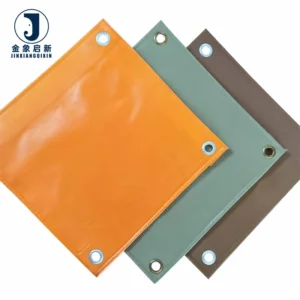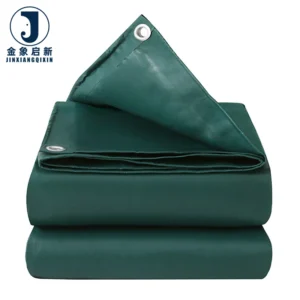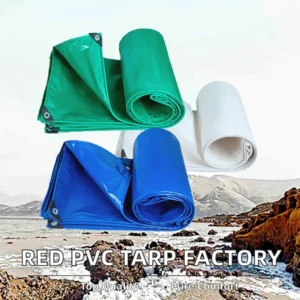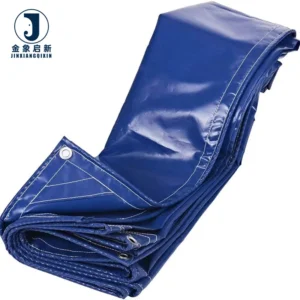
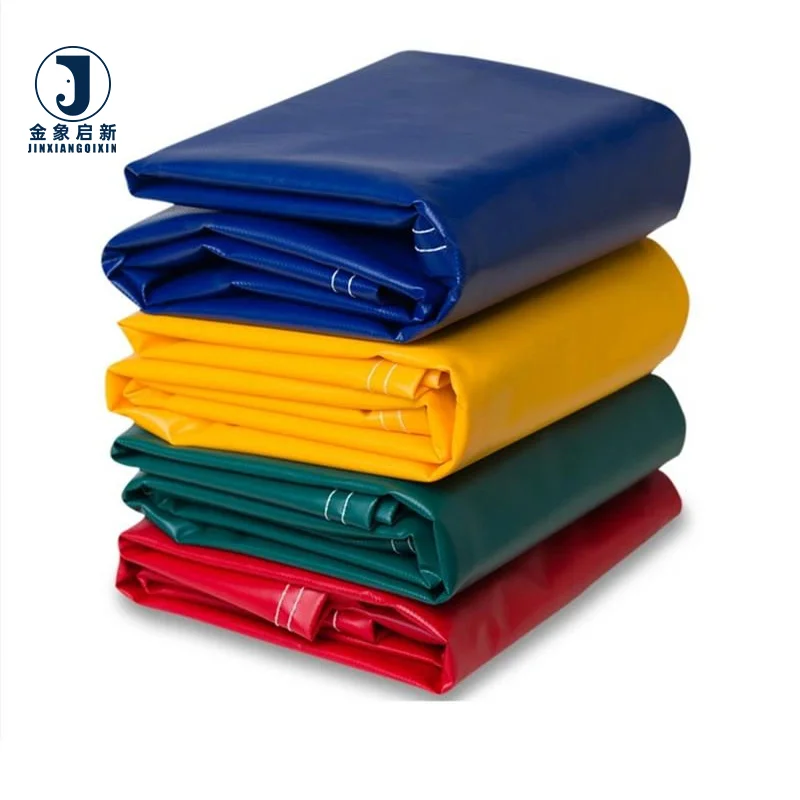
Coating Weight Control — Every roll of PVC coated tarpaulin roll coating weight is verified against the material specification sheet before dispatch, ensuring the GSM you order is the GSM you receive.
Technical Specifications
| Parameter | Value |
|---|---|
| Product Type | PVC Coated Fabric |
| Coating Material | PVC coated fabric |
| Base Fabric Denier (Medium-duty) | 500D |
| Base Fabric Denier (Heavy-duty) | 1000D |
| Base Fabric Denier (Super heavy-duty) | 500D–2000D |
| Total Thickness (Medium-duty) | 0.35–0.45 mm |
| Total Thickness (Heavy-duty) | 0.70–1.0 mm |
| Total Thickness (Super heavy-duty) | 1.2–1.5 mm |
| Weight (Medium-duty) | 400–500 g/m² |
| Weight (Heavy-duty) | 700–1000 g/m² |
| Weight (Super heavy-duty) | 1100–1500 g/m² |
| Tensile Strength (Medium-duty) | Warp 1500–2000 N/5cm / Weft 1200–1800 N/5cm (test basis not stated) |
| Tensile Strength (Heavy-duty) | Warp 2000–2500 N/5cm / Weft 1800–2200 N/5cm (test basis not stated) |
| Tensile Strength (Super heavy-duty) | Warp 2500–3000 N/5cm / Weft 2200–2800 N/5cm (test basis not stated) |
| Color Options | Blue, Blue/Orange, Green, Grey, Black, Clear, Grey/Green, Orange, or custom |
| UV Treatment | Available (test basis not stated) |
| Flame Retardant | Available in flame retardant grades — confirm the grade required for your market |
| Key Features | Waterproof, tear resistant, mildew proof, anti-aging |
| Standards | ISO and CE certified |
Application Suitability
| Application | Exposure & Requirement |
|---|---|
| Truck and trailer tarpaulin covers | Constant road vibration, flexing at load points, weather exposure, abrasion from tie-downs |
| Industrial pipe canopy and protective enclosures | Prolonged UV exposure, wind loading, chemical contact from stored materials |
| Tensioned membrane and inflatable structures | Sustained biaxial tension, cyclic inflation pressure, weld seam integrity |
| Construction site protection fabric | Impact from falling debris, water ingress, repeated handling and folding |
| Tent and awning fabric | UV degradation, mildew in humid storage, frequent assembly and dismantling stress |
| Outdoor storage and farm equipment covers | Moisture penetration, soil contact, temperature fluctuation across seasons |
Why GSM Alone Does Not Define PVC Coated Fabric Performance
GSM tells you what the fabric weighs, not how the coating bonds to the base fabric or how the yarn structure distributes load.
When technical buyers evaluate PVC coated fabric GSM specification, the number on the quotation often becomes the sole basis for comparison. Yet a 900 g/m² fabric with poor adhesion between the PVC coating and the polyester base will delaminate at the weld line long before a well-bonded 750 g/m² material shows any sign of failure. The coating method, the base fabric weave density, and the treatment chemistry all interact to produce the field performance you actually experience. [NEED_CITE: tensile and tear test methods for coated fabrics per ISO 1421] Without examining these variables together, the GSM figure becomes a marketing claim rather than a specification tool.
Base Fabric Denier and Its Role in Load Distribution
The base fabric is the structural skeleton of any PVC coated tarpaulin roll coating weight system. A 1000D polyester yarn distributes tensile load across more filaments than a 500D yarn, which directly influences how the material behaves when a truck cover flexes under wind load or when a tensioned membrane structure sustains biaxial stress. The denier selection must align with the tensile strength requirement of the end application, not simply with the target GSM.
Coating Adhesion and Weld Line Integrity
The bond between the PVC coating and the base fabric determines whether a heat-welded seam holds or peels apart under stress. Knife coating forces the PVC compound into the weave structure under controlled pressure, producing a mechanical and chemical bond that directly affects peel strength. When fabricators weld panels together for side curtains or membrane roofs, the adhesion quality dictates whether the weld fails before the fabric itself — a common field failure that has nothing to do with GSM. [NEED_CITE: coating adhesion and peel strength standards for technical textiles]
Reading the Tensile Data in Context
The tensile strength values across medium, heavy, and super heavy-duty grades show a clear progression in both warp and weft directions. However, these numbers only become meaningful when evaluated against the specific load geometry of your application. A truck side curtain experiences predominantly warp-direction tension from gravity and wind, while an inflatable structure demands balanced biaxial strength. The difference between warp 2500–3000 N/5cm and weft 2200–2800 N/5cm in the super heavy-duty grade reflects the weave construction optimized for specific stress profiles. The test basis for these values should be confirmed before using them for structural calculations.
The Hidden Cost of Specifying on Price Per Kilogram
When purchasing decisions reduce PVC coated fabric GSM specification to a cost-per-kilogram calculation, the consequences surface months after installation. A coating formulated to hit a target weight with excessive filler content will crack at fold lines in cold weather and soften beyond acceptable limits in summer heat. Roll-to-roll colour variation becomes visible once panels are installed side by side on a fleet of trailers, forcing an entire batch replacement. These failures trace back to process control, not to the stated GSM on the original quotation. [NEED_CITE: relationship between coating formulation and field performance in coated fabrics] Welded seams failing before the fabric body, particularly at the flex points where the load shifts during transport, represent a recurring pattern when adhesion strength is sacrificed to meet a price target.
What Process Control Means for This Material Range
Deep process control over coating weight and adhesion across three full production lines ensures that every roll within a shipment carries the same GSM, colour density, and surface finish. A 10-person R&D team develops material formulations matched to specific application demands, from UV treatment chemistry for prolonged outdoor exposure to flame retardant grades required by local building codes. The 36 sets of professional equipment support both bulk roll stock and custom-width orders without sacrificing batch consistency. Each production stage includes dedicated QA/QC checkpoints, with 100% inspection before any roll leaves the facility. Samples for custom material requirements are developed within days, allowing technical buyers to verify coating weight, colour match, and weld behaviour before committing to a full production run.
Documentation & Verification
- Material specification sheet stating GSM, base fabric denier and coating type issued per roll
- Test report for UV and flame-retardant grades provided where applicable with shipment documentation
- Pre-shipment inspection record confirming weight verification against stated PVC coated tarpaulin roll coating weight
- Roll packing list with batch identification for traceability across multi-roll orders
- Certificate of origin and customs documentation prepared for international dispatch
Fabrication, Handling & Storage
- Heat welding parameters must be adjusted to the specific coating thickness — 0.35 mm medium-duty and 1.5 mm super heavy-duty grades require different temperature and dwell time settings
- Store rolls upright on pallets in a dry environment to prevent permanent creasing across the PVC coating surface
- Allow cold-stored rolls to acclimatize to workshop temperature before unrolling to avoid cracking the coating at low temperatures
- Cut panels with a minimum overlap allowance appropriate to the fabric thickness to ensure full weld penetration
- Clean surfaces with mild detergent only — solvent-based cleaners can degrade the PVC coating and compromise subsequent weld adhesion
- Reinforce eyelet positions with additional fabric patches when working with medium-duty 400–500 g/m² grades for high-load tie-down applications
How to Structure Your Material Inquiry
Provide the specific application environment, including exposure conditions such as sustained UV, chemical contact, or cyclic mechanical stress. State the target market and any fire safety classification that the finished product must meet, so the correct flame retardant grade can be selected. Indicate whether you require roll stock in standard widths or custom dimensions, along with the annual volume forecast to determine production scheduling.
Frequently Asked Questions
Q: How is the stated GSM verified against the actual coating weight on arrival?
A: Every roll undergoes weight verification during the 100% pre-shipment inspection process. A material specification sheet is issued per order stating the confirmed GSM, base fabric denier, and coating type. This documentation travels with the shipment so you can cross-reference the received material against your original PVC coated fabric GSM specification without ambiguity.
Q: What base fabric denier should I specify for my tensile strength requirement?
A: The denier selection depends on your load geometry. For applications with predominant single-direction stress such as truck side curtains, the 1000D heavy-duty base provides strong warp-direction performance. For biaxial tension in membrane structures, the 500D–2000D super heavy-duty range offers balanced strength. Confirm the tensile test basis before finalizing your specification for structural calculations.
Q: Are UV and flame-retardant test reports included with the shipment?
A: UV treatment is available and test reports are provided where applicable. Flame retardant grades are offered to match different market requirements, but the specific grade must be confirmed during the inquiry stage. Request the test documentation relevant to your target market’s fire safety standards before placing your order.
Q: How consistent is colour across multiple rolls in a single order?
A: Roll-to-roll colour consistency is verified during pre-shipment inspection. All rolls within one production batch are checked side by side for colour density and surface finish uniformity. This is critical when panels from different rolls will be installed adjacent to each other on visible applications such as fleet truck covers or tensile structures.
Q: What lead time applies to custom specification roll stock?
A: Custom widths, colours, and treatment specifications require sample development before bulk production. Samples are typically produced within days of specification confirmation. Bulk lead times depend on order volume and the complexity of the custom requirement, and are confirmed at the quotation stage along with minimum order quantities.