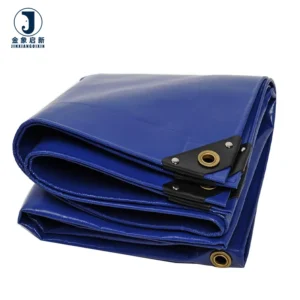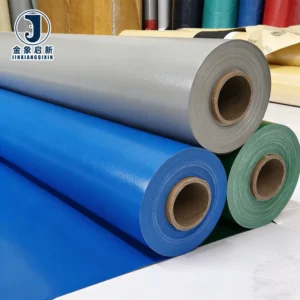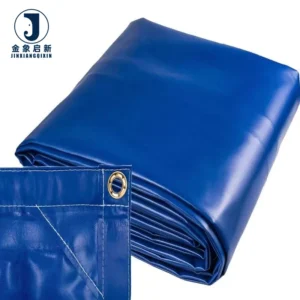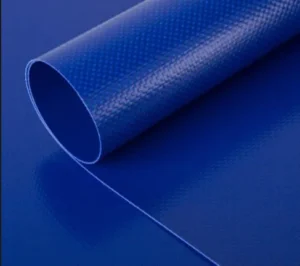
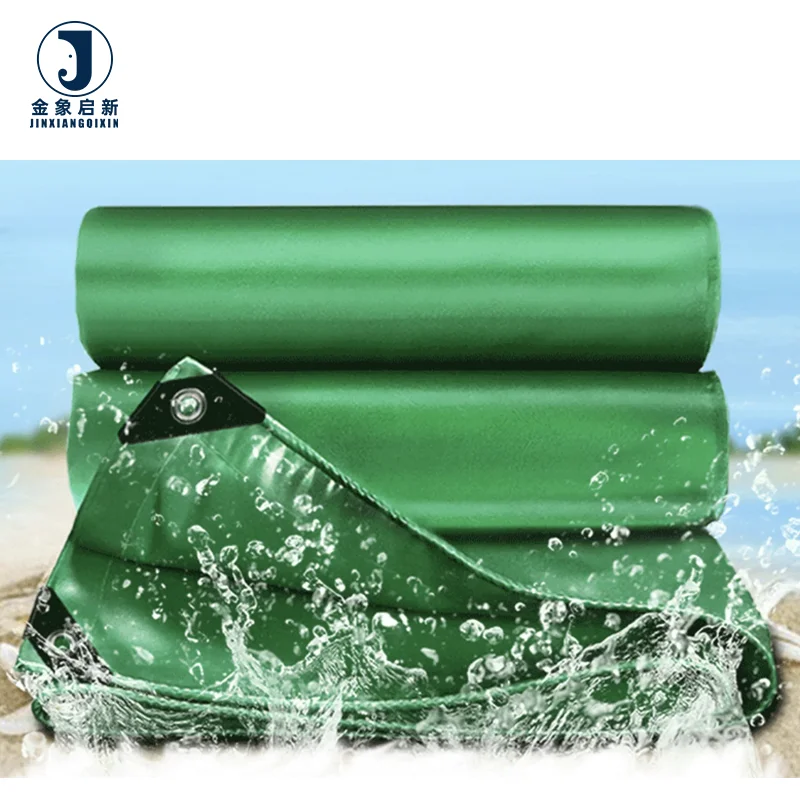
Process-Controlled Coating — Three full production lines and 36 sets of professional equipment manage every GSM grade from 350 gsm to 1000 gsm with documented in-process quality checks at each stage.
Technical Specifications
| Parameter | Value |
|---|---|
| Product Type | PVC Coated Tarpaulin |
| Coating Material | PVC |
| Base Fabric | High-strength polyester mesh fabric |
| Base Fabric Denier Options | 500D×500D / 500D×1000D / 840D×840D / 1000D×1000D / 2000D×2000D |
| Mesh Count Options | 15×15 / 18×18 / 20×20 / 18×25 / 23×24 / 30×17 / 30×30 |
| Weight (GSM) Options | 250 / 300 / 400 / 450 / 500 / 560 / 600 / 650 / 680 / 950 / 1000 gsm |
| Thickness Options | 0.32 mm / 0.35 mm / 0.4 mm / 0.45 mm / 0.5 mm / 0.65 mm |
| Coating Method | Laminated technology & Hot-melt coating technology |
| Roll Width | 2 m / 2.1 m |
| Roll Length | 75 m (2 m width) / 50 m (2.1 m width) |
| Available Colors | Blue / Red / Yellow / Light Blue / Grey (Customized) |
| Key Features | Cold crack resistance, anti-mildew, waterproof, color fastness, high tenacity yarns |
| Service Life | 3–7 years under normal conditions (source value — verify against manufacturer catalog) |
Application Suitability
| Application | Exposure & Requirement |
|---|---|
| Truck and trailer covers | Road debris impact, flexing at load points, continuous weather exposure, need for abrasion-resistant surface |
| Truck curtain side panels | Repeated lateral folding, wind load at highway speed, welding along hem and reinforcement strips |
| Goods yard and cargo covers | Standing water, UV exposure over months, tie-down stress at grommet zones |
| Push-and-pull tents | Structural tension on membrane, seasonal UV, rain pooling risk on horizontal panels |
| Liquid storage tanks and fish pools | Permanent water contact, hydrostatic pressure, puncture risk from substrate |
| Breed farm waste transportation | Chemical exposure from organic waste, repeated handling, wash-down cycles |
Why Coating Weight Alone Cannot Predict Weld Seam Performance
The denier and mesh count behind the coating determine whether a heat-welded seam holds or delaminates under load.
Technical buyers sourcing PVC coated tarpaulin rolls often specify by GSM, expecting that a heavier roll will automatically produce stronger welded fabrications. In practice, a 600 gsm roll built on a 500D×500D base with a thick coating layer may have lower tear propagation resistance than a 550 gsm roll woven from 1000D×1000D yarn at a 20×20 mesh. The coating contributes weight but not structural integrity — the polyester base fabric carries the tensile and tear loads [NEED_CITE: tensile and tear test methods for coated fabrics per ISO 1421]. When the fabric flexes at a fold line or tie-down point, the base yarn structure determines whether the stress transfers through the material or concentrates at the weld boundary. Specifying by denier and weave density alongside GSM removes this uncertainty.
How Denier and Mesh Density Interact at Each Weight Grade
Selecting a PVC coated tarpaulin roll for side curtain welding or structural membrane work requires reading the denier and mesh count together. A 500D×1000D construction at 18×25 mesh places heavier yarns in the weft direction, giving higher cross-direction tear resistance — a property that matters when curtain panels flex laterally under wind load. Moving to a 1000D×1000D 30×30 base increases yarn count per square inch, distributing stress across more intersection points and reducing the chance that a single yarn failure propagates into a run. For liquid containment applications where puncture resistance governs selection, the 1000D×1000D 30×30 grade at higher GSM provides a denser substrate that resists localized point loads from tank floors and pool substrates.
Coating Technology and Its Effect on Fabrication
The hot-melt coating technology used across this PVC coated tarpaulin roll range drives PVC resin into the polyester mesh under heat and pressure, filling the interstices between yarns and creating a mechanical bond rather than a surface-level adhesive layer. This matters directly at the weld line: when two panels are heat-welded, the coating material on each face must fuse into a continuous layer without trapping air or leaving a delamination plane. Laminated technology, by contrast, bonds a pre-formed PVC film to the base fabric and can produce a cleaner surface finish, but the bond line between film and fabric represents a potential failure plane if weld parameters exceed the lamination adhesion threshold. Fabricators should match their weld temperature and dwell time to the coating method stated on the material specification sheet [NEED_CITE: heat welding parameters for laminated versus coated PVC fabrics].
What GSM, Thickness and Denier Actually Mean for Roll Selection
The GSM value printed on a roll label is the total weight — base fabric plus coating — per square metre. A 650 gsm roll at 0.5 mm thickness may achieve its weight through a heavier coating on a lighter base, while a 680 gsm roll at the same thickness may carry more yarn mass. The first will have better surface abrasion resistance; the second will show higher tensile values in strip tests. Thickness alone correlates with puncture resistance and stiffness during handling, but does not predict how the material behaves once fabricated into a tensioned structure. Technical buyers specifying PVC coated tarpaulin GSM denier specification should request the denier and mesh count for every GSM grade on the quotation, because those two parameters define the structural skeleton that the coating protects and encapsulates.
The Hidden Cost of Specifying by Weight Without Verifying the Base
When rolls arrive on site and the base fabric is lighter than the application demands, the failure sequence is predictable: the coating surface holds, but the polyester yarn structure underneath yields at stress concentration points — typically at welded hems, around eyelets, or along fold lines where the material is repeatedly bent. For truck curtain applications, this manifests as delamination at the weld seam after several months of road vibration. For tent and membrane structures, it appears as tear propagation from a small puncture that a denser base fabric would have arrested [NEED_CITE: tear propagation behavior in coated polyester fabrics under cyclic loading]. The material did not fail to meet its quoted GSM — it met the weight but not the structural requirement, because weight was the only parameter specified.
Why Fabricators Source Rolls from This Facility
Nearly three decades of focused production on coated polyester fabric means the coating weight and adhesion parameters for each denier-mesh combination are established process baselines, not trial runs. Three full production lines with 36 sets of professional equipment handle volume orders while maintaining roll-to-roll consistency — a requirement for fabricators cutting multiple panels from different rolls on the same project. A dedicated 10-person R&D team develops samples within days for custom width, colour and print requirements, allowing fabricators to validate weld parameters and colour match before committing to production volume. Quality assurance runs at every production stage, with 100% inspection before dispatch confirming GSM, thickness and colour reference against the approved sample — eliminating the batch variation that causes visible colour differences when panels are installed side by side.
Documentation & Verification
- Material specification sheet stating GSM, base fabric denier, mesh count and coating method for every roll in the shipment
- Test reports for UV and flame-retardant grades where applicable — available on request before order confirmation
- Pre-shipment inspection record confirming measured GSM and thickness against the values stated on the quotation
- Roll packing list with individual roll identification, width, length, colour reference and net weight for customs clearance
- Certificate of origin and customs documentation supporting export to North American, European and Asian markets
Fabrication, Handling & Storage
- Hot-weld parameters should be adjusted to the coating method — hot-melt coated rolls tolerate higher dwell times than laminated grades
- Store rolls horizontally on a flat rack to prevent permanent creasing across the 2 m or 2.1 m width
- Allow cold-stored rolls to reach ambient temperature before unrolling to avoid cracking the PVC surface layer
- Use a rotary blade rather than a shear cutter on heavier GSM grades to prevent edge delamination at the base fabric boundary
- Weld test pieces from each new roll before running production panels to confirm adhesion at the chosen temperature and speed
Requesting a Specification That Matches Your Application
Provide the end-use application and the environmental exposure profile — sustained UV, chemical contact, cyclic flexing, or hydrostatic load — so the correct denier and mesh count can be matched to your GSM target. Specify the required roll width, colour reference and whether you need glossy or matte finish, along with your annual volume and whether finished panels or stock rolls are required. If your market requires flame-retardant or anti-static certification, state the test standard your jurisdiction mandates so the correct grade can be quoted with supporting documentation.
Frequently Asked Questions
Q: How do I verify the GSM on arrival matches the quoted specification?
A: The total coated weight includes both the polyester base fabric and the PVC coating. Request the material specification sheet before shipment, which breaks down denier, mesh count and coating weight for your grade. On arrival, cut a measured sample and weigh it on a calibrated scale. Our pre-shipment inspection record documents measured GSM per roll so any discrepancy can be traced to a specific production batch.
Q: How do denier and mesh count affect weld seam strength?
A: The base fabric carries the structural load while the coating provides the fusion material at the weld line. A denser mesh count such as 30×30 gives more yarn intersections per area, distributing weld stress across a broader zone. Hot-melt coated rolls typically produce stronger welds because the resin penetrates the mesh fully, eliminating air pockets at the bond interface.
Q: Are UV and flame-retardant test reports available with each order?
A: UV and flame-retardant treatments are available in specific grades, and the applicable test reports can be supplied with your order. Confirm the fire classification or UV exposure standard required by your market before placing the order, so the correct treatment grade is applied and documented on the material specification sheet.
Q: Can I get consistent colour across multiple rolls in the same order?
A: Roll-to-roll colour consistency is managed through in-process quality checks at every production stage. Each roll is compared to the approved colour reference before packing. The pre-shipment inspection record confirms that colour variance stays within the accepted range, so panels cut from different rolls will match when installed adjacent to each other.
Q: What documentation ships with the rolls?
A: Every shipment includes a roll packing list with individual roll identification, a material specification sheet covering GSM, denier and mesh count, test reports where applicable, certificate of origin and customs documentation. The pre-shipment inspection record accompanies the packing list for traceability.