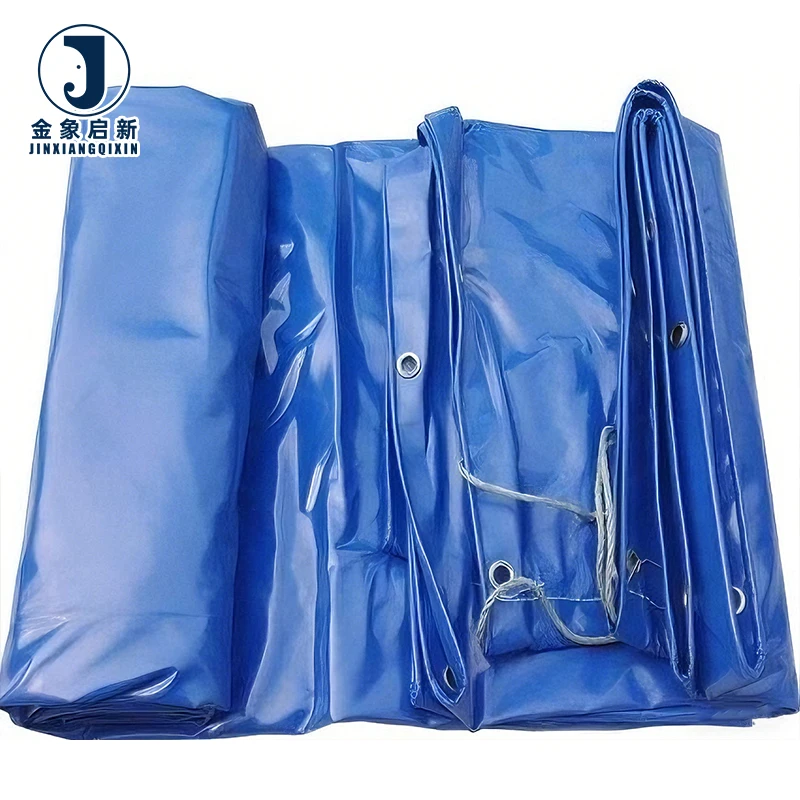
Deep Process Control Over Coating Weight and Adhesion — Nearly 30 years of coated fabric production informs how every roll of this PVC coated tarpaulin is formulated, coated and inspected before leaving the line.
Technical Specifications
| Parameter | Value |
|---|---|
| Product Type | PVC Coated Tarpaulin |
| Weight (GSM) | 250gsm–1500gsm |
| Base Fabric Denier | 200DX300D, 500DX500D, 840DX840D, 1000DX1000D |
| Coating Material | PVC |
| Surface Finish | Glossy or matte |
| Temperature Range | -15°C to 70°C |
| Waterproof | Yes |
| UV Treatment | Customized (test basis not stated) |
| Flame Retardant | FR treated (grade not stated) |
| Anti-Fungal | Treated |
| Available Colors | Blue, yellow, black, green, white, etc. |
| Standard Sizes | 3x4m, 6x8m, 8x10m, 10x12m or custom made |
| Standards | ISO, CE |
Application Suitability
| Application | Exposure & Requirement |
|---|---|
| Truck and trailer load covers | Constant flexing at tie-down points, road abrasion, UV and weather exposure |
| Construction site and equipment covers | Puncture risk from sharp edges, dust ingress, prolonged outdoor UV exposure |
| Agricultural and aquaculture pond liners | Permanent water contact, soil chemistry, puncture from substrate irregularities |
| Tent and awning fabrication | Repeated folding and unfolding, wind load tension, colour fastness under sun |
| Inflatable and membrane structure fabric | Internal air pressure stress, weld seam integrity, flame retardant compliance |
Why GSM on the Quotation Does Not Guarantee GSM on Arrival
A quoted GSM means nothing if the base fabric denier, coating weight and adhesion strength are not each verified independently before dispatch.
Every technical buyer has experienced this: the material specification sheet states one weight, but the roll that arrives on the dock feels lighter, tests lighter and performs lighter. The problem is rarely dishonesty — it is usually that the PVC coated tarpaulin was specified by total GSM alone, without separating the contribution of the base fabric from the contribution of the coating. When only the total number is controlled, a mill can compensate for a lighter base cloth by adding more PVC, or vice versa, and the finished fabric passes the weight check but fails the tensile or tear test that actually matters in service. [NEED_CITE: relationship between base fabric denier, coating weight and total GSM in coated fabric specification]
The consequence shows up months later — a truck cover splitting at the flex point, a pond liner puncturing under hydrostatic pressure, or a tent panel tearing in a gust. The fabric met the weight spec. It did not meet the performance spec.
How Base Fabric Denier Determines What the Coating Cannot Fix
When evaluating PVC coated tarpaulin for a specific application, the denier of the base fabric is the structural skeleton. A 200DX300D weave provides a lighter substrate suited to short-term covers and awning panels where flexibility and pack weight matter more than ultimate tear resistance. Moving to 840DX840D or 1000DX1000D increases the yarn mass in both warp and weft, giving the finished fabric its resistance to tear propagation — the failure mode that causes most field returns. The PVC coating protects the yarns from moisture and abrasion, but it cannot add tensile strength that the base cloth does not already possess. This is why selecting the correct denier before specifying coating weight is the single most important decision in the material selection process.
Coating Method, Finish and Their Effect on Fabrication
The PVC coating applied to this fabric family is available in glossy or matte finish, and the choice affects more than appearance. A glossy surface tends to release dirt more easily and accepts printed branding with sharper definition, making it the default for visible truck side curtains and branded event tents. A matte finish reduces glare and can improve adhesion when bonding panels with solvent-based cements during fabrication. For heat-welded seams — the preferred joining method for heavy-duty PVC coated tarpaulin — the formulation of the PVC compound and the surface finish both influence the temperature window and dwell time needed to achieve a peel strength that matches or exceeds the base fabric strength. [NEED_CITE: peel strength requirements for welded seams in coated fabric per ISO 1421]
Reading the Specification Sheet Like a Technical Buyer
Four parameters on the material specification sheet interact to define how this fabric behaves in service. The base fabric denier (from 200DX300D to 1000DX1000D) sets the floor for tensile and tear strength — no amount of coating compensates for an under-specified yarn. The total GSM (250gsm to 1500gsm) is the sum of base cloth weight plus coating weight; a higher GSM achieved through coating alone will feel stiffer without being proportionally stronger. The temperature range of -15°C to 70°C reflects the PVC compound formulation and plasticiser system — operating outside this window risks low-temperature embrittlement or high-tack softening. Finally, the surface finish (glossy or matte) governs not only aesthetics but also weld parameters, cleanability and suitability for printed graphics. Understanding these four variables as a system, rather than as isolated numbers, is what separates a material selection from a material gamble.
The Hidden Cost of Specifying by Weight Alone
When a buyer specifies PVC coated tarpaulin only by GSM and colour, the mill has wide latitude in how to achieve that number. A lighter base fabric with a thicker coating coat will pass the weight check but will show reduced tear resistance and may delaminate at the weld line under repeated flexing. Colour inconsistency between rolls in the same order is another symptom of insufficient specification — without a defined colour reference and batch control protocol, two rolls installed side by side on a truck fleet or tent structure can show visible shade variation. [NEED_CITE: batch-to-batch colour consistency standards for coated textiles] Weld seam failure is the most expensive consequence: the seam is only as strong as the coating adhesion to the base cloth, and if the coating formulation was adjusted to hit a GSM target rather than a peel-strength target, the weld becomes the weakest point in the entire assembly. These failures do not appear on the pre-shipment weight certificate. They appear in the field, under load, after the container has sailed.
Why Technical Buyers Source This Fabric Here
Three full production lines and 36 sets of professional coating and finishing equipment mean this PVC coated tarpaulin is manufactured on dedicated machinery, not squeezed between unrelated product runs — a direct contributor to roll-to-roll consistency.
A 10-person R&D team handles material selection, sample development and custom sizing, so when a fabricator needs a specific denier and GSM combination outside standard grades, the development cycle is measured in days rather than weeks.
Every production stage includes dedicated QA/QC checkpoints, culminating in 100% pre-shipment inspection that verifies actual GSM, colour reference and coating adhesion against the agreed specification — not just a random sample from the batch.
ISO and CE certification underpins the documentation package, giving importers and specifiers the compliance trail their market requires without needing to audit the factory independently.
Documentation & Verification
- Material specification sheet stating exact GSM, base fabric denier and coating method for the grade ordered
- UV and flame retardant test reports referenced to specific standards, available where applicable for the selected grade
- ISO and CE certificates provided for download prior to order placement
- Pre-shipment inspection record confirming roll weight, colour and coating adhesion against the agreed spec
- Roll packing list with gross and net weight per roll for container planning
- Certificate of origin and customs documentation for international shipment
Fabrication, Handling & Storage
- Heat-weld seams using temperature and dwell time matched to the selected glossy or matte finish for optimal peel strength
- Allow heavy-grade rolls (1000DX1000D base) to acclimatise before unrolling in cold conditions to avoid coating stiffness and cracking
- Store rolls upright on pallets in a shaded, ventilated area to prevent flat-spot deformation of the PVC coating surface
- Cut panels with allowance for weld overlap; nested layout planning improves yield on custom-width rolls
- Clean glossy-finish panels with mild detergent; avoid solvent-based cleaners that may attack the plasticiser in the PVC compound
- Field repairs on punctures use PVC-compatible adhesive patches matched to the coating weight of the parent fabric
What to Include in Your Enquiry
To receive an accurate material recommendation and sample, provide the application environment and the mechanical stresses the fabric will face — wind load, flex cycles, water immersion or abrasion. State whether your market requires a specific flame retardant or UV test standard, so the correct treatment grade can be quoted. Confirm whether you need roll stock in standard widths or custom-cut panels, and include your target colour reference and annual volume so batch consistency can be planned from the first production run.
Frequently Asked Questions
Q: How is the actual GSM of each roll verified before shipment?
A: Every roll undergoes a weight check during pre-shipment inspection. The recorded GSM is compared against the material specification sheet agreed at order placement. If a deviation is found, the roll is held and re-evaluated. This prevents the common problem of quoted weight not matching delivered weight.
Q: What flame retardant grades are available, and how do I confirm the right one?
A: The fabric is available in flame retardant treated grades. The specific grade and test standard must be confirmed based on your market’s regulatory requirements — for example, building code compliance for membrane structures or mining ventilation standards. Request the applicable test report when placing your enquiry.
Q: How does the base fabric denier affect weld seam performance?
A: Higher denier base fabrics such as 840DX840D or 1000DX1000D provide greater tear resistance around the weld zone, where flexing concentrates stress. The coating must penetrate the weave adequately for the weld to achieve full peel strength. Denier selection and coating weight must be specified together to ensure weld integrity.
Q: Can I get consistent colour across multiple rolls for a single project?
A: Yes. When you provide a colour reference and confirm the full roll quantity at order stage, production is planned within a single batch run. A pre-shipment colour check against your reference is included in the inspection record, reducing the risk of shade variation between installed panels.
Q: What is the typical sample development timeline for a custom specification?
A: The R&D team develops samples within days for custom requirements including non-standard denier, GSM or colour combinations. Samples ship with a full material specification sheet so you can evaluate the exact construction before committing to a production order.