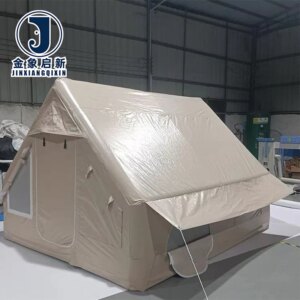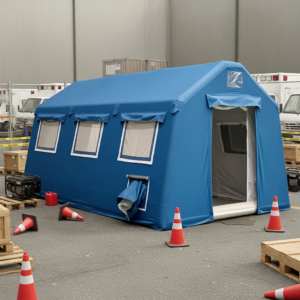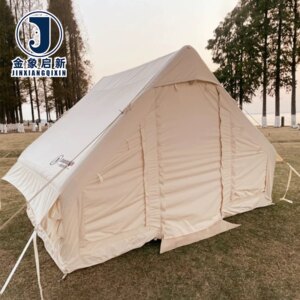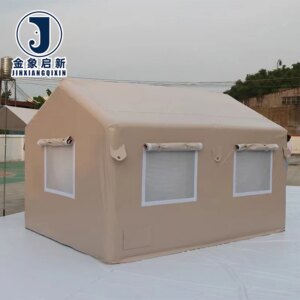
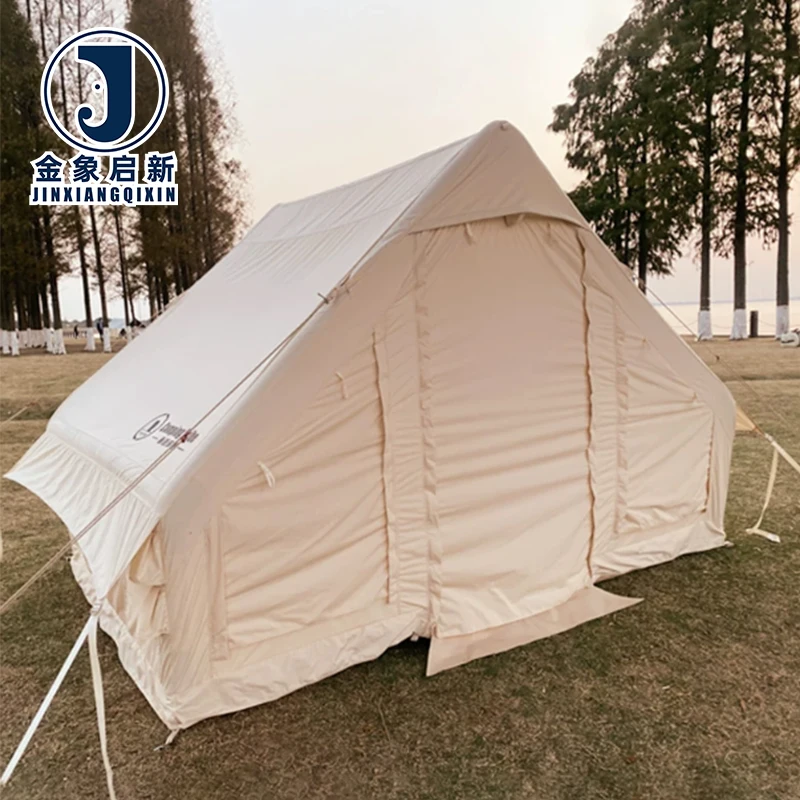
Deep Coating Process Control — Every roll of PVC inflatable tent fabric undergoes verified coating weight and adhesion checks, ensuring the material properties specified on your order match what arrives at your facility.
Technical Specifications
| Parameter | Value |
|---|---|
| Product Type | Inflatable Tent |
| Core Material | PVC Tarpaulin |
| Key Performance | Waterproof, UV-Resistant (test basis not stated), Tear-Resistant |
| Capacity Range | 2–8 Person |
| Construction | Single-layer |
| Opening Mechanism | Quick Automatic Opening |
| Season Rating | 4-Season |
| Customization Scope | OEM & ODM — size adjustments, pattern printing, material thickness modifications |
| Production Facility | 9,180 m² with 3 full production lines |
| Processing Equipment | 36 sets of professional equipment |
| R&D Capability | 10 technicians |
| Quality Control | Full-process inspection with dedicated QA & QC staff |
| Certifications | ISO9001, ISO14001, ISO45001, CE |
Application Suitability
| Application | Exposure & Requirement |
|---|---|
| Commercial camping grounds | Repeated inflation cycles, ground abrasion, seasonal UV exposure, guest turnover demands rapid setup |
| Temporary event shelters | Short-term high-visibility deployment, wind load on inflated structure, frequent transport and redeployment |
| Industrial site accommodation | Continuous occupancy, dust and chemical exposure, fire safety compliance on regulated worksites |
| Outdoor exhibition areas | Public foot traffic, branded surface printing requirements, daily inflation and deflation |
| Emergency response scenarios | Rapid deployment under adverse weather, reliability without maintenance infrastructure |
Why Coating Weight and Base Fabric Denier Define Tent Longevity More Than GSM Alone
A fabric’s real strength comes from how the coating bonds to the base weave, not just total weight per square metre.
When a PVC inflatable tent fabric fails prematurely, the cause is rarely the total GSM. Tents fail at the seams before the fabric does, or UV degradation appears within one season because the coating weight and treatment were specified on the quotation but never verified on arrival. Buyers often receive rolls that meet the stated GSM but achieve it through a heavier base fabric and a thinner coating — the result is a material that looks right on paper but lacks the adhesion strength needed for welded seams on inflated structures. [NEED_CITE: tensile and tear test methods for coated fabrics per ISO 1421]
The PVC inflatable tent fabric you source must perform under internal air pressure that places constant tension on every welded joint. If the coating does not penetrate and lock into the base fabric weave with sufficient adhesion, the heat-welded seams will separate before the fabric body shows any sign of wear. This is why specifying coating weight and base fabric denier separately — and verifying both on receipt — matters more than a single GSM figure.
How Coating Method Affects Weld Seam Integrity on Inflatable Structures
The performance of an inflatable tent is fundamentally determined by its PVC coated fabric. The coating method — whether knife-over-roll, laminating, or calendering — directly controls how deeply the PVC penetrates the base fabric. For inflatable tent applications, knife-coated fabrics deliver superior coating-to-yarn adhesion, which translates directly into stronger heat-welded seams that resist the constant internal pressure of an inflated structure.
When sourcing PVC inflatable tent fabric, the relationship between coating adhesion and weld strength should be your primary evaluation criterion. A fabric with high GSM but poor coating penetration will produce weld seams that delaminate under flex stress at inflation points and structural joints. Our production process controls coating weight and adhesion as independent parameters, ensuring that the material arriving at your fabrication line produces consistent, reliable welds across the entire roll.
The Role of Surface Treatment in Long-Term Outdoor Performance
PVC tarpaulin used for inflatable camping tents faces continuous UV exposure, and the surface treatment applied during manufacturing determines how the material holds up across seasons. Available in UV-resistant grades — confirm the specific test standard required for your target market before placing your order. Without documented test data, a UV-resistance claim on a quotation provides no assurance that the treatment will survive a full season of commercial deployment.
The tear-resistant construction of this fabric supports repeated setup and takedown cycles that commercial camping operators and event contractors demand. [NEED_CITE: accelerated weathering test standards for PVC coated textiles] Single-layer construction with quick automatic opening mechanisms places high stress on the material at fold lines and inflation valves, making tear propagation resistance a critical specification for any PVC inflatable tent material supplier serving commercial buyers.
Reading the Specification Sheet: What GSM, Denier, and Coating Weight Actually Tell You
Total GSM is the sum of base fabric weight and coating weight, but two fabrics with identical GSM can perform very differently. A PVC tarpaulin with a high-denier base fabric and thin coating will have strong tensile resistance but weaker weld seams, while a lighter base with heavier coating will weld better but may tear more easily along the weave. For inflatable tent applications, the balance between these two components determines whether the structure holds pressure reliably over hundreds of inflation cycles.
The base fabric denier and weave density control how a tear propagates once initiated — a ripstop or high-density weave limits tear spread, which is critical when the fabric is under internal air pressure. The coating method determines peel strength between layers; knife-coated fabrics typically achieve deeper yarn encapsulation than calendered alternatives, directly supporting the heat-welding process used to construct inflatable tent seams. Surface finish — available in glossy or matte options — affects both the visual appearance of printed branding and the material’s resistance to dirt accumulation during outdoor use.
The Hidden Cost of Specifying Material Without Verifying Batch Consistency
When rolls within the same shipment vary in coating thickness or colour, the consequences extend far beyond a single defective tent. A tent manufacturer cutting panels from multiple rolls may find that welded seams hold on some panels but peel on others — not because the welding parameters changed, but because the coating weight shifted between production batches. [NEED_CITE: coating weight variance impact on heat weld strength in PVC fabrics]
Colour variation between rolls in a single order becomes visible once inflatable tents are deployed side by side at a commercial campsite or event venue. This forces the buyer into a position of either accepting a product that looks inconsistent to end users or rejecting an entire shipment at significant cost. Batch-to-batch consistency in both coating weight and colour is not a premium feature — it is a baseline requirement for any PVC inflatable tent fabric manufacturer supplying commercial quantities.
What Makes This Supply Chain Different for Tent Fabric Buyers
Our 10-person R&D team develops custom material specifications — including thickness adjustments, pattern printing, and size configurations — with sample turnaround measured in days, not weeks. This capability directly supports tent manufacturers who need to validate material performance before committing to production volumes.
Three full production lines and 36 sets of professional processing equipment provide the capacity to maintain roll-to-roll consistency across large orders, which is where most supply chains fail inflatable tent manufacturers. Every roll undergoes full-process quality inspection with dedicated QA and QC staff, meaning the coating weight and colour you approved on the sample are what you receive in production. OEM and ODM customization is handled in-house, eliminating the coordination risk of sending rolls to a third-party printer or finisher before fabrication.
Documentation & Verification
- Material specification sheet confirming base fabric denier, coating type, and performance parameters for each roll order
- UV-resistance and waterproof test reports matching the specific batch dispatched to your facility
- Pre-shipment inspection record documenting 100% quality check before container loading
- ISO9001, ISO14001, ISO45001, and CE certificates included as standard shipping documentation
- Roll packing list with individual roll weights and coating weight verification per production batch
Fabrication, Handling & Storage
- Set heat-weld temperature based on the specific coating thickness of this PVC tarpaulin — thicker coatings require adjusted dwell times for full seam fusion
- Store rolls upright on pallets to prevent flat-spot deformation that creates weak points at inflation stress zones
- Avoid folding single-layer inflatable tent fabric at the same crease line repeatedly to prevent coating micro-cracking
- Use compatible PVC adhesive for field repairs, matching the coating chemistry of the supplied material
- Cut panels with allowance for weld seam width to maintain structural dimensions after inflation pressure is applied
Before You Request a Quote
To provide an accurate specification recommendation, we need to understand your intended application and the compliance environment of your target market. Share the deployment conditions — continuous seasonal use, temporary event rotation, or emergency standby — along with any fire safety or building code requirements that apply to inflatable structures in your region.
Specify whether you require raw roll stock for in-house fabrication or finished panels with custom sizing and pattern printing applied. If colour consistency across multiple production runs is critical for your brand or project, provide your Pantone or RAL reference early in the sampling stage. [NEED_CITE: colour fastness evaluation methods for coated technical textiles]
Frequently Asked Questions
Q: How is the GSM and coating weight of the inflatable tent fabric verified before shipment?
A: Every roll is weighed and measured against the stated GSM before dispatch. Our pre-shipment inspection record documents coating weight verification for each individual roll, ensuring the material properties on your purchase order match what arrives at your facility. This process prevents the common problem of receiving fabric that meets total GSM but has insufficient coating thickness for reliable weld seams.
Q: What UV-resistance test basis supports the outdoor durability claim?
A: UV-resistant treatment is available across our inflatable tent fabric range — confirm the specific test standard required for your target market before ordering. We provide test reports matching the treatment grade specified on your purchase order, so you have documented evidence of outdoor performance rather than an unsupported claim on a quotation.
Q: How are batch-to-batch colour and thickness consistency maintained across rolls?
A: Our three production lines operate under full-process quality control with dedicated QA and QC staff monitoring coating weight and colour at every stage. Each production batch is cross-referenced against the approved sample, and rolls showing deviation are held before shipment. This ensures multi-roll orders arrive with consistent colour and thickness suitable for commercial tent fabrication.
Q: What OEM and ODM customization options are available for inflatable tent projects?
A: Customization covers size adjustments, pattern printing, and material thickness modifications to match your tent design requirements. Our 10-person R&D team develops samples within days, allowing you to validate weld seam performance, print quality, and inflation behaviour before committing to production volume. Both single-layer and custom construction configurations are supported.
Q: What documentation is supplied with each order for compliance and traceability?
A: Standard documentation includes a material specification sheet confirming base fabric and coating parameters, test reports for UV resistance and waterproof performance, ISO9001, ISO14001, ISO45001, and CE certificates, plus a pre-shipment inspection record. This package provides full traceability from production batch to delivered roll, supporting compliance audits and quality assurance reviews.