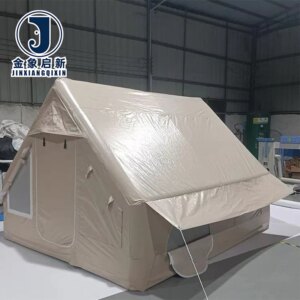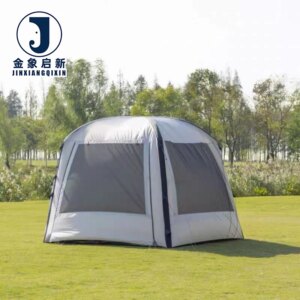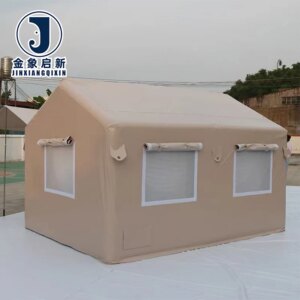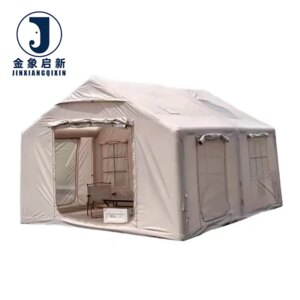
Coating Weight Precision — Every roll of inflatable tent fabric we produce undergoes in-process GSM verification at the coating head, ensuring the waterproof rating your production line relies on holds across every batch.
Technical Specifications
| Parameter | Value |
|---|---|
| Product Type | Inflatable Tent Fabric |
| Core Material | PVC tarpaulin |
| Construction | Single layer |
| Coating Method | Knife coated |
| Waterproof Rating | ≥2000mm water column (verify against latest batch test) |
| Tear Strength | ≥300N (verify against latest batch test) |
| UV Treatment | 500 hours exposure (test basis not stated in source) |
| Flame Retardant Grade | Available in flame retardant grades — confirm the grade required for your market |
| Anti-Static | Available with anti-static treatment — confirm the standard required for your market |
| Customization | OEM & ODM: sample customization, pattern printing, material selection, product design |
| Prototype Lead Time | 7–10 business days |
| Production Lead Time | 15–20 days for standard orders |
| Standards | ISO 9001, ISO 14001, ISO 45001, CE |
Application Suitability
| Application | Exposure & Requirement |
|---|---|
| Commercial inflatable camping tent manufacturing | Repeated inflation cycles, flexing at air-beam seams, sustained UV and rain exposure |
| Family-sized shelter assembly for outdoor brands | Large-panel cutting, high-frequency welding along tube channels, multi-season weather demands |
| Professional expedition tent production | Low-temperature flexibility, abrasion from rocky or icy ground contact, wind-load stress on bonded seams |
| Wholesale distribution for glamping operators | Batch colour consistency across large orders, roll-to-roll GSM uniformity for predictable fabrication yield |
Why Waterproof Claims Fail When Production Scales
Consistent coating adhesion across every metre matters more than the peak waterproof number on a single sample.
Inflatable tent fabric that passes a lab water-column test on one swatch can still let water through at the heat-welded seam when the coating formulation shifts between batches. When an inflatable tent fabric manufacturer scales production without tight in-line process control, finished tents return with delaminated air beams and leaking tube joints. Outdoor gear brands then face warranty claims that trace back to inconsistent PVC coating weight and adhesion strength — not the base fabric itself. [NEED_CITE: peel strength and coating adhesion test methods for PVC-coated textiles per ISO 2411]
Coating Chemistry and Air-Beam Integrity
The single-layer PVC tarpaulin construction used for inflatable tent air beams must balance internal air pressure containment with external abrasion resistance. Our knife coating process deposits a controlled PVC compound layer onto the woven base fabric, building adhesion through direct mechanical interlock with the yarn surface. When the coating weight is held within a tight tolerance, the resulting inflatable tent fabric maintains consistent flex behaviour along the entire tube length — critical for automated cutting and welding on high-volume production lines.
Weld Compatibility Across Production Batches
Heat-welded seams on inflatable tent structures carry the full load of internal air pressure. If the PVC compound formulation varies from roll to roll, the optimal welding temperature and dwell time shift without warning, producing seams that peel apart under cyclic inflation. We formulate each batch to a locked compound recipe so your fabrication team sets weld parameters once and maintains them throughout the production run. [NEED_CITE: high-frequency and hot-air welding parameters for PVC-coated polyester fabrics]
Reading the Specification Sheet Beyond GSM
GSM alone tells you how much material is present but not how that mass is distributed between base fabric and coating. A heavy coating with a loosely woven base may deliver high GSM yet poor tear propagation resistance. Conversely, a tightly woven high-denier polyester base with a thinner, well-bonded coating can outperform a heavier construction in both tensile and tear tests. For inflatable tent structures, the base fabric denier and weave density govern how the material resists puncture and tear at stress points — particularly where air-beam tubes bend and where guy-line attachment patches are welded. The PVC coating weight then determines waterproof integrity, weld peel strength, and surface cleanability. Evaluating all three parameters together gives a reliable picture of how the fabric will behave during fabrication and in field use.
The Hidden Cost of Ignoring Batch Consistency
When a fabric lot arrives with slightly lower GSM than the approved sample, the inflatable tent air beams may still inflate correctly but fail to hold pressure through a full night in cold conditions. When UV stabiliser loading varies between rolls, one batch of finished tents may show surface chalking after a single season while the next batch holds colour for years. These inconsistencies rarely appear during incoming inspection because standard sampling checks only a fraction of each roll. The cost surfaces later — in returned goods, re-cutting wasted material, and reputational damage with end users who expect commercial-grade reliability from inflatable camping shelters. [NEED_CITE: batch variability effects on coated fabric performance in outdoor applications]
What Makes This Supply Source Different for Your Line
Deep process control over PVC coating weight and adhesion is built into every production stage, not inspected in after the fact. Three full coating lines and 36 sets of professional equipment provide the capacity to deliver multi-roll orders of inflatable tent fabric with matching colour and compound formulation across the entire shipment. A 10-person R&D team handles material selection, compound adjustments, and sample development so you can evaluate weld behaviour and surface finish before committing to bulk. Dedicated QA/QC checkpoints run at every production stage, culminating in 100% pre-shipment inspection with batch-specific test records. ISO 9001, ISO 14001, and ISO 45001 certified management systems underpin the quality and environmental controls that commercial outdoor equipment brands require from their fabric supply chain.
Documentation & Verification
- Material specification sheet confirming base fabric denier, weave density, coating method, and measured GSM per roll
- Waterproof rating test result matched to the dispatched batch
- UV exposure and flame retardant test reports provided where the applicable grade is specified
- ISO 9001, ISO 14001, ISO 45001, and CE certificates valid at time of shipment
- Pre-shipment inspection record covering GSM, colour, and surface defect count per roll
Fabrication, Handling & Storage
- Set hot-air weld temperature based on the single-layer PVC coating thickness stated on the batch certificate
- Allow knife coated rolls to acclimatise at workshop temperature before unrolling to prevent surface micro-cracking
- Store rolls upright on padded racks to avoid flat-spot compression marks on the PVC surface
- Use PVC-compatible solvent cleaners only — aggressive alkaline agents degrade the coating plasticiser layer
- Plan cutting layouts around the supplied roll width to minimise off-cuts and reduce weld seam count on air-beam panels
How to Structure Your Enquiry
Share the target market for the finished inflatable tent so we can align flame retardant and UV treatment grades with local regulatory requirements. Specify your preferred roll width, annual volume, and whether you need fabric by the roll or pre-cut panels with welded tube channels. If colour matching to an existing product line is critical, send a physical sample or Pantone reference so we can develop a lab-dip for your approval before production begins.
Frequently Asked Questions
Q: What is the relationship between GSM and tear strength in inflatable tent fabric?
A: GSM measures total mass per square metre across base fabric and coating combined. Tear strength depends more on the base fabric denier and weave density than on coating mass alone. A heavier coating adds waterproof performance and weld peel strength but does not automatically improve tear propagation resistance. We provide full base fabric and coating specifications so you can evaluate each contribution separately.
Q: Can flame retardant and anti-static treatments be applied to the same fabric batch?
A: Yes, both treatments can be incorporated into the PVC compound during the coating stage. The specific grade and test standard depend on the regulations in your target market. Confirm the required fire classification and anti-static standard with us so we formulate the compound and arrange third-party testing to match.
Q: How do you ensure colour consistency across multiple rolls in one order?
A: Each production batch follows a locked compound recipe with measured pigment loading. Rolls from the same dye lot are grouped for dispatch, and a pre-shipment colour check compares every roll against the approved reference swatch under controlled lighting. If your order spans multiple dye lots, we flag this before shipping so you can plan panel matching accordingly.
Q: What is the prototype development timeline for custom inflatable tent fabric?
A: Prototype samples are typically ready within 7–10 business days from approval of the material specification and colour reference. Samples are produced on the same knife coating line used for bulk orders, so the coating weight, surface finish, and weld behaviour you evaluate on the sample carry through to full production.
Q: How does the knife coating process affect heat-weld seam performance?
A: Knife coating builds a uniform PVC layer with strong mechanical adhesion to the base fabric yarns. This consistent coating profile allows high-frequency and hot-air welding at stable temperature settings, producing seams where the weld zone strength approaches that of the parent fabric. Variations in coating thickness are the primary cause of weak or inconsistent welds in inflatable tube construction.